An increases in pressure required to decreases the $200\,\,litres$ volume of a liquid by $0.004\%$ in container is ........... $kPa$. (Bulk modulus of the liquid $= 2100\,\,MPa$ )
Medium


Download our appand get started for free
Experience the future of education. Simply download our apps or reach out to us for more information. Let's shape the future of learning together!No signup needed.*
Similar Questions
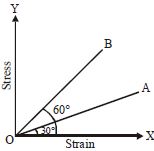
- 1The stress versus strain graphs for wires of two materials $A$ and $B$ are as shown in the figure. If $Y_A$ and $Y_B$ are the Young's modulus of the materials, thenView Solution
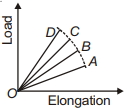
- 2View SolutionThe load versus elongation graph for four wires of same length and the same material is shown in figure. The thinnest wire is represented by line
- 3A uniform heavy rod of weight $10\, {kg} {ms}^{-2}$, crosssectional area $100\, {cm}^{2}$ and length $20\, {cm}$ is hanging from a fixed support. Young modulus of the material of the rod is $2 \times 10^{11} \,{Nm}^{-2}$. Neglecting the lateral contraction, find the elongation of rod due to its own weight. (In $\times 10^{-10} {m}$)View Solution
- 4The bulk modulus of rubber is $9.1\times 10^8\,N/m^2$. To ......... $m$ depth a rubber ball be taken in a lake so that its volume is decreased by $0.1\,\%$ .View Solution
- 5A uniform plank of Young’s modulus $Y $ is moved over a smooth horizontal surface by a constant horizontal force $F.$ The area of cross section of the plank is $A.$ The compressive strain on the plank in the direction of the force isView Solution
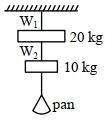
- 6Wires ${W}_{1}$ and ${W}_{2}$ are made of same material having the breaking stress of $1.25 \times 10^{9} \,{N} / {m}^{2}$ ${W}_{1}$ and ${W}_{2}$ have cross-sectional area of $8 \times 10^{-7}\, {m}^{2}$ and $4 \times 10^{-7}\, {m}^{2}$, respectively. Masses of $20 \,{kg}$ and $10\, {kg}$ hang from them as shown in the figure. The maximum mass that can be placed in the pan without breaking the wires is $.....{kg}$ (Use $\left.{g}=10\, {m} / {s}^{2}\right)$View Solution
- 7Join the relation of physical quantities in Column$-I$ to the details given in Column$-II$ appropriately :View Solution
Column $-I$ Column $-II$ $(a)$ Stress $\propto $ Strain $(i)$ $M^1\,L^{-1}\,T^{-2}$ $(b)$ Dimensional formula for compressibility $(ii)$ $M^{-1}\,L^{1}\,T^{-2}$ $(iii)$ Poisson’s ratio $(iv)$ Hooke’s law - 8View SolutionLiquids have no Poisson's ratio, because
- 9View SolutionIf Young's modulus for a material is zero, then the state of material should be
- 10A steel wire is stretched with a definite load. If the Young's modulus of the wire is $Y$. For decreasing the value of $Y$View Solution