Question
Two wires carrying equal currents i each, are placed perpendicular to each other, just avoiding a contact. If one wire is held fixed and the other is free to move under magnetic forces, what kind of motion will result?

Answer

The magnetic force on a wire carrying an electric current i is $\overrightarrow{\text{F}}=\text{i}.\big(\overrightarrow{\text{l}}\times\overrightarrow{\text{B}}\big),$ where l is the length of the wire and B is the magnetic field acting on it. Suppose we have one wire in the horizontal direction (fixed) and other wire in the vertical direction (free to move). If the horizontal wire is carrying current from right to left is held fixed perpendicular to the vertical wire, which is free to move, the upper portion of the free wire will tend to move in the left direction and the lower portion of the wire will tend to move in the right direction, according to Fleming's left hand rule, as the magnetic field acting on the wire due to the fixed wire will point into the plane of paper above the wire and come out of the paper below the horizontal wire and the current will flow in upward direction in the free wire. Thus, the free wire will tend to become parallel to the fixed wire so as to experience maximum attractive force.

Need a full question paper?

Generate a complete, print-ready paper with questions like this in minutes — across 16+ boards, with answer keys.
Start Generating Free

Similar questions

A rod, when suspended in a magnetic field, stays in the east-west direction. Can we be sure that the field is in the east-west direction? Can it be in the north-south direction?
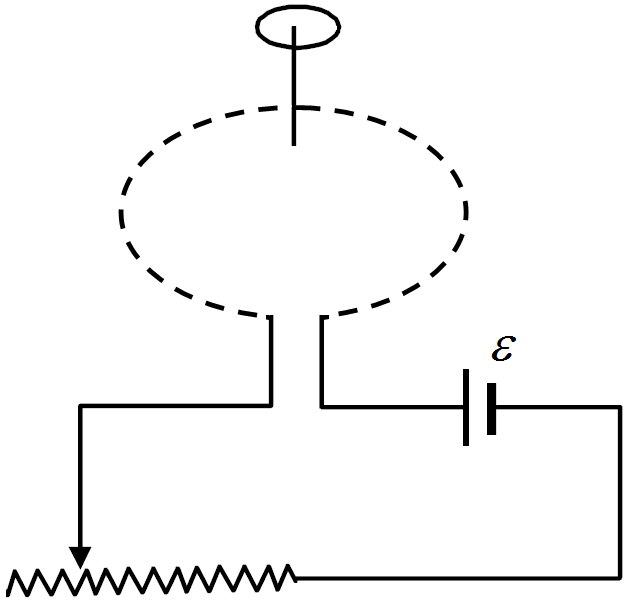
Figure shows a circular coil of N turns and radius a, connected to a battery of emf ϵ through a rheostat. The rheostat has a total length L and resistance R. The resistance of the coil is r. A small circular loop of radius a' and resistance r' is pl-aced coaxially with the coil. The centre of the loop is at a distance x from the centre of coil. the In the beginning, the sliding contact of the rheostat is at the left end and then onwards it is moved towards right at a constant speed u. Find the emf induced in the small circular loop at the instant:
  1. The contact begins to slide.
  2. It has slide through half the length of the rheostat.

Define total internal reflection. Establish the relation between $u, v$ and $f$ for a spherical mirror. Draw the necessary ray diagram. ### Define lateral displacement. Derive the lens maker formula.
$
\frac{1}{f}=\left(n_{21}-1\right)\left(\frac{1}{R_1}-\frac{1}{R_2}\right)
$
Draw the necessary ray diagram. (Where the signs have their usual meanings.)
A particle A having a charge of 2.0 × 10-6C is held fixed on a horizontal table. A second charged particle of mass 80g stays in equilibrium on the table at a distance of 10cm from the first charge. The coefficient of friction between the table and this second particle is $\mu=0.2.$ Find the range within which the charge of this second particle may lie.
A particle A having a charge of 2.0 × 10-6C and a mass of 100g is placed at the bottom of a smooth inclined plane of inclination 30°. Where should another particle B, having same charge and mass, be placed on the incline so that it may remain in equilibrium?
A charge of 8 mC is located at the origin. Calculate the work done in taking a small charge of –2 × 10⁻⁹ C from a point P (0, 0, 3 cm) to a point Q (0, 4 cm, 0), via a point R (0, 6 cm, 9 cm).
A capacitance C, a resistance R and an emf $\in$ are connected in series at t = 0. What is the maximum value of (a) the potential difference across the resistor (b) the current in the circuit (c) the potential difference across the capacitor (d) the energy stored in the capacitor (e) the power delivered by the battery and (f) the power converted into heat?
A coil of number of turns N, area A is rotated at a constant angular speed ω, in a uniform magnetic field B and connected to a resistor R. Deduce expression for:
  1. Maximum emf induced in the coil.
  2. Power dissipation in the coil.
Calculate the Q-values of the following fusion reactions:
  1. $\text{ }^2_1\text{H}+\text{ }^2_1\text{H}\rightarrow\text{ }^3_1\text{H}+\text{ }^1_1\text{H}$
  2. $\text{ }^2_1\text{H}+\text{ }^2_1\text{H}\rightarrow\text{ }^3_2\text{H}+\text{n}$
  3. $\text{ }^2_1\text{H}+\text{ }^3_1\text{H}\rightarrow\text{ }^4_1\text{H}+\text{n}$
Atomic masses are
$\text{m}\big(\text{ }^2_1\text{H}\big)=2.014102\text{u}$
$\text{m}\big(\text{ }^3_1\text{H}\big)=3·016049\text{u}$
$\text{m}\big(\text{ }^3_2\text{H}\big)=3.016029\text{u}$
$\text{m}\big(\text{ }^4_2\text{He}\big)=4·002603\text{u}$
A radioactive isotope has a half-life of T years. How long will it take the activity to reduce to
  1. 3.125%,
  2. 1% of its original value?