Two wires of resistance $R_1$ and $R_2$ have temperature coefficient of resistance ${\alpha _1\,}{\rm{ and \,}}{\alpha _2}$, respectively. These are joined in series. The effective temperature coefficient of resistance is
Diffcult
Download our app for free and get started
(c) ${R_{{t_1}}} = {R_1}(1 + {\alpha _1}t)$ and ${R_{{t_2}}} = {R_2}(1 + {\alpha _2}t)$
Also ${R_{eq.}} = {R_{{t_1}}} + {R_{{t_2}}} \Rightarrow {R_{eq}} = {R_1} + {R_2}$$ + ({R_1}{\alpha _1} + {R_2}{\alpha _2})t$
$==>$ ${R_{eq}} = ({R_1} + {R_2})\left\{ {1 + \left( {\frac{{{R_1}{\alpha _1} + {R_2}{\alpha _2}}}{{{R_1} + {R_2}}}} \right).t} \right\}$
So ${\alpha _{eff}} = \frac{{{R_1}{\alpha _1} + {R_2}{\alpha _2}}}{{{R_1} + {R_2}}}$
Also ${R_{eq.}} = {R_{{t_1}}} + {R_{{t_2}}} \Rightarrow {R_{eq}} = {R_1} + {R_2}$$ + ({R_1}{\alpha _1} + {R_2}{\alpha _2})t$
$==>$ ${R_{eq}} = ({R_1} + {R_2})\left\{ {1 + \left( {\frac{{{R_1}{\alpha _1} + {R_2}{\alpha _2}}}{{{R_1} + {R_2}}}} \right).t} \right\}$
So ${\alpha _{eff}} = \frac{{{R_1}{\alpha _1} + {R_2}{\alpha _2}}}{{{R_1} + {R_2}}}$

Download our appand get started for free
Experience the future of education. Simply download our apps or reach out to us for more information. Let's shape the future of learning together!No signup needed.*
Similar Questions
- 1Potentiometer wire of length $1 \,m$ is connected in series with $490\,\Omega $ resistance and $2\,V$ battery. If $0.2\, mV/cm $ is the potential gradient, then resistance of the potentiometer wire is ................ $\Omega$View Solution
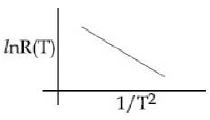
- 2View SolutionIn an experiment, the resistance of a material is plotted as a function of temperature (in some range). As shown in the figure, it is a straight line. One may conclude that:
- 3Four resistances $10$ $\Omega$, $5$ $\Omega$, $7$ $\Omega$ and $3$ $\Omega$ are connected so that they form the sides of a rectangle $AB$, $BC$, $CD$ and $DA$ respectively. Another resistance of $10$ $\Omega$ is connected across the diagonal $AC$. The equivalent resistance between $A$ and $B $ is .............. $\Omega$View Solution
- 4A current of $2\, mA$ was passed through an unknown resistor which dissipated a power of $4.4\, W$. Dissipated power when an ideal power supply of $11\, V$ is connected across it isView Solution
- 5In the box shown current $i$ enters at $H$ and leaves at $C$. If $i_{AB} = \frac{{\text{i}}}{6}$ , $i_{DC} = \frac{{\text{2i}}}{3}$ ,$i_{HA} = \frac{{\text{i}}}{2} , i_{GF} = \frac{{\text{i}}}{6} , i_{HE} = \frac{{\text{i}}}{6}$ , choose the branch in which current is zeroView Solution

- 6A certain piece of silver of given mass is to be made like a wire. Which of the following combination of length $(L)$ and the area of cross-sectional $(A) $ will lead to the smallest resistanceView Solution
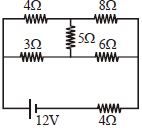
- 7In the given figure the ratio of current in $8\,\Omega $ and $3\,\Omega $ will beView Solution
- 8A null point is found at $200\,cm$ in potentiometer when cell in secondary circuit is shunted by $5\,\Omega$. When a resistance of $15\,\Omega$ is used for shunting null point moves to $300\,cm$. The internal resistance of the cell is $..............\,\Omega$.View Solution
- 9The current in a conductor is expressed as $I=3 t^2+4 t^3$, where $I$ is in Ampere and $t$ is in second. The amount of electric charge that flows through a section of the conductor during $t=1$ s to $t=2 \mathrm{~s}$ is_______ C.View Solution
- 10In the given network current through branch $BG$ is almost equal to ............ $A$View Solution