Two wires of resistance $R_1$ and $R_2$ have temperature coefficient of resistance ${\alpha _1\,}{\rm{ and \,}}{\alpha _2}$, respectively. These are joined in series. The effective temperature coefficient of resistance is
Diffcult


Download our appand get started for free
Experience the future of education. Simply download our apps or reach out to us for more information. Let's shape the future of learning together!No signup needed.*
Similar Questions
- 1If an electron revolves in the path of a circle of radius of $0.5 × 10^{-10}\, m$ at frequency of $5 × 10^{15}$ $cycles/s$ the electric current in the circle is ..................$mA$ (Charge of an electron $=1.6 × 10^{-19}\, C$ )View Solution
- 2A resistor ${R_1}$ dissipates the power $P$ when connected to a certain generator. If the resistor ${R_2}$ is put in series with ${R_1}$, the power dissipated by ${R_1}$View Solution
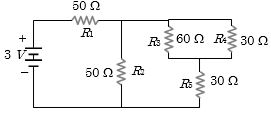
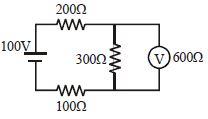
- 3The reading of voltmeter is :- .............. $V$View Solution
- 4What equal length of an iron wire and a copper-nickel alloy wire, each of $2 \; {mm}$ diameter connected parallel to give an equivalent resistance of $3 \Omega ?$View Solution
(Given resistivities of iron and copper-nickel alloy wire are $12 \;\mu \Omega {cm}$ and $51\; \mu \Omega {cm}$ respectively) (in ${m}$)
- 5In India electricity is supplied for domestic use at $220 \,V$. It is supplied at $110 \,V$ in USA. If the resistance of a $60 \,W$ bulb for use in India is $R$, the resistance of a $60 \,W$ bulb for use in USA will beView Solution
- 6View SolutionIt is easier to start a car engine on a hot day than on a cold day. This is because the internal resistance of the car battery
- 7View SolutionA thick wire is stretched so that its length become two times. Assuming that there is no change in its density, then what is the ratio of change in resistance of wire to the initial resistance of wire
- 8$A$ current $I$ flows through a uniform wire of diameter $d$ when the mean electron drift velocity is $V$. The same current will flow through a wire of diameter $d/2$ made of the same material if the mean drift velocity of the electron is :View Solution
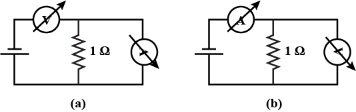
- 9A student uses the resistance of a known resistor $(1 \,\Omega)$ to calibrate a voltmeter and an ammeter using the circuits shown below. The student measures the ratio of the voltage to current to be $1 \times 10^3 \,\Omega$ in circuit $(a)$ and $0.999 \,\Omega$ in circuit $(b)$. From these measurements, the resistance (in $\Omega$ ) of the voltmeter and ammeter are found to be close toView Solution
- 10In circuit shown below, the resistances are given in $ohms$ and the battery is assumed ideal with emf equal to $3\, volt$. The voltage across the resistance $R_4$ is ................. $V$View Solution