MCQ
Two wires of the same material and equal length are joined in parallel combination. If one of them has half the thickness of the other and the thinner wire has a resistance of $8\, ohms$, the resistance of the combination is equal to
  • A
    $\frac{5}{8}\,\,ohms$
  • $\frac{8}{5}\,\,ohms$
  • C
    $\frac{3}{8}\,\,ohms$
  • D
    $\frac{8}{3}\,\,ohms$

Answer

Correct option: B.
$\frac{8}{5}\,\,ohms$
b
$\rho - {\rm{same, }}\,l - {\rm{same, }}\,{A_2} = \frac{1}{4}{A_1}$ (as ${r_2} = \frac{{{r_1}}}{2}$)

By using $R = \rho \frac{l}{A} \Rightarrow \frac{{{R_1}}}{{{R_2}}} = \frac{{{A_2}}}{{{A_1}}} \Rightarrow \frac{{{R_1}}}{8} = \frac{1}{4} \Rightarrow {R_1} = 2\,\Omega $

Hence, ${R_{eq}} = \frac{{{R_1}{R_2}}}{{{R_1} + {R_2}}} = \frac{{2 \times 8}}{{(2 + 8)}} = \frac{8}{5}\,\Omega .$

Need a full question paper?

Generate a complete, print-ready paper with questions like this in minutes — across 16+ boards, with answer keys.

Start Generating Free

Similar questions

An NPN-transistor circuit is arranged as shown in figure. It is
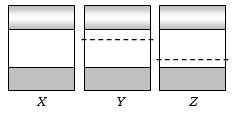
The energy band diagrams for three semiconductor samples of silicon are as shown. We can then assert that
A car has a fresh battery of $e.m.f$. $12\, V$ and internal resistance of $0.05\, \Omega$. If the starter motor draws a current of $90\, A$, the terminal voltage when the starter is on will be ............... $V$
Photons of energies $1\ eV$ and $2\ eV$ are successively incident on a metallic surface of work function $ 0.5\ eV$. The ratio of kinetic energy of most energetic photoelectrons in the two cases will be:
The key feature of Bohr's theory of spectrum of hydrogen atom is the quantization of angular momentum when an electron is revolving around a proton. We will extend this to a general rotational motion to find quantized rotational energy of a diatomic molecule assuming it to be rigid. The rule to be applied is Bohr's quantization condition.

$1.$ A diatomic molecule has moment of inertia I. By Bohr's quantization condition its rotational energy in the $\mathrm{n}^{\text {th }}$ level ( $\mathrm{n}=0$ is not allowed) is

$(A)$ $\frac{1}{\mathrm{n}^2}\left(\frac{\mathrm{h}^2}{8 \pi^2 \mathrm{I}}\right)$ $(B)$ $\frac{1}{\mathrm{n}}\left(\frac{\mathrm{h}^2}{8 \pi^2 \mathrm{I}}\right)$

$(C)$ $n\left(\frac{h^2}{8 \pi^2 \mathrm{I}}\right)$ $(D)$ $\mathrm{n}^2\left(\frac{\mathrm{h}^2}{8 \pi^2 \mathrm{I}}\right)$

$2.$ It is found that the excitation frequency from ground to the first excited state of rotation for the $\mathrm{CO}$ molecule is close to $\frac{4}{\pi} \times 10^{11} \mathrm{~Hz}$. Then the moment of inertia of $\mathrm{CO}$ molecule about its centre of mass is close to (Take $\mathrm{h}=2 \pi \times 10^{-34} \mathrm{Js}$ )

$(A)$ $2.76 \times 10^{-46} \mathrm{~kg} \mathrm{~m}^2$ $(B)$ $1.87 \times 10^{-46} \mathrm{~kg} \mathrm{~m}^2$

$(C)$ $4.67 \times 10^{-47} \mathrm{~kg} \mathrm{~m}^2$ $(D)$ $1.17 \times 10^{-47} \mathrm{~kg} \mathrm{~m}^2$

$3.$ In a $\mathrm{CO}$ molecule, the distance between $\mathrm{C}$ (mass $=12$ a.m.u) and $\mathrm{O}$ (mass $=16$ a.m.u.), where $1$ a.m.u. $=\frac{5}{3} \times 10^{-27} \mathrm{~kg}$, is close to

$(A)$ $2.4 \times 10^{-10} \mathrm{~m}$ $(B)$ $1.9 \times 10^{-10} \mathrm{~m}$

$(C)$ $1.3 \times 10^{-10} \mathrm{~m}$ $(D)$ $4.4 \times 10^{-11} \mathrm{~m}$

Give the answer question $1,2$ and $3.$
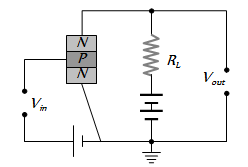
In the given circuit the cells have zero internal resistance. The currents (in Amperes) passing through resistance $R_1$ and $R_2$ respectively, are
Young's double slit experiment is first performed in air and then in a medium other than air. It is found that $8^{th}$ bright fringe in the medium lies where $5^{th}$ dark fringe lies in air. The refractive index of the medium is nearly 
Suppose that intensity of a laser is $\left(\frac{315}{\pi}\right)\, W / m ^{2} .$ The $rms$ electric field, in units of $V / m$ associated with this source is close to the nearest integer is $\left(\in_{0}=8.86 \times 10^{-12} C ^{2} Nm ^{-2} ; c =3 \times 10^{8} ms ^{-1}\right)$
$1$ wire mesh consisting of very small squares is viewed at a distance of $S\,cm$ through a magnifying converging lens of focal length $10\,cm$, kept close to the eye. The magnification produced by the lens is
The frequency order for $\gamma -$ rays $(a)$, $X-$ rays $(b)$ and $UV-$ rays $(c)$ is given as