Two wires that are made up of two different materials whose specific resistance are in the ratio $2 : 3$, length $3 : 4$ and area $4 : 5$. The ratio of their resistances is
Easy
Download our app for free and get started
(c) Resistance $ = \rho \frac{l}{A}$
$\therefore $ $\frac{{{R_1}}}{{{R_2}}} = \frac{{{\rho _1}}}{{{\rho _2}}} \times \frac{{{l_1}}}{{{l_2}}} \times \frac{{{A_2}}}{{{A_1}}} = \frac{2}{3} \times \frac{3}{4} \times \frac{5}{4} = \frac{5}{8}$

Download our appand get started for free
Experience the future of education. Simply download our apps or reach out to us for more information. Let's shape the future of learning together!No signup needed.*
Similar Questions
- 1One $kg$ of water, at $20\,^oC$, is heated in an electric kettle whose heating element has a mean (temperature averaged) resistance of $20\, \Omega $. The rms voltage in the mains is $200\, V$. Ignoring heat loss from the kettle, time taken for water to evaporate fully, is close to.......... $\min$ [Specific heat of water $= 4200\, J/kg\, ^oC$), Latent heat of water $= 2260\, k\,J/kg$]View Solution
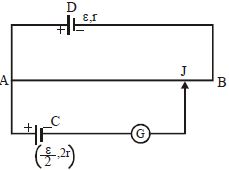
- 2In the figure, the potentiometer wire $AB$ of length $L$ and resistance $9r$ is joined to the cell $D$ of $emf$ $\varepsilon $ and internal resistance $r$. The cell $C's$ $emf$ is $\frac{\varepsilon }{2}$and its internal resistance is $2r$. The galvanometer $G$ will show no deflection when the length $AJ$ isView Solution
- 3A cylindrical metal wire of length $l$ and cross sections area $S$, has resistance $R$, conductance $G$, conductivity $\sigma$ and resistivity $\rho$. Which one of the following expressions for $\sigma$ is validView Solution
- 4View SolutionWhich of the following is not a correct statement
- 5A galvanometer together with an unknown resistance in series is connected to two identical batteries each of $1.5\, V$. When the batteries are connected in series, the galvanometer records a current of $1\,A$, and when batteries are in parallel the current is $0.6\,A$. What is the internal resistance of the battery ?View Solution
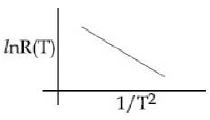
- 6View SolutionIn an experiment, the resistance of a material is plotted as a function of temperature (in some range). As shown in the figure, it is a straight line. One may conclude that:
- 7An electric heater consists of a nichrome coil and runs under $220 \,V$, consuming $1 \,kW$ power. Part of its coil burned out and it was reconnected after cutting off the burnt portion.The power it will cunsume now isView Solution
- 8What length of the wire of specific resistance $48 \times {10^{ - 8}}\,\Omega \,\,m$ is needed to make a resistance of $4.2 \, \Omega$ .............. $m$ (diameter of wire = $0.4\, mm$)View Solution
- 9A conducting wire of length $ l$ area of cross-section $A$ and electric resistivity $\rho$ is connected between the terminals of a battery. $A$ potential difference $V$ is developed between its ends, causing an electric current.If the length of the wire of the same material is doubled and the area of cross-section is halved, the resultant current would beView Solution
- 10A potentiometer wire has length $4\,\, m$ and resistance $8\,\,\Omega $. The resistance that must be connected in series with the wire and an accumulator of e.m.f. $2\,\, V,$ so as to get a potential gradient $1\,\, m \,V$ per $cm$ on the wire is ............. $\Omega$View Solution