A cylindrical metal wire of length $l$ and cross sections area $S$, has resistance $R$, conductance $G$, conductivity $\sigma$ and resistivity $\rho$. Which one of the following expressions for $\sigma$ is valid
Medium
Download our app for free and get started
Conductivity $\sigma = \frac{1}{\rho }$ .... $(i)$
and conductance $G = \frac{1}{R}$
$ \Rightarrow \,\,GR = 1$ ..... $(ii)$
From equation $(i)$ and $(ii)$ $\sigma = \frac{{GR}}{\rho }$

Download our appand get started for free
Experience the future of education. Simply download our apps or reach out to us for more information. Let's shape the future of learning together!No signup needed.*
Similar Questions
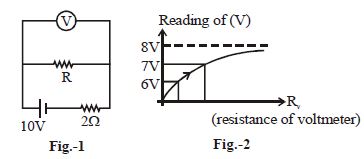
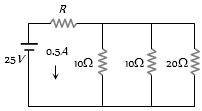
- 1In the given figure $-1$, resistance of shown voltmeter is variable. Variation of whose reading with respect to its resistance is shown in figure $-2$. The value of $R$ is ............... $\Omega$View Solution
- 2When a current of $2\, A$ flows in a battery from negative to positive terminal, the potential difference across it is $12\, V$. If a current of $3\, A$ flows in the opposite direction potential difference across the terminals of the battery is $15\, V$, the $emf$ of the battery is ............... $\mathrm{V}$View Solution
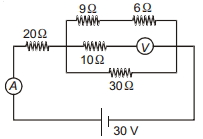
- 3In the circuit shown in figure, if ammeter and voltmeter are ideal, then the power consumed in $9 \,\Omega$ resistor will be .......... $W$View Solution
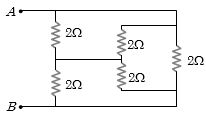
- 4Find the equivalent resistance across $AB$ .............. $\Omega$View Solution
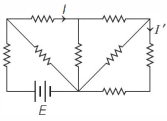
- 5Consider the following circuit shown below. All the resistors are identical. The ratio of $I / I^{\prime}$ isView Solution
- 6In a Wheatstone's bridge, three resistances $P, Q$ and $R$ connected in the three arms and the fourth arm is formed by two resistances $S_1$ and $S_2$ connected in parallel. The condition for the bridge to be balanced will beView Solution
- 7View SolutionIn the circuit as shown in figure the
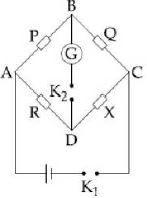
- 8In a Wheatstone bridge (see figure) Resistance $P$ and $Q$ are approximately equal. When $R = 400\,\Omega ,$ the bridge is balanced. On interchanging $P$ and $Q,$ the value of $R,$ for balance is $405\,\Omega .$ The value of $X$ is close to ................. $ohm$View Solution
- 9An ammeter with internal resistance $90\,\Omega $ reads $1.85\, A$ when connected in a circuit containing a battery and two resistors $700\,\Omega $ and $410\,\Omega $ in series. Actual current will beView Solution
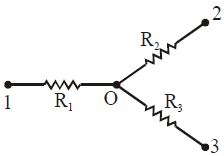
- 10.............. $A$ the current flowing through the resistance $R_2$ of the circuit shown in fig if the resistance are equal to $R_1 = 20\ \Omega, R_2 = 30 \ \Omega$ and $R_3 = 60 \ \Omega$ and potentials of points $1, 2$ and $3$ are equal to $V_1= 20\, V,$ $V_2 = 30\ V$ and $V_3 = 60\ V$View Solution