Two wires $W_1$ and $W_2$ have the same radius $r$ and respective densities ${\rho _1}$ and ${\rho _2}$ such that ${\rho _2} = 4{\rho _1}$. They are joined together at the point $O$, as shown in the figure. The combination is used as a sonometer wire and kept under tension $T$. The point $O$ is midway between the two bridges. When a stationary waves is set up in the composite wire, the joint is found to be a node. The ratio of the number of an tin odes formed in $W_1$ to $W_2$ is
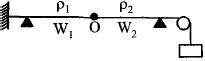
JEE MAIN 2017, Diffcult
Download our app for free and get started
${n_1} = {n_2}$
$T \to Same$
$r \to Same$
$l \to Same$
Frequency of vibration
$\mathrm{n}=\frac{\mathrm{p}}{2 l} \sqrt{\frac{\mathrm{T}}{\pi \mathrm{r}^{2} \rho}}$
As $\mathrm{T}, \mathrm{r},$ and $l$ are same for both the wires
$n_{1}=n_{2}$
$\frac{p_{1}}{\sqrt{\rho_{1}}}=\frac{p_{2}}{\sqrt{p_{2}}}$
$\frac{p_{1}}{p_{2}}=\frac{1}{2} $
$ \because \rho_{2}=4 \rho_{1}$
$T \to Same$
$r \to Same$
$l \to Same$
Frequency of vibration
$\mathrm{n}=\frac{\mathrm{p}}{2 l} \sqrt{\frac{\mathrm{T}}{\pi \mathrm{r}^{2} \rho}}$
As $\mathrm{T}, \mathrm{r},$ and $l$ are same for both the wires
$n_{1}=n_{2}$
$\frac{p_{1}}{\sqrt{\rho_{1}}}=\frac{p_{2}}{\sqrt{p_{2}}}$
$\frac{p_{1}}{p_{2}}=\frac{1}{2} $
$ \because \rho_{2}=4 \rho_{1}$

Download our appand get started for free
Experience the future of education. Simply download our apps or reach out to us for more information. Let's shape the future of learning together!No signup needed.*
Similar Questions
- 1View SolutionStanding waves can be produced
- 2If two waves having amplitudes $2A$ and $A$ and same frequency and velocity, propagate in the same direction in the same phase, the resulting amplitude will beView Solution
- 3Three waves of equal frequency having amplitudes $10\, \mu m, 4\, \mu m$ and $7\, \mu m$ arrive at a given point with successive phase difference of $\pi/2$. The amplitude of the resulting wave in $\mu m$ is given byView Solution
- 4A stretched string of $1m$ length and mass $5 \times {10^{ - 4}}kg$ is having tension of $20N.$ If it is plucked at $25cm$ from one end then it will vibrate with frequency ... $Hz$View Solution
- 5The equation of progressive wave is $y = 0.2\sin 2\pi \left[ {\frac{t}{{0.01}} - \frac{x}{{0.3}}} \right]$, where $x$ and $y$ are in metre and $t$ is in second. The velocity of propagation of the wave is .... $m/s$View Solution
- 6A vibrating tuning fork is moving slowly and uniformly in a horizontal circular path of radius $8\,m$. The shortest distance of an observer in same plane from the tuning fork is $9 \,m$. The distance between the tuning fork and observer at the instant when apparent frequency becomes maximum is ......... $m$View Solution
- 7The vibrations of a string of length $60\, cm$ fixed at both the ends are represented by the equation $y = 2\,\sin \,\left( {\frac{{4\pi x}}{{15}}} \right)\,\cos \,\left( {96\pi t} \right)$ where $x$ and $y$ are in $cm$. The maximum number of loops that can be formed in it isView Solution
- 8When two sound waves with a phase difference of $\pi /2$, and each having amplitude $A$ and frequency $\omega $, are superimposed on each other, then the maximum amplitude and frequency of resultant wave isView Solution
- 9Fundamental frequency of sonometer wire is $n$. If the length, tension and diameter of wire are tripled, the new fundamental frequency isView Solution
- 10The intensity ratio of two waves is $1 : 16$. The ratio of their amplitudes isView Solution