A stretched string of $1m$ length and mass $5 \times {10^{ - 4}}kg$ is having tension of $20N.$ If it is plucked at $25cm$ from one end then it will vibrate with frequency ... $Hz$
Medium
Download our app for free and get started
(b) As we know plucking distance from one end $ = \frac{l}{{2p}}$
==> $25 = \frac{{100}}{{2p}}$ ==> $p = 2$. Hence frequency of vibration
$n = \frac{p}{{2l}}\sqrt {\frac{T}{m}} = \frac{2}{{2 \times 1}}\sqrt {\frac{{20}}{{5 \times {{10}^{ - 4}}}}} $ = $200Hz.$
==> $25 = \frac{{100}}{{2p}}$ ==> $p = 2$. Hence frequency of vibration
$n = \frac{p}{{2l}}\sqrt {\frac{T}{m}} = \frac{2}{{2 \times 1}}\sqrt {\frac{{20}}{{5 \times {{10}^{ - 4}}}}} $ = $200Hz.$

Download our appand get started for free
Experience the future of education. Simply download our apps or reach out to us for more information. Let's shape the future of learning together!No signup needed.*
Similar Questions
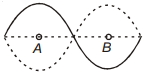
- 1In the standing wave shown, particles at the positions $A$ and $B$ have a phase difference ofView Solution
- 2A vibrating string of certain length $l$ under a tension $T$ resonates with a mode corresponding to the first overtone (third harmonic) of an air column of length $75\, cm$ inside a tube closed at one end. The string also generates $4\, beats$ per second when excited along with a tuning fork of frequency $n$. Now when the tension of the string is slightly increased the number of beats reduces to $2\, per second$. Assuming the velocity of sound in air to be $340\, m/s$, the frequency $n$ of the tuning fork in $Hz$ isView Solution
- 3Two waves represented by the following equations are travelling in the same medium ${y_1} = 5\sin 2\pi (75t - 0.25x)$, ${y_2} = 10\sin 2\pi (150t - 0.50x)$ The intensity ratio ${I_1}/{I_2}$ of the two waves isView Solution
- 4A source of sound $S$ is moving with a velocity $50m/s$ towards a stationary observer. The observer measures the frequency of the source as $1000 Hz$. What will be the apparent frequency of the source when it is moving away from the observer after crossing him .... $Hz$ $?$ The velocity of sound in the medium is $350 m/s$View Solution
- 5At $23^{\circ} C$, a pipe open at both ends resonates at a frequency of $450 \,Hz$. At what frequency does the same pipe resonate on a hot day when the speed of sound is $4 \%$ higher than it would be at $23^{\circ} C$ ?View Solution
- 6The length of the string of a musical instrument is $90 \;cm$ and has a fundamental frequency of $120 \;Hz$. Where (In $cm$) should it be pressed to produce fundamental frequency of $180 \;Hz ?$View Solution
- 7A source producing sound of frequency $170 Hz$ is approaching a stationary observer with a velocity $17 \,ms^{-1}$. The apparent change in the wavelength of sound heard by the observer is (speed of sound in air $= 340 \,ms^{-1}$) ..... $m$View Solution
- 8A wave equation is $y = 10^{-4}\, sin\, (60 t + 2x)$ Where $x$ and $y$ are in $metres$ and $t$ is in $sec$ . Which of the following statements is correct ?View Solution
- 9A sonometer wire resonates with a given tuning fork forming standing waves with five antinodes between the two bridges when a mass of $9 kg$ is suspended from the wire. When this mass is replaced by a mass $M$, the wire resonates with the same tuning fork forming three antinodes for the same positions of the bridges. The value of $M$ is ... $kg$View Solution
- 10The displacement of a particle is given by $y = 5 \times {10^{ - 4}}\sin (100t - 50x)$, where $x$ is in meter and $t$ in sec, find out the velocity of the wave .... $m/sec$View Solution