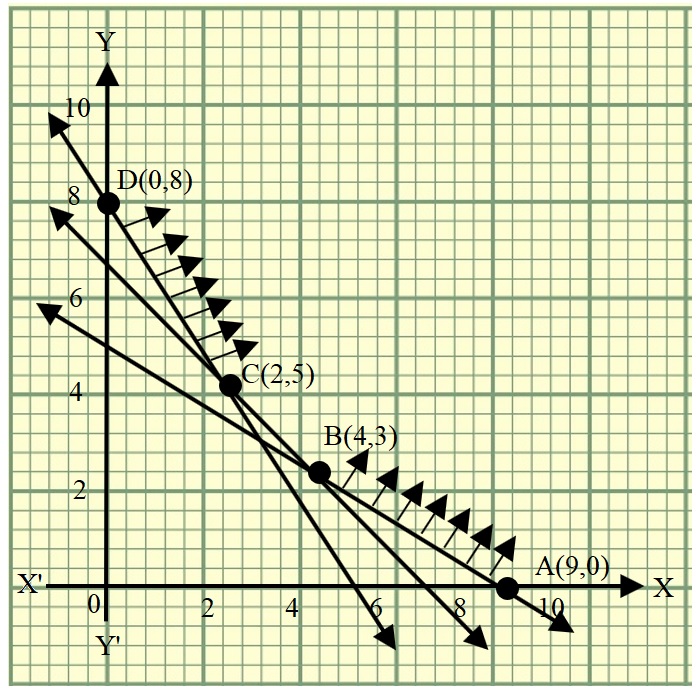
Question
Unboundedness is usually a sign that the LP problem.
  1. Has finite multiple solutions.
  2. Is degenerate.
  3. Contains too many redundant constraints.
  4. Has been formulated improperly.
  5. None of the above.

Answer

  1. Has been formulated improperly.
Solution:
A linear programming problem is said to have unbounded solution if it has infinite number of solutions.
I.e., the problem has been formulated improperly.

Need a full question paper?

Generate a complete, print-ready paper with questions like this in minutes — across 16+ boards, with answer keys.

Start Generating Free

Similar questions

Choose the correct answer out of the given four options.Let T be the set of all triangles in the Euclidean plane and let a relation R on T be defined as aRb, if a is congruent to $\text{b}\ \forall\ \text{a},\ \text{b}\in\text{T}.$ Then, R is:
  1. Reflexive but not transitive.
  2. Transitive but not symmetric.
  3. Equivalence.
  4. None of these.
$\int \frac{d x}{x^3\left(1+x^4\right)^{\frac{1}{2}}} \quad$ equals
If $\alpha,\beta$ and $\gamma$ are the angles which a half ray makes with the positive direction of the axes, then $\sin^2\alpha+\sin^2\beta+\sin^2\gamma$ is equal to:
  1. 1
  2. 2
  3. 0
  4. -1
Evaluate : $\cos \left(2 \cos ^{-1}\left(\frac{2}{5}\right)\right)$
The principal solution of $\sin ^{-1}\left(\sin \left(\frac{5 \pi}{3}\right)\right)$ is
Maximize Z = 6x + 4y, subject to $\text{x}\leq2,\text{x}+\text{y}\leq3,-2\text{x}+\text{y}\leq1,\text{x}\geq0,\text{y}\geq0.$
  1. 12 at (2, 0)
  2. 16 at (2, 1)
  3. $\frac{140}{3}$ at $\Big(\frac{2}{3},\frac{1}{3}\Big)$
  4. 4 at (0, 1)
The value of $\hat{\text{i}}.\big(\hat{\text{j}}\times\hat{\text{k}}\big)+\hat{\text{j}}.\big(\hat{\text{i}}\times\hat{\text{k}}\big)+\hat{\text{k}}.\big(\hat{\text{i}}\times\hat{\text{j}}\big),$ is:
  1. 0
  2. -1
  3. 1
  4. 3
If $\text{f}(\text{x})=\text{e}^{\text{x}}\sin\text{x}$ in $[0,\pi],$ then c in Rolle's theorem is:
  1. $\frac{\pi}{6}$
  2. $\frac{\pi}{4}$
  3. $\frac{\pi}{2}$
  4. $\frac{3\pi}{4}$
Feasible region (shaded) for a LPP is shown in the given figure. Minimum of z = 4x + 3y occurs at the point.
Find the identity element in the set $I^+$ of all positive integers defined by $a \times b = a + b$ for all $a, b \in I^+.$