- a = 2b
- 2a = b
- a = b
- 3a = b
- a = 2b
4a + 0b = 2a + 4b
4a = 2a + 4b
4a - 2a = 4b
2a = 4b
a = 2b
157 questions · 14 auto-graded MCQ + 143 self-marked written.


|
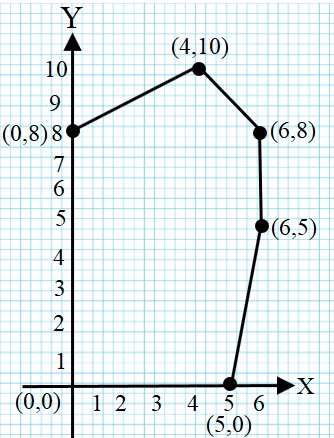
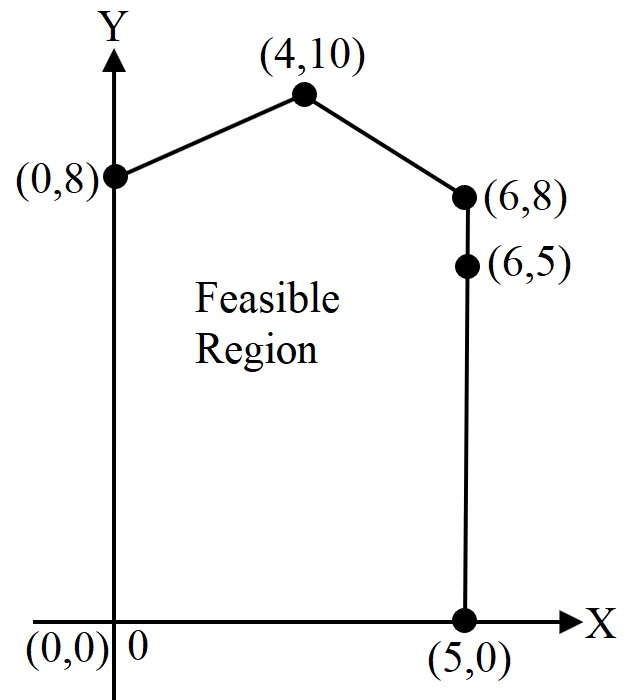
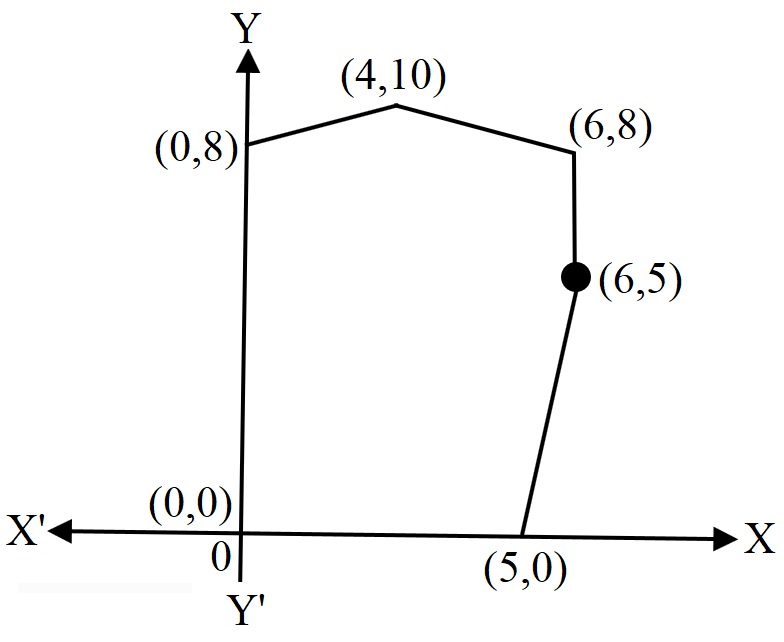
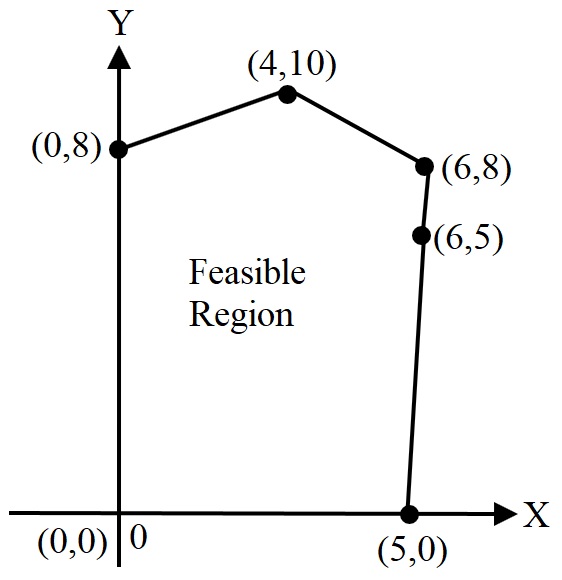
Corner points
|
Corresponding value of Z = 3x - 4y
|
|
(0, 0)
(5, 0)
(6, 5)
(6, 8)
(4, 10)
(0, 8)
|
0
15 (Maxmimum)
-2
-14
-28
-32
|
|
Column A
|
Column B
|
|
Maximum of Z
|
325
|
|
|
Number of cars manufactured
|
||
|
Colour
|
Vento
|
Creta
|
Wagonr
|
|
Red
|
65
|
88
|
93
|
|
White
|
54
|
42
|
80
|
|
Black
|
66
|
52
|
88
|
|
Sliver
|
37
|
49
|
74
|

|
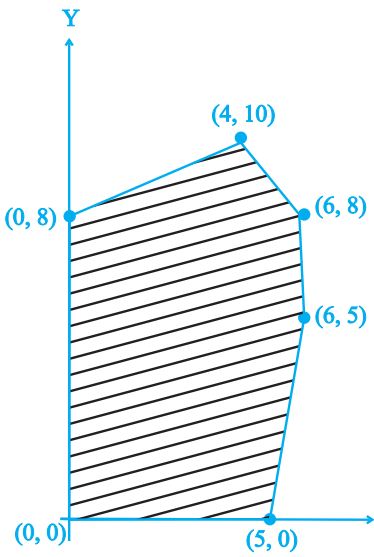
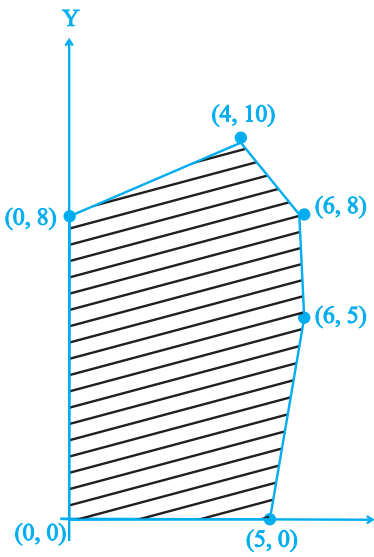
Corner points
|
Corresponding value of Z = 3x - 4y
|
|
(0, 0)
(5, 0)
(6, 5)
(6, 8)
(4, 10)
(0, 8)
|
0
15 (Maximum)
-2
-14
-28
-32 (Minimum)
|
|
Corner points
|
Corresponding value of F = 4x + 6y
|
|
(0, 2)
|
12 (Minimum)
|
|
(3, 0)
|
12 (Minimum)
|
|
(6, 0)
|
24
|
|
(6, 8)
|
72 (Maxmimum)
|
|
(0, 5)
|
30
|
|
|
Number of cars manufactured
|
||
|
Colour
|
Vento
|
Creta
|
WagonR
|
|
Red
|
65
|
88
|
93
|
|
White
|
54
|
42
|
80
|
|
Black
|
66
|
52
|
88
|
|
Sliver
|
37
|
49
|
74
|

|
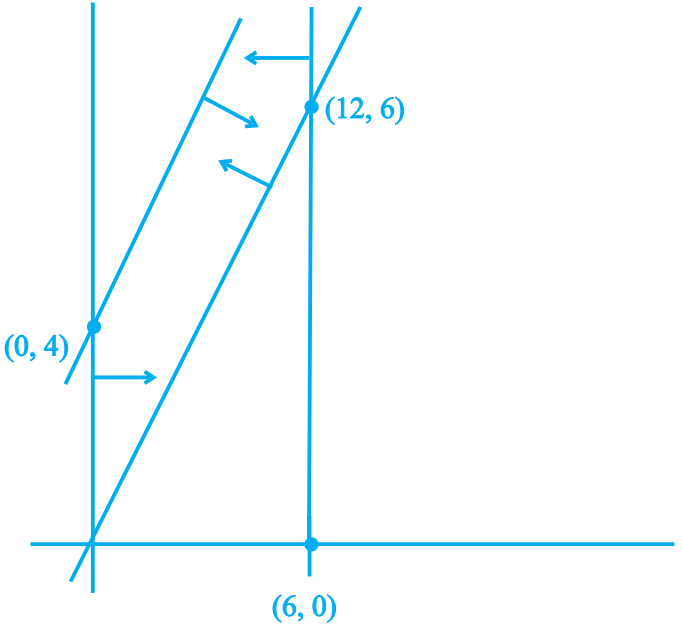
Corner points
|
Corresponding value of Z = 3x - 4y
|
|
(0, 0)
(12, 6)
(0, 4)
|
0
12 (maximum)
-16 (minimum)
|

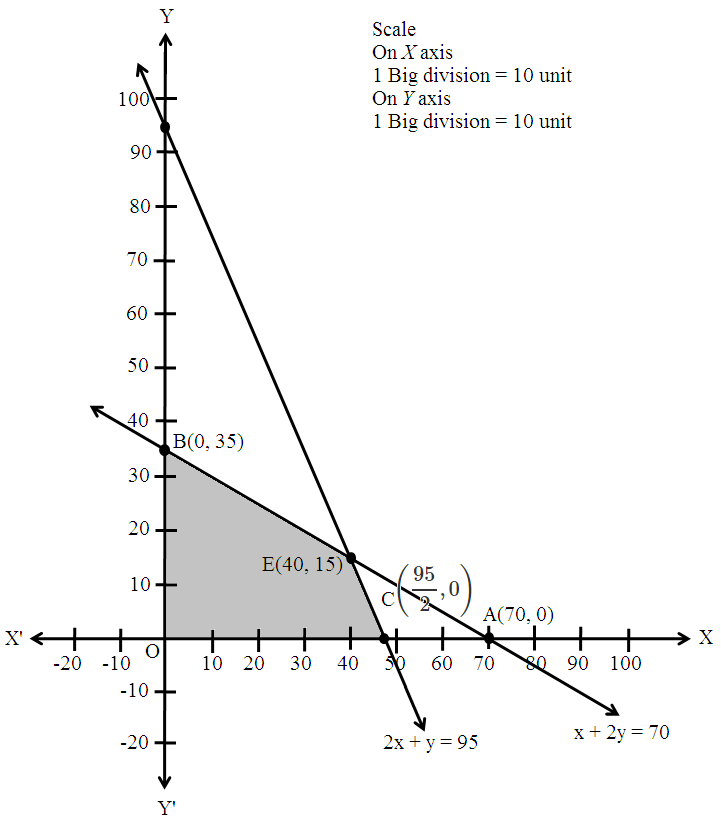
| $\text{Corner point}$ | $\text{Z} = \text{x} + \text{y}$ |
| $\text{O}(0, 0)$ | $0 + 0 = 0$ |
| $\text{C}\Big(\frac{95}{2},0\Big)$ | $\frac{95}{2}+0,2=\frac{95}{2}$ |
| $\text{E}(40, 1)$ | $40 + 15 = 55$ |
| $\text{B}(0, 35)$ | $0 + 35 = 35$ |
We know that $ \text{A}.\text{M}.\geq\text{G}.\text{M}.$
Therefore, $ \frac{{\text{b}^2+\text{c}^2}}{2}\geq\sqrt{\text{b}^2\text{c}^2}$
$\Rightarrow\text{b}^{2}+\text{c}^{2}\geq2\text{bc}$
Multiplying a on both sides doesn’t change the inequality.
Since, given that a is positive.
$\Rightarrow\text{a}(\text{b}^{2}+\text{c}^{2})\geq2\text{abc}\ ...(1)$
Similarly, $\text{b}(\text{a}^{2}+\text{c}^{2})\geq2\text{abc}\ ...(2)$
and $\text{c}(\text{a}^{2}+\text{c}^{2})\geq2\text{abc}\ ...(3)$
adding $(1), (2)$ and $(3)$ we get
$\text{a}(\text{b}^{2}+\text{c}^{2})+\text{b}(\text{a}^{2}+\text{c}^{2})+\text{c}(\text{a}^{2}+\text{b}^{2})\geq2\text{abc}+2\text{abc}+2\text{abc}$
$\Rightarrow\text{a}(\text{b}^{2}+\text{c}^{2})+\text{b}(\text{a}^{2}+\text{b}^{2})+\text{c}(\text{a}^{2}+\text{b}^{2})\geq6\text{abc}$
Therefore $\lambda$ is $6$

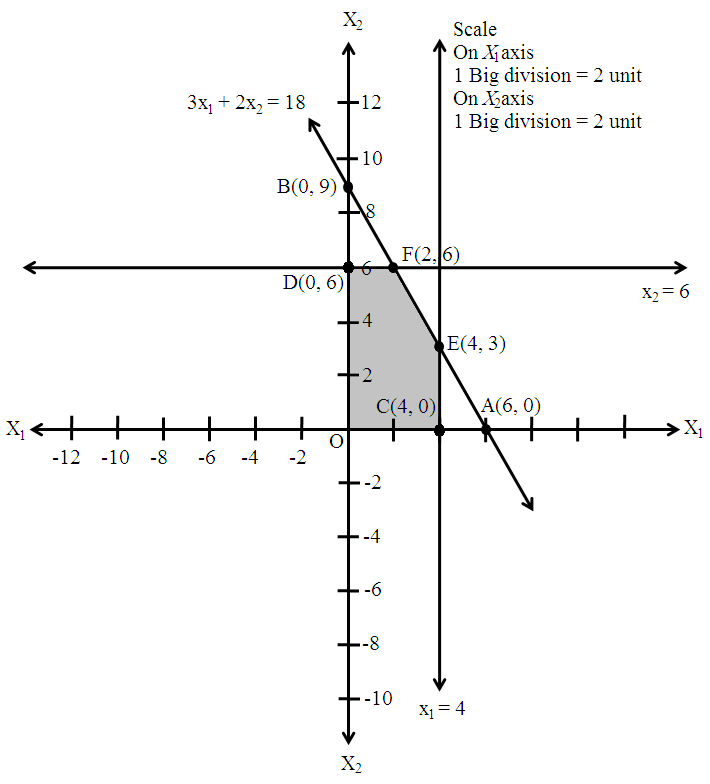
|
Points
|
Value of $Z$
|
| $O(0, 0)$ | $3(0) + 5(0) = 0$ |
| $D(0, 6)$ | $3(0) + 5(6) = 30$ |
| $F(2, 6)$ | $3(2) + 5(6) = 36$ |
| $E(4, 3)$ | $3(4) + 5(3) = 27$ |
| $C(4, 0)$ | $3(4) + 5(0) = 12$ |
| $\text{Corner point}$ | $\text{Z} = 4\text{x} + 3\text{y}$ |
| $\text{O}(0, 0)$ | $4 \times 0 + 3 \times 0= 0$ |
| $\text{G}(5, 0)$ | $4 \times 5 + 3 \times 0 = 20$ |
| $\text{F}\Big(5,\frac{4}{3}\Big)$ | $4\times5+3\times\frac{4}{3}=24$ |
| $\text{E}\Big(\frac{24}{7},\frac{24}{7}\Big)$ | $4\times\frac{24}{7}+3\times\frac{24}{7}=\frac{196}{7}=24$ |
| $\text{B}(0, 6)$ | $4\times0+3\times6=18$ |
A set $A$ is convex if, for any two points $X_1, X_{2 }$
$\in\text{A}$ and $\lambda\in0,1$ imply that $\lambda\times1+1-\lambda\times2\in\text{A}$.
Since, here $X_1$ and $X_2$ are optimal solution
Therefore, their convex combination will also be an optimal solution
Thus, $\text{X}=\lambda\ \text{X}_1+(1-\lambda)\text{X}_2,0\leq\lambda\leq1$ gives an optimal solution.
|
Corner points
|
Corresponding value of z = 3x - 4y
|
|
(0, 0)
|
0
|
|
(12, 6)
|
12 (masimum)
|
|
(0, 4)
|
-16 (miminum)
|
|
Corner point
|
Corresponding value of X = px + qy; p,q > 0
|
|
(0, 3)
|
3q
|
|
(1, 1)
|
p + q
|
|
(3, 0)
|
3p
|
|
Corner points
|
Corresponding value of F = 4x + 6y
|
|
(0, 2)
|
12 (Minimum)
|
|
(3, 0)
|
12 (minimum)
|
|
(6, 0)
|
24
|
|
(6, 8)
|
72 (maxmimum)
|
|
(0, 5)
|
30
|


|
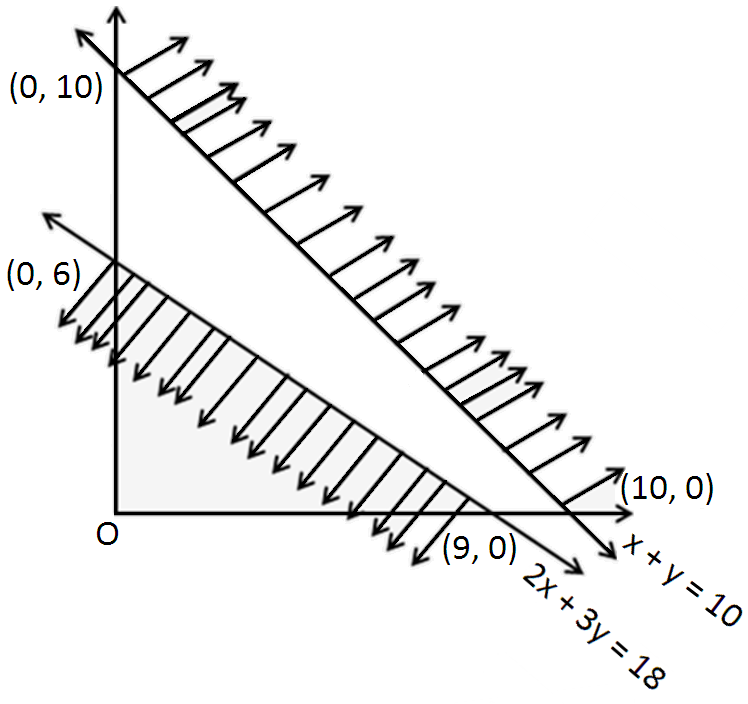
x
|
y
|
(x, y)
|
|
0
|
6
|
(0, 6)
|
|
9
|
0
|
(9, 0)
|
|
x
|
y
|
(x, y)
|
|
0
|
10
|
(0, 10)
|
|
10
|
0
|
(10, 0)
|


|
Column A
|
Column B
|
|
Maximum of Z
|
325
|
|
Corner points
|
Corresponding value of Z = 4x + 3y
|
|
(0, 0)
|
0
|
|
(0, 40)
|
120
|
|
(20, 40)
|
200
|
|
(60, 20)
|
300 (Maximum)
|
|
(60, 0)
|
240
|
|
x
|
y
|
(x, y)
|
|
0
|
10
|
(0, 10)
|
|
5
|
0
|
(5, 0)
|


|
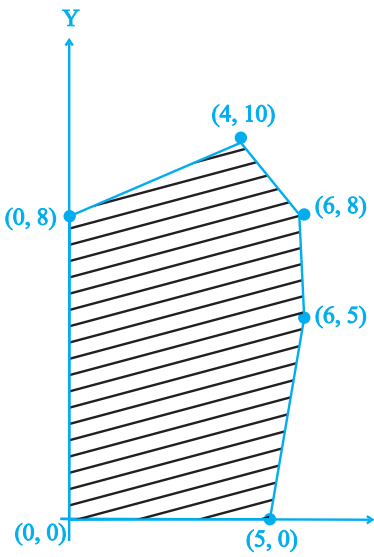
Corner points
|
Corresponding value of Z = 3x - 4y
|
|
(0, 0)
(5, 0)
(6, 5)
(6, 8)
(4, 10)
(0, 8)
|
0
15 - 2
-14
-28
-32 (Minimum)
|

|
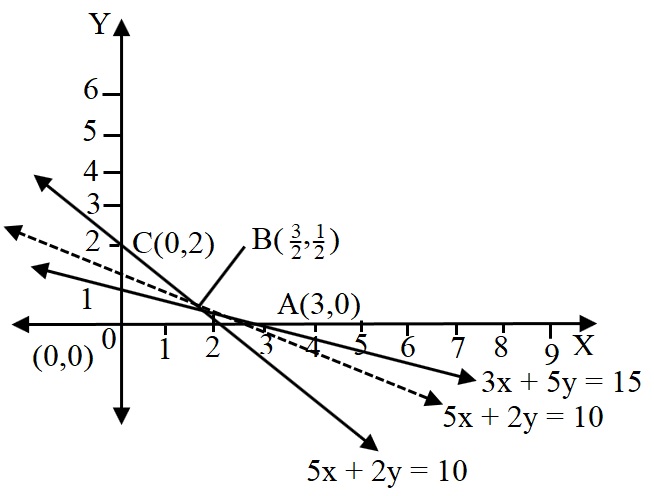
Corner point
|
z = 3x + 5y
|
|
|
A (3, 0)
|
9
|
|
|
$ \text{B}\Big(\frac{3}{2},\frac{1}{2}\Big)$
|
7
|
Smallest
|
|
C (0, 2)
|
10
|

|
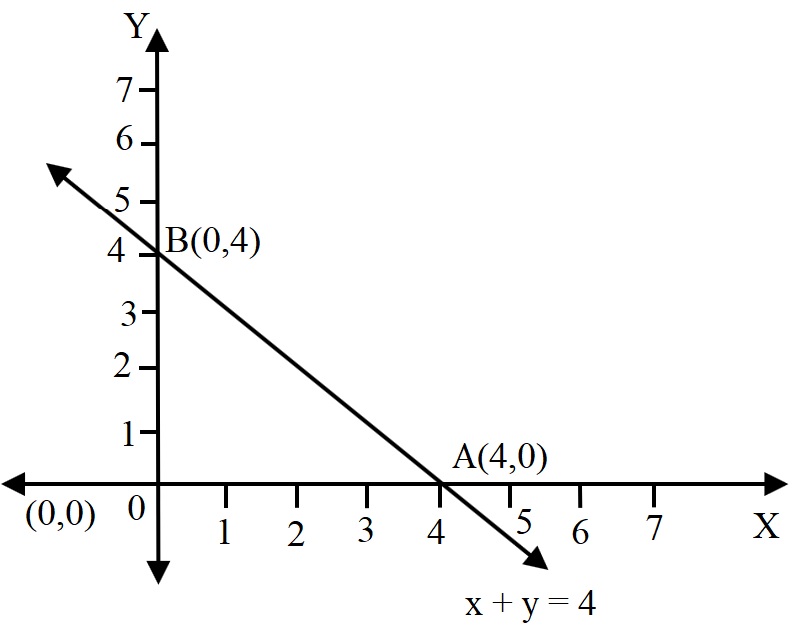
Corner Point
|
z = 3x + 4y
|
|
O(0, 0)
|
0
|
|
A(4, 0)
|
12
|
|
B(0, 4)
|
16
|