MCQ
Under elastic limit the stress is 
  • A
    Inversely, proportional to strain
  • Directly proportional to strain
  • C
    Square root of strain
  • D
    Independent of strain

Answer

Correct option: B.
Directly proportional to strain
b
(b)

Need a full question paper?

Generate a complete, print-ready paper with questions like this in minutes — across 16+ boards, with answer keys.
Start Generating Free

Similar questions

At change of state the kinetic energy of the molecules of a substances increases greatly.
The orbital velocity of an artificial satellite in a circular orbit just above the earth's surface is $v$. For a satellite orbiting at an altitude of half of the earth's radius, the orbital velocity is
Two satellites revolve around a planet in coplanar circular orbits in anticlockwise direction. Their period of revolutions are $1\, hour$ and $8\, hours$ respectively. The radius of the orbit of nearer satellite is $2 \times 10^{3}\, {km}$. The angular speed of the farther satellite as observed from the nearer satellite at the instant when both the satellites are closest is $\frac{\pi}{{x}}\, {rad} \,{h}^{-1}$ where ${x}$ is ..... .
Coefficient of linear expansion of a vessel completely filled with $Hg$ is $1 \times 10^{-5} /{ }^{\circ} C$. If there is no overflow of $Hg$ on heating the vessel, then coefficient of cubical expansion of $Hg$ is ......
Which graph represents the difference between total energy and potential energy of a particle executing $SHM$ Vs it's distance from mean position?
Which of the following graphs is/are correct.
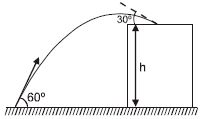
A stone projected at an angle of $60^o$ from the ground level strikes at an angle of $30^o$ on the roof of a building of height $‘h= 30\,m ’$ . Find the speed of projection(in $m/s$ ) of the stone
A solid sphere moves at a terminal velocity of $20 \mathrm{~m} / \mathrm{s}$ in air at a place where $\mathrm{g}=9.8 \mathrm{~m} / \mathrm{s}^2$. The sphere is taken in a gravity free hall having air at the same pressure and pushed down at a speed of $20 \mathrm{~m} / \mathrm{s}$.
A steel rod of length $\ell$, cross sectional area $A$, young's modulus of elasticity $Y$, and thermal coefficient of linear expansion $'a'$ is heated so that its temperature increases by $t\,^oC$. Work that can be done by rod on heating will be
If the maximum velocity and maximum acceleration of a particle executing $SHM$ are equal in magnitude, the time period will be .... $\sec$