In figure, two blocks $M$ and $m$ are tied together with an inextensible and light string. The mass $M$ is placed on a rough horizontal surface with coefficient of friction $\mu$ and the mass $m$ is hanging vertically against a smooth vertical wall. The pulley is frictionless. Choose the correct statement $(s)$ related to the tension $T$ in the string

Difficult
Download our app for free and get started

Download our appand get started for free
Experience the future of education. Simply download our apps or reach out to us for more information. Let's shape the future of learning together!No signup needed.*
Similar Questions
- 1A disc with a flat small bottom beaker placed on it at a distance $R$ from its center is revolving about an axis passing through the center and perpendicular to its plane with an angular velocity $\omega$. The coefficient of static friction between the bottom of the beaker and the surface of the disc is $\mu$. The beaker will revolve with the disc ifView Solution
- 2View SolutionA motor cycle driver doubles its velocity when he is having a turn. The force exerted outwardly will be
- 3A block of mass $5\, kg$ is on a rough horizontal surface and is at rest. Now a force of $24\, N $is imparted to it with negligible impulse. If the coefficient of kinetic friction is $0.4$ and $g = 9.8\,m/{s^2}$, then the acceleration of the block is ........ $m/s^2$View Solution
- 4A $20\, kg$ block is initially at rest on a rough horizontal surface. A horizontal force of $75 \,N$ is required to set the block in motion. After it is in motion, a horizontal force of $60\, N$ is required to keep the block moving with constant speed. The coefficient of static friction isView Solution
- 5Two blocks $A$ and $B$ of masses $5 \,kg$ and $3 \,kg$ respectively rest on a smooth horizontal surface with $B$ over $A$. The coefficient of friction between $A$ and $B$ is $0.5$. The maximum horizontal force (in $kg$ wt.) that can be applied to $A$, so that there will be motion of $A$ and $B$ without relative slipping, isView Solution
- 6For a body moving in a circular path, a condition for no skidding if $\mu $ is the coefficient of friction, isView Solution
- 7The coefficient of friction between a body and the surface of an inclined plane at $45^°$ is $0.5.$ If $g = 9.8\,m/{s^2}$, the acceleration of the body downwards in $m/{s^2}$ isView Solution
- 8View SolutionA car accelerates on a horizontal road due to force exerted by
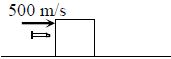
- 9A bullet of mass $20\, g$ travelling horizontally with a speed of $500 \,m/s$ passes through a wooden block of mass $10.0 \,kg$ initially at rest on a surface. The bullet emerges with a speed of $100\, m/s$ and the block slides $20 \,cm$ on the surface before coming to rest, the coefficient of friction between the block and the surface. $(g = 10\, m/s^2)$View Solution
- 10A particle is moving along the circle $x^2 + y^2 = a^2$ in anti clock wise direction. The $x-y$ plane is a rough horizontal stationary surface. At the point $(a\, cos\theta , a\, sin\theta )$, the unit vector in the direction of friction on the particle is:View Solution