Question
Under perfect competition, MR = AR, but under monopoly, MR < AR. Explain.
Answer

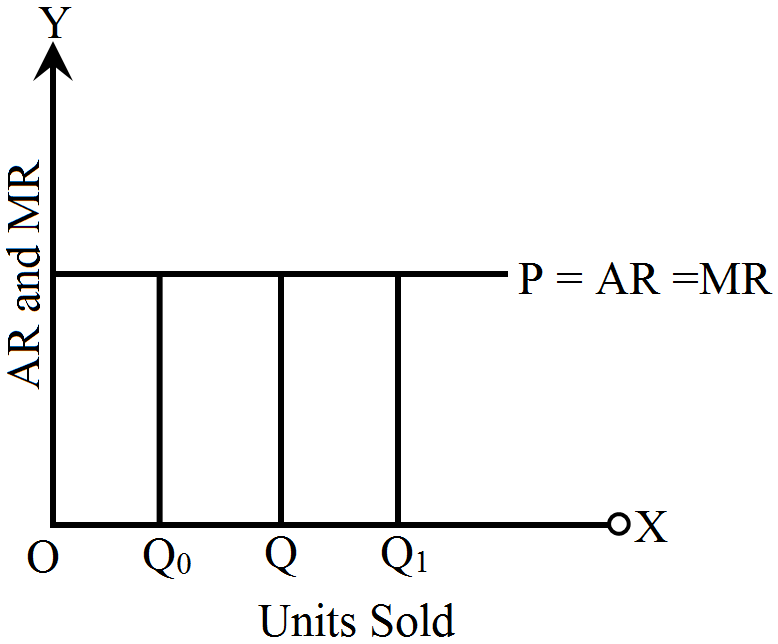
Under Perfect Competition, AR = MR. Here, industry is the price maker and firm is the price taker. A firm has to accept the price as given by the industry. At this price a firm can sell any amount of the commodity it wants. This means that with sale of every additional unit, additional revenue (i.e., MR) and average revenue (AR) will be equal to the price and thus equal to each other.

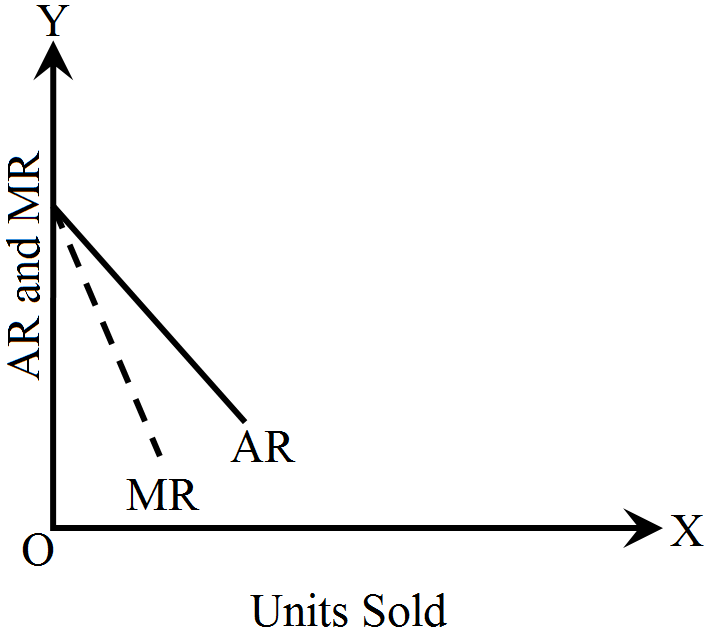
But under Monopoly, MR < AR. Here, more of a commodity can be sold only at a lower price and thus MR < AR. AR and MR curves of the firm are downward sloping indicating more units of output can be sold at lower price. MR curve is below AR curve because sale of an extra unit forces down the price at which all units can be sold.

Need a full question paper?

Generate a complete, print-ready paper with questions like this in minutes — across 16+ boards, with answer keys.

Start Generating Free

Similar questions

A consumer consumes only two goods $X$ and $Y$. At a consumption level of these two goods, he finds that the ratio of marginal utility to price in case of $X$ is higher than in case of $Y$. Explain the reaction of the consumer through utility analysis.OR
A consumer consumes only two goods $X$ and $Y$ and is in equilibrium, price of $X$ falls. Explain the reaction of the consumer through utility analysis.OR
By spending his entire income only on two goods $X$ and $Y$, a consumer finds that Explain how will the consumer react.$\frac{\text{MU}_\text{X}}{\text{P}_\text{X}}>\frac{\text{MU}_\text{Y}}{\text{P}_\text{Y}}.$
Explain with the help of a diagram the effect of a decrease in demand for a commodity on its equilibrium price and quantity
OR
Explain the chain of effects on demand, supply and price of a commodity caused by a leftward shift of its demand curve. Use diagram.
At the market price of $₹\10$, a firm supplies $4$ units of output. The market price increases to $₹\ 30$. The price elasticity of the firm's supply is $1.25$. What quantity will the firm supply at the new price?

The following data shows the number of cars manufactured by Maruti Ltd, Tata Motors and Hyundai in the year 2015-16. Represent it with the help of a piediagram.


Production of Cars (in Rs.)

Maruti Limited

15,75,000

Tata Motors

7,25,000

Hyundai

5,50,000

Distinguish between causes of increase in demand and decrease in demand.
An individual is both the owner and the manager of a shop taken on rent. Identify implicit cost and explicit cost ore from this information. Explain.
When the price of a commodity rises from Rs. 10 to Rs. 11 per unit, its quantity supplied rises by 100 units. Its price elasticity of supply is 2. Calculate its quantity supplied at the increased price.
Differentiate between Short Period production and Long Period production function.
From the following data on cost schedule of a firm, calculate.
  1. Average fixed cost and.
  2. Average variable cost of producing 3 units of output:
Units of Output (No.)
0
3
Total Cost ( Thousand)
51
96
The price of commodity is ₹15 per unit and its quantity demanded is 500 units. Its quantity demanded rises by 80 units as a result of fall in its price by 20 percent. Calculate its price elasticity of demand. Is its demand inelastic? Give reason for your answer.