Under the influence of a uniform magnetic field a charged particle is moving in a circle of radius $R$ with constant speed $v$. The time period of the motion
AIPMT 2007,AIPMT 2009, Easy
Download our app for free and get started
When a particle moves in a magnetic field of intensity B pointing downwards into the page and particle is moving with a speed of $v$ on the plane of paper:
$F = qvB$ (Force of charged particle in a magnetic field)
And we know that
$F =\frac{ mv ^2}{ r } \quad$ (r is the radius of motion and $m$ is mass of particle)
$\Rightarrow qvB =\frac{ mv ^2}{ r }$
$\Rightarrow r =\frac{ mv }{ Bq }$
Now as we know that
$\omega=\frac{ V }{ r }$
$\Rightarrow \omega=\frac{ Bq }{ m }$
Time period, $T =\frac{2 \pi}{\omega}$
$\Rightarrow T =\frac{2 \pi m }{ Bq }$
And this shows that it is independent of both radius and velocity.

Download our appand get started for free
Experience the future of education. Simply download our apps or reach out to us for more information. Let's shape the future of learning together!No signup needed.*
Similar Questions
- 1The resistance of a galvanometer is $25\, ohm$ and it requires $50\,\mu A$ for full deflection. The value of the shunt resistance required to convert it into an ammeter of $5\, amp$ isView Solution
- 2$A$ microammeter has a resistance of $100\,\Omega$ and $a$ full scale range of $50\,\mu$ $A$. It can be used as a voltmeter or a higher range ammeter provided a resistance is added to it. Pick the correct range and resistance combination $(s)$.View Solution
- 3A helium nucleus makes a full rotation in a circle of radius $0.8$ metre in two seconds. The value of the magnetic field $B$ at the centre of the circle will beView Solution
- 4In a uniform magnetic field of $0.049 \mathrm{~T}$, a magnetic needle performs $20$ complete oscillations in $5$ seconds as shown. The moment of inertia of the needle is $9.8 \times 10^{-5} \mathrm{~kg} \mathrm{~m}^2$. If the magnitude of magnetic moment of the needle is $x \times 10^{-5} \mathrm{Am}^2$, then the value of ' $x$ ' is :View Solution
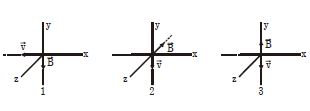
- 5The figure shows three situations when an electron with velocity $\vec v$ travels through a nuniform magnetic field $\vec B$ . In each case, what is the direction of magnetic force on the electron?View Solution
- 6A long solenoid is formed by winding $70$ turns $cm ^{-1}$. If $2.0\,A$ current flows, then the magnetic field produced inside the solenoid is $.......\times 10^{-4}\,T$ $\left(\mu_0=4 \pi \times 10^{-7}\,TmA ^{-1}\right)$View Solution
- 7A charge particle of $2\,\mu\,C$ accelerated by a potential difference of $100\,V$ enters a region of uniform magnetic field of magnitude $4\,m\,T$ at right angle to the direction of field. The charge particle completes semicircle of radius $3\,cm$ inside magnetic field. The mass of the charge particle is $........\times 10^{-18}\,kg$.View Solution
- 8An element $d l=d x \hat{l}$ (where, $d x=1\, cm$ ) is placed at the origin and carries a large current $i=10 A$. What is the magnetic field on the $Y$ -axis at a distance of $0.5\, m$ ?View Solution
- 9A charge $q$ is released in presence of electric $(E)$ and magnetic field $(B)$ then after some time its velocity is $v$ thenView Solution
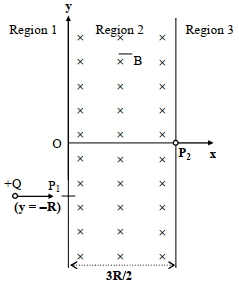
- 10A uniform magnetic field $B$ exists in the region between $x=0$ and $x=\frac{3 R}{2}$ (region $2$ in the figure) pointing normally into the plane of the paper. A particle with charge $+Q$ and momentum $p$ directed along $x$-axis enters region $2$ from region $1$ at point $P_1(y=-R)$. Which of the following option(s) is/are correct?View Solution
$[A$ For $B>\frac{2}{3} \frac{p}{QR}$, the particle will re-enter region $1$
$[B]$ For $B=\frac{8}{13} \frac{\mathrm{p}}{QR}$, the particle will enter region $3$ through the point $P_2$ on $\mathrm{x}$-axis
$[C]$ When the particle re-enters region 1 through the longest possible path in region $2$ , the magnitude of the change in its linear momentum between point $P_1$ and the farthest point from $y$-axis is $p / \sqrt{2}$
$[D]$ For a fixed $B$, particles of same charge $Q$ and same velocity $v$, the distance between the point $P_1$ and the point of re-entry into region $1$ is inversely proportional to the mass of the particle