Under what circumstances did Mahatma Gandhi start the Quit India Movement? What were its consequences?
Download our app for free and get started
After the failure of 'Cripps Mission' and during the middle of the Second World War, Mahatma Gandhi decided to start another phase of movement, i.e., Quit India Movement. In this, he asked the British to leave the country immediately.
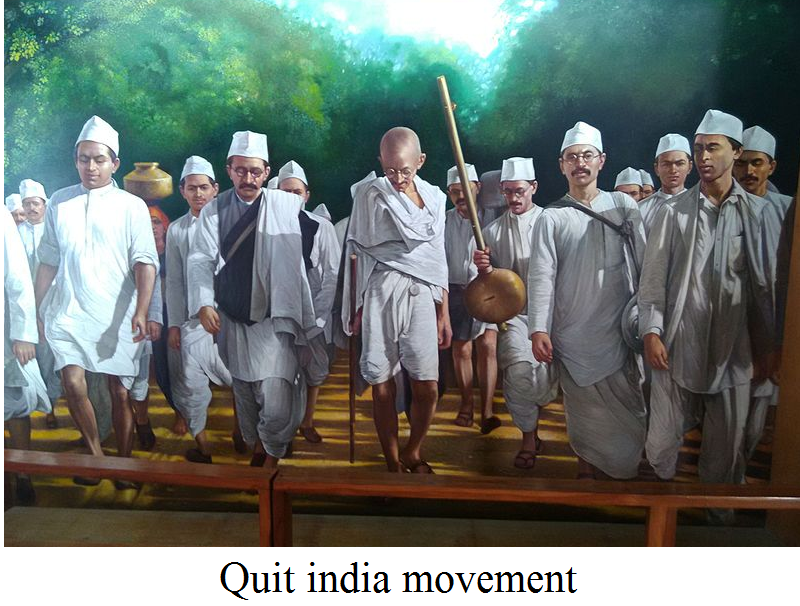
In Vardha on 14 July 1942, the session of Indian National Congress presented the historical Quit India' resolution, which was passed at the Bombay Session of the Congress on 8 August, 1942. Gandhiji thought that the British must Quit India without further delay. He raised the slogan 'Do or Die' which spread among the common mass very soon. But he warned the people not to be violent in any condition. The movement spread on larger scale. Workers went on strike, students, peasants, labourers and women joined the movement with full enthusiasm. Several leaders like Jaya Prakash Narayan, Ram Manohar Lohia, Aruna Asaf Ali, Matangini Hajra (from Bengal), Karkalta Barua (from Assam) and Rama Devi (from Orissa) participated actively in it.
Initially, the British responded with severe repression. All the major leaders were sent to jail. Thousands of people were killed in police firing. At the end, the government suppressed the movement, but the sheer scale of movement brought the British government down to its knees.
In Vardha on 14 July 1942, the session of Indian National Congress presented the historical Quit India' resolution, which was passed at the Bombay Session of the Congress on 8 August, 1942. Gandhiji thought that the British must Quit India without further delay. He raised the slogan 'Do or Die' which spread among the common mass very soon. But he warned the people not to be violent in any condition. The movement spread on larger scale. Workers went on strike, students, peasants, labourers and women joined the movement with full enthusiasm. Several leaders like Jaya Prakash Narayan, Ram Manohar Lohia, Aruna Asaf Ali, Matangini Hajra (from Bengal), Karkalta Barua (from Assam) and Rama Devi (from Orissa) participated actively in it.
Initially, the British responded with severe repression. All the major leaders were sent to jail. Thousands of people were killed in police firing. At the end, the government suppressed the movement, but the sheer scale of movement brought the British government down to its knees.

Download our appand get started for free
Experience the future of education. Simply download our apps or reach out to us for more information. Let's shape the future of learning together!No signup needed.*
Similar Questions
- 1View SolutionWhy did Gandhiji decide to withdraw the ‘Non-Cooperation Movement’ in February, 1922? Explain any three reasons.
- 2View SolutionWhich were the two types of demands mentioned by Gandhiji in his letter to Viceroy Irwin on 31st January, 1930? Why was abolition of ‘Salt tax’ most stirring demand?
- 3View SolutionWhat is Hindu Mahasabha?
- 4View SolutionStudy the given passage and answer the questions that follow:-The Independence Day Pledge, 26 January 1930.
‘We believe that it is the inalienable right of the Indian people, as of any other people, to have freedom and to enjoy the fruits of their toil and have the necessities of life, so that they may have full opportunities of growth. We believe also that if any government deprives a people of these rights and oppresses them, the people have a further right to alter it or to abolish it. The British Government in India has not only deprived the Indian people of their freedom but has based itself on the exploitation of the masses, and has ruined India economically, politically, culturally and spiritually. We believe, therefore, that India must sever the British connection and attain Puma Swaraj or Complete Independence.’- Why was it the inalienable right of the Indian people to have freedom?
- How did British Government exploit the Indian masses? Explain.
- 5View SolutionUnder what circumstances did Gandhijire-launch the Civil Disobedience Movement?
- 6View SolutionWhy did the tribal peasant participate in the Non-Cooperation Movement?
- 7View SolutionExplain the Khilafat Movement.
- 8View SolutionDescribe the portrait of Bharat Mata and also its different image forms.
- 9View Solution“Ideas of nationalism also developed through a movement to revive Indian folklore.” Elaborate.
- 10View SolutionExplain the circumstances under which Gandhiji decided Toca loff the Civil Disobedience Movement in 1931.