MCQ
Unit of energy is
  • A
    $J/\sec $
  • $Watt - day$
  • C
    $Kilowatt$
  • D
    $gm{\rm{ - }}cm/{\sec ^2}$

Answer

Correct option: B.
$Watt - day$
b
(b)

Need a full question paper?

Generate a complete, print-ready paper with questions like this in minutes — across 16+ boards, with answer keys.
Start Generating Free

Similar questions

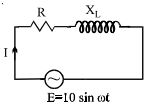
An ac-circuit having supply voltage $E$ consists of a resistor of resistance $3\Omega$ and an inductor of reactance $4\Omega$ as shown in the figure. The voltage across the inductor at $t = \pi /\omega$ is.......$volts$
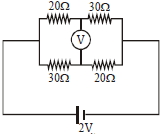
The reading of an ideal voltmer in the circuit shown is.....$V$
A uniform wire of length $l$ and radius $r$ has a resistance of $100\, \Omega $. It is recast into a wire of radius $\frac{r}{2}$. The resistance of new wire will be ............... $\Omega$
Mark the wrong statement :-
Two metallic spheres each of mass $M$ are suspended by two strings each of length $L$ . The distance between the upper ends of strings is $L$ . The angle which the strings will make with the vertical due to mutual attraction of the spheres is
A rectangular loop of sides $12 \mathrm{~cm}$ and $5 \mathrm{~cm}$, with its sides parallel to the $x$-axis and $y$-axis respectively moves with a velocity of $5 \mathrm{~cm} / \mathrm{s}$ in the positive $\mathrm{x}$ axis direction, in a space containing a variable magnetic field in the positive $z$ direction. The field has a gradient of $10^{-3} \mathrm{~T} / \mathrm{cm}$ along the negative $\mathrm{x}$ direction and it is decreasing with time at the rate of $10^{-5} \mathrm{~T} / \mathrm{s}$. If the resistance of the loop is $6 \mathrm{~m} \Omega$, the power dissipated by the loop as heat is______ $\times 10^{-9} \mathrm{~W}$.
Two identical particles of mass $m$ and charge $q$ are shot at each other from a very great distance with an initial speed $v$. The distance of closest approach of these charges is
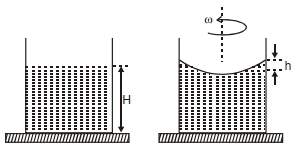
A beaker of radius $r$ is filled with water (refractive index $\frac{4}{3}$ ) up to a height $H$ as shown in the figure on the left. The beaker is kept on a horizontal table rotating with angular speed $\omega$. This makes the water surface curved so that the difference in the height of water level at the center and at the circumference of the beaker is $h(h \ll H, h \ll r)$, as shown in the figure on the right. Take this surface to be approximately spherical with a radius of curvature $R$. Which of the following is/are correct? ( $g$ is the acceleration due to gravity)

$(A)$ $R=\frac{h^2+r^2}{2 h}$

$(B)$ $R=\frac{3 r^2}{2 h}$

$(C)$ Apparent depth of the bottom of the beaker is close to $\frac{3 H }{2}\left(1+\frac{\omega^2 H }{2 g }\right)^{-1}$

$(D)$ Apparent depth of the bottom of the beaker is close to $\frac{3 H }{4}\left(1+\frac{\omega^2 H}{4 g }\right)^{-1}$
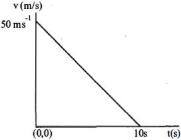
Velocity-time graph for a body of mass $10\, kg$ is shown in figure. Work-done on the body in first two seconds of the motion is  ................ $\mathrm{J}$
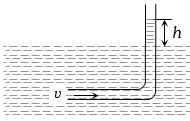
An $ L-$ shaped glass tube is just immersed in flowing water such that its opening is pointing against flowing water. If the speed of water current is $v$, then