MCQ
Unit of Faraday is
  • A
    Ampere
  • B
    Coulomb
  • Coulomb $mol{e^{ - 1}}$
  • D
    Coulomb ${{\mathop{\rm Sec}\nolimits} ^{ - 1}}$

Answer

Correct option: C.
Coulomb $mol{e^{ - 1}}$
c
In the International System of Units ( $SI$ ), the coulomb ($C$) is the preferred unit of electric charge quantity. It is equivalent to one ampere-second ($1\,A.s$) and represents approximately $6.24 \times 10^{18}$ electric charge carriers. To convert from coulombs to faradays, multiply by $1.04 \times 10^{-5}$.

Need a full question paper?

Generate a complete, print-ready paper with questions like this in minutes — across 16+ boards, with answer keys.

Start Generating Free

Similar questions

Which of the following is not present in nucleotide ?
Which statement about the composition of vapour over an ideal $1 : 1$ molar mixture of benzene and toluene is correct ? Assume the temperature is constant at $25\,^oC$. Vapour pressure data $(25\,^oC)$
Benzene                       $75\, mm\, Hg$
Toluene                         $22\, mm\, Hg$
The compound showing highest basic strength in aqueous solution is :
If $1$ molal solution of benzoic acid in benzene has a freezing point depression of $2.56\,^oC$.
$(K_f = 5.12\,^oC\,mol^{-1}\, kg)$ and boiling point elevation of $2.53\,^oC$ $(K_b = 2.53\,^oC\,mol^{-1}\,kg)$, then select the correct statement/s :
Statement $I :$ there is dimer formation when undergoing freezing.

Statement $II :$ there is no change when undergoing boiling

Statement $III :$ reverse of $I$ and $II$

Statement $IV :$ dimer formation in freezing and boiling state
Alcohol which gives red colour with Victor Meyer test is
Assertion : Aniline is better nucleophile than anilium ion. 
Reason : Anilium ion have $+ve$ charge.
Rate constant $K = 2.303\, min^{-1}$ for a particular reaction the initial concentration of the reactant is $1\, mol/litre$ then rate of reaction after $1\, minute$ is
The sum of oxidation states of two silver ions in $\left[\mathrm{Ag}\left(\mathrm{NH}_{3}\right)_{2}\right]\left[\mathrm{Ag}(\mathrm{CN})_{2}\right]$ complex is .... .
The sequence of ionic mobility in aqueous solutions is
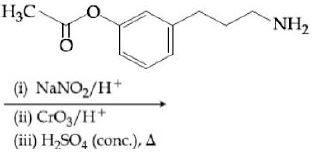
The major product of the following reaction is