Question
Unless the vector and source DNAs are cut, fragments separated and joined, the desired recombinant vector molecules cannot be created.
  1. How are the desired DNA sequences cut?
  2. Explain the technique used to separate the cut fragments.
  3. How are the resultant fragments joined to the vector molecule?

Answer

  1.  
  • The purified DNA molecule containing the desired gene is incubated with the specific restriction endonuclease, at optimal conditions of pH, temperature, etc. of that enzyme.
  • Similarly, the vector DNA is also incubated with the same restriction endonuclease under optimal conditions.
  • This results into cutting of the DNA into fragments.
  1.  
  • Gel electrophoresis is used to separate the DNA fragments produced by restriction digestion.
  • The DNA fragments resolve according to their sizes, through the sieving effect provided bythe agarose gel.
  1. The resultant fragments are joined to the vector by use of DNA-ligases.

Need a full question paper?

Generate a complete, print-ready paper with questions like this in minutes — across 16+ boards, with answer keys.

Start Generating Free

Similar questions

Observe the representation of genes involved in the lac operon given below:

  1. Identify the region where the repressor protein will attach normally.
  2. Under certain conditions repressor is unable to attach at this site. Explain.
  3. If repressor fails to attach to the said site what products will be formed by z, y and a?
  4. Analyse why this kind of regulation is called negative regulation.
(a) Draw the diagram of human sperm and label the cellular component. Also mention the functions of three components.
(b) Where does the head of sperm remain embedded in spermatogenesis.
Explain co–dominance taking an example of human blood groups in the population.
The following table shows certain diseases, their causative organisms and symptoms. Fill the gaps.
  Name of the Disease Causative organism Symptoms
i. Ascariasis Ascaris ________
ii. ________ Trichophyton Appearance of dry, scaly lesions on various parts of the body.
iii. Typhoid ________ High fever, weakness, headache, stomach pain, constipation.
iv. Pneumonia Streptococcus pneumoniae ________
v. ________ Rhino viruses Nasal congestion and discharge, sorethroat, cough, headache.
vi. Filariasis ________ Inflammation in lower limbs.
List the harmful effects of alcohol abuse.
Compare and contrast the advantages and disadvantages of production of genetically modified crops.
Answer the following questions:
Why is follicular phase in the menstrual cycle also referred as proliferative phase? Explain.
Justify the following statement in terms of ecosystem dynamics. “Nature tends to increase the gross primary productivity, while man tends to increase the net primary productivity”.
Answer the following questions:

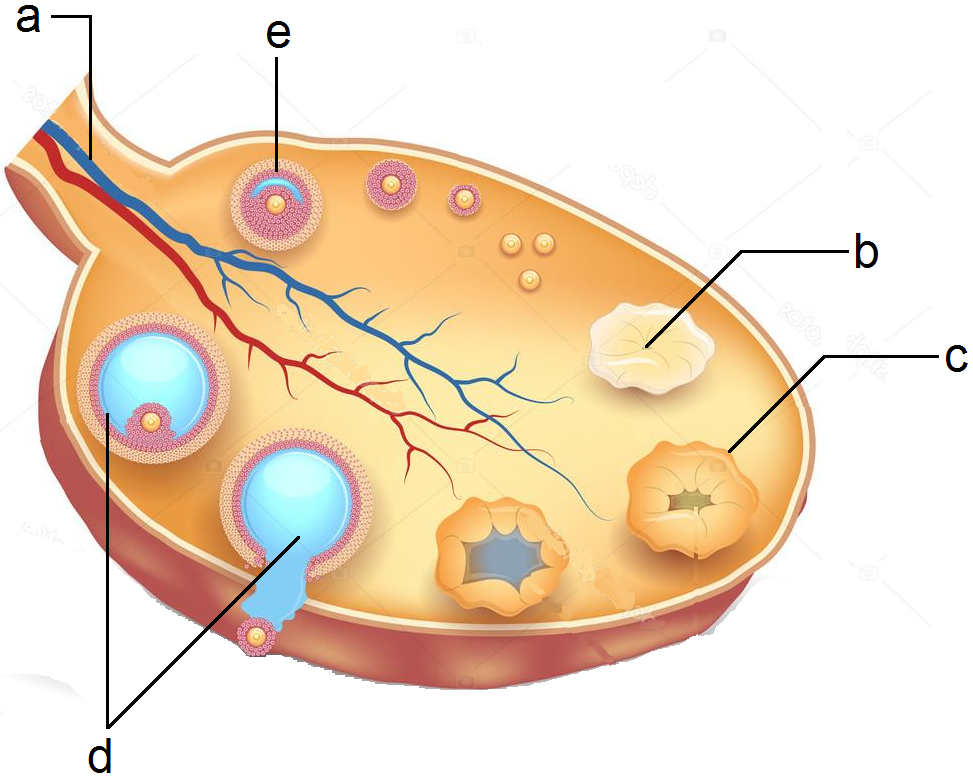
Given below is the T.S. of human ovary. Identify the following in the diagram:

  1. Corpus luteum.
  2. Secondary oocyte.
  3. Antrum.
  4. Primary follicle.
  5. Blood vessels.
Describe the difference between the structures of a dicot embryo and monocot embryo. Also draw LS of monocot and dicot seeds.