Question types

Biotechnology: Principles and Processes question types

599 questions across 8 question groups — pick any mix to generate a BIOLOGY paper with step-by-step answer keys.

599
Questions
8
Question groups
5
Question types
Sample Questions

Biotechnology: Principles and Processes questions

One sample from each question group in this chapter. Select any group above to see the full set with answer keys.

Q 1M.C.Q [1M]1 Mark
Gel electrophoresis is used in
  • A
    Cutting DNA fragments
  • Separating DNA fragments
  • C
    Joining DNA fragments
  • D
    Cutting RNA frogments

Answer: B.

View full solution
Q 2M.C.Q [1M]1 Mark
A bioreactor is a _______:
  • A
    Fermentation tank
  • B
    Culture containing radioactive isotopes
  • C
    Culture for synthesis of new chemicals
  • D
    Hybridoma
View full solution
Q 3M.C.Q [1M]1 Mark
Which of the given statement is correct in the context of observing DNA separated by agarose gel electrophoresis?
  • A
    DNA can be seen in visible light.
  • B
    DNA can be seen without staining in visible light.
  • C
    Ethidium bromide stained DNA can be seen in visible light.
  • D
    Ethidium bromide stained DNA can be seen under exposure to UV light.
View full solution
Q 4M.C.Q [1M]1 Mark
Selective markers in plasmids are used to:
  • A
    Identify cancer cellsI
  • B
    dentify antibiotics
  • C
    Identify recombinants from non recombinants
  • D
    None of these
View full solution
Q 5M.C.Q [1M]1 Mark
Which of the following has revolutionized the discipline of biotechnology ___________________:
  • A
    Restriction endonucleases
  • B
    Discovery of DNA structure
  • C
    Recombinant DNA
  • D
    All of the above
View full solution
Two statements are given-one labelled Assertion and the other labelled Reason. Select the correct answer to these questions from the codes (a), (b), (c) and (d) as given below.
  1. Both assertion and reason are true and reason is the correct explanation of assertion.
  2. Both assertion and reason are true but reason is not the correct explanation of assertion.
  3. Assertion is true but reason is false.
  4. Both assertion and reason are false.
Assertion: Restriction endonuclease recognises palindromic sequence in DNA and cuts them.
Reason: Palindromic sequence has two unique recognition sites Pst I and Pvu I recognised by restriction endonuclease.
View full solution
Directions: In the following questions, the Assertions (A) and Reason(s) (R) have been put forward. Read both the statements carefully and choose the correct alternative from the following:
Assertion: Recognition site should be preferably single and responsive to commonly used restriction enzyme.
Reason: In pBR 322 alien DNA is ligated generally in the area of Bam - HI site of tetracycline resistance gene.
  1. If both the assertion and the reason are true and the reason is a correct explanation of the assertion.
  2. If both the assertion and reason are true but the reason is not a correct explanation of the assertion.
  3. If the assertion is true but the reason is false.
  4. If both the assertion and reason are false.
  5. If the assertion is false but reason is true.
View full solution
Two statements are given-one labelled Assertion and the other labelled Reason. Select the correct answer to these questions from the codes (a), (b), (c) and (d) as given below.
  1. Both assertion and reason are true and reason is the correct explanation of assertion.
  2. Both assertion and reason are true but reason is not the correct explanation of assertion.
  3. Assertion is true but reason is false.
  4. Both assertion and reason are false.
Assertion: Both the passenger and vehicle DNAs are treated separately with separate restriction endonuclease.
Reason: Ligation is done by the use of alkaline phosphatase and DNA ligase.
View full solution
Two statements are given-one labelled Assertion and the other labelled Reason. Select the correct answer to these questions from the codes (a), (b), (c) and (d) as given below.
  1. Both assertion and reason are true and reason is the correct explanation of assertion.
  2. Both assertion and reason are true but reason is not the correct explanation of assertion.
  3. Assertion is true but reason is false.
  4. Both assertion and reason are false.
Assertion: Type I restriction endonucleases are not used in recombinant DNA technology.
Reason: Type I restriction endonucleases recognise specific sites within the DNA but do not cut these sites.
View full solution
Two statements are given-one labelled Assertion and the other labelled Reason. Select the correct answer to these questions from the codes (a), (b), (c) and (d) as given below.
  1. Both assertion and reason are true and reason is the correct explanation of assertion.
  2. Both assertion and reason are true but reason is not the correct explanation of assertion.
  3. Assertion is true but reason is false.
  4. Both assertion and reason are false.
Assertion: Soil inhabiting bacterium Agrobacterium tumefaciens is called a natural plant genetic engineer.
Reason: Agrobacterium tumefaciens produce crown galls in several dicot plants.
View full solution
Q 233 Marks Question3 Marks
Can you think and answer how a reporter enzyme can be used to monitor transformation of host cells by foreign DNA in addition to a selectable marker?
View full solution
Q 243 Marks Question3 Marks
  1. Explain the significance of 'palindromic nucleotide sequence' in the formation of recombinant DNA.
  2. Write the use of restriction endonuclease in the above process.
View full solution
Q 263 Marks Question3 Marks
  1. Name the selectable markers in the cloning vector pBR322? Mention the role they play.
  2. Why is the coding sequence of an enzyme (â-galactosidase) a preferred selectable marker in comparison to the ones named above?
View full solution
If a desired gene is identified in an organism for some experiments, explain the process of the following:
  1. Cutting this desired gene at specific location.
  2. Synthesis of multiple copies of this desired gene.
View full solution
  1. Describe the characteristics a cloning vector must possess.
  2. Why DNA cannot pass through the cell membrane? Explain. How is a bacterial cell made ‘competent’ to take up recombinant DNA from the medium?
View full solution
Give the technical terms for the following:
  1. Molecular Scissors.
  2. Molecular Sieve.
  3. Molecular Glue.
  4. Autonomous replicating circular DNA.
  5. First isolated restriction endonuclease.
  6. Extraction of DNA fragments from gel.
View full solution
Read the following and answer any four questions from (i) to (v) given below:
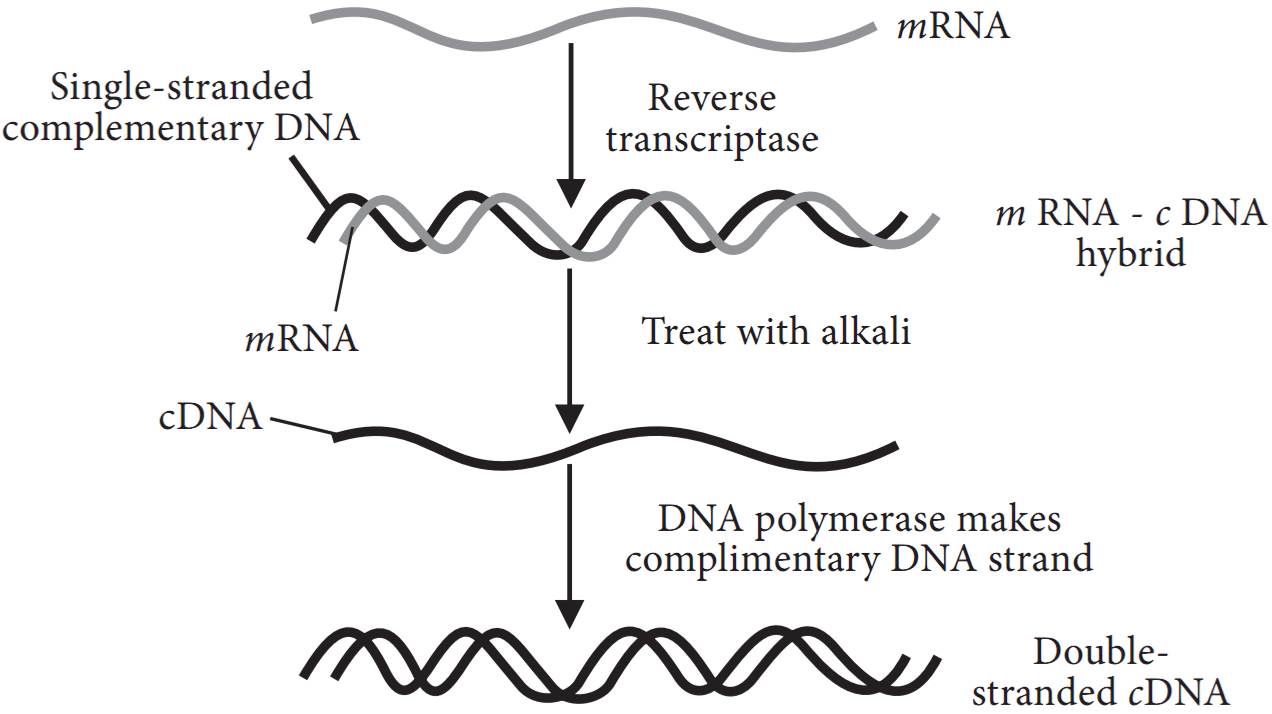
The DNA, which is transferred from one organism into another by joining it with the vehicle DNA is called passenger or foreign DNA. Generally three types of passenger DNAs are used. These are complementary DNA (cDNA), synthetic DNA (sDNA) and random DNA. Complementary DNA (cDNA) is synthesized on RNA template (usually mRNA) with the help of reverse transcriptase. Synthetic DNA (sDNA) is synthesized on DNA template or without a template. Random DNA are small fragments fanned by breaking a chromosome of an organism in the presence of restriction endonucleases.

  1. Reverse transcriptase enzyme was discovered by:
  1. Temin and Baltimore.
  2. Cohen and Boyer.
  3. Arber and Nathan.
  4. Paul Berg.
  1. During cDNA formation, what would happen if DNA formed by reverse transcriptase is not treated with the alkali?
  1. cDNA will not be digested.
  2. mRNA will not be digested.
  3. Hydrogen bonds will not form between base pairs.
  4. rnRNA will not be formed.
  1. Enzyme that helps in the formation of double stranded cDNA is:
  1. DNA synthetase
  2. Ligase
  3. DNA polymerase
  4. Helicase.
  1. DNA polymerase can be obtained form:
  1. Retrovirus.
  2. Agrobacteriurn.
  3. Tobacco mosaic virus.
  4. Thermus aquaticus.
  1. DNA synthesised without a template is referred to as:
  1. Complementary DNA.
  2. Random DNA.
  3. Synthetic DNA.
  4. Z-DNA..
View full solution
Read the following and answer any four questions from (i) to (v) given below:

Gene manipulation is a fast emerging science. It started with development of recombinant DNA molecule. It is named variously as DNA manipulation biotechnology, recombinant DNA technology and genetic engineering. This technology, that mostly involves cutting and pasting of desired DNA fragments, is based on two important discoveries in bacteria, i.e., presence of plasmid in bacteria and restriction endonucleases. Paul Berg was able to introduce a gene ofSV-40 into a bacterium. The science of recombinant DNA technology took birth when Cohen and Boyer (1973) were able to introduce a piece of gene containing foreign DNA into plasmid of E.coli.

  1. Biotechnology is also known as:
  1. DNA manipulation biotechnology.
  2. Recombinant DNA technology.
  3. Genetic engineering.
  4. All of these.
  1. A bacterial plasmid is a/ an,
  1. Extra chromosomal material that do not replicate.
  2. Extra chromosomal material that undergo replication with or without chromosomal DNA.
  3. Tubular structures that help in conjugation.
  4. Bristle like solid structure that help in adhesion.
  1.  Father of genetic engineering is:
  1. Paul Berg.
  2. Arber.
  3. Nathan.
  4. Smith.
  1. Which of the following is used by Paul Berg to introduce a gene of SV-40 in a bacterium?
  1. E. coli.
  2. cos-plasmids.
  3. Lambda phage.
  4. None of these.
  1.  Read the given statements and select the correct option.

Assertion: Biotechnology started with the development of recombinant DNA molecule.

Reason: Biotechnology mostly involves cutting and pasting of desired DNA fragments.

  1. Both assertion and reason are true and reason is the correct explanation of assertion.
  2. Both assertion and reason are true but reason is not the correct explanation of assertion.
  3. Assertion is true but reason is false.
  4. Both assertion and reason are false.
View full solution
Read the following and answer any four questions from (i) to (v) given below:
The foundations of recombinant DNA (rDNA) were laid by the discovery of restriction enzymes. These enzymes are present in many bacterias where they function as a part of their defense mechanism called the Restriction Modification system (RM system). Molecular basis of this system was explained first by Werner Arber in 1962. The Restriction Modification system consists of two components:
  • A restriction enzyme (called restriction endonuclease) identifies the introduced foreign DNA and cuts it into pieces.
  • The second component is a modification enzyme (methylase) that adds a methyl group to DNA at specific site to protect it from the restriction enzyme cleavage.
  1. Restriction endonucleases are enzymes present in ________ where they function as a part of _______ mechanism.
  1. (i) bacteria (ii) digestive
  2. (i) protists (ii) transcription
  3. (i) plant cells (ii) replication
  4. (i) prokaryotes (ii) defence
  1. Which of the following statements regarding modification enzyme is correct?
  1. It adds methyl group to one or two bases usually within the host DNA sequence to protect it from the restriction enzyme.
  2. It adds ethyl group to one or two bases usually within the sequence recognised by the restriction enzymes.
  3. It adds methyl group to only one of bases within the foreign DNA sequence that is recognised by the restriction enzymes.
  4. None of these.
  1. Which of the following is a type II restriction enzyme?
  1. Alu I
  2. EcoR I
  3. BamH I
  4. All of these.
  1. Which of the following is the first discovered restriction endonuclease?
  1. Sal I
  2. EcoR I
  3. Hind II
  4. EcoR II
  1. Components of Restriction Modification System include?
  1. Restriction enzyme.
  2. Modification enzyme.
  3. Lysing enzyme.
  4. Both (a) and (b).
View full solution
Read the following and answer any four questions from 9(i) to 9(v) given below:

Bioreactors are considered as vessels in which raw materials are biologically converted into specific products by microbes, plant and animal cells or their enzymes. They are used for large scale production as they provide optimum growth conditions such as temperature, pH, substrate, vitamins, oxygen and salts for obtaining desired product. Most commonly used bioreactors are of stirring type which include simple stirred tank bioreactor and sparged stirred-tank bioreactor.

  1. Bioreactor are useful in:
  1. Amplifying a gene.
  2. Isolation of genetic material.
  3. Processing large volume of culture.
  4. Infecting DNA in a cell.
  1. Which of the following is essential to obtain desired product in a bioreactor?
  1. Size of the bioreactor.
  2. Sterile condition.
  3. Quantity of the raw material.
  4. All of these.
  1. Assertion: The stirred-tank is well suited for large scale production of microorganisms under aseptic conditions.

Reason: In sparged stirred tank bioreactor, surface area for oxygen transfer is increased.

  1. Both assertion and reason are true and reason is the correct explanation of assertion.
  2. Both assertion and reason are true but reason is not the correct explanation of assertion.
  3. Assertion is true but reason is false.
  4. Both assertion and reason are false.
  1. Growth condition that could affect the quality of obtained product in a bioreactor are:
  1. Temperature and pH only.
  2. pH and oxygen supply only.
  3. Temperature and oxygen supply only.
  4. Temperature, pH and oxygen supply.
  1. Vessels in which raw materials are biologically converted into specific products are.
  1. Bioreactors.
  2. Fermentors.
  3. Gene guns.
  4. Both (a) and (b).
View full solution
Read the following and answer any four questions from 2(i) to 2(v) given below:

Restriction endonuclease was isolated for the first ti me by W. Arb er in 1962 in bacteria. Restriction endonucleases cut the DNA duplex at specific points therefore they are also called as molecular scissors or biological scissors. Three types of restriction endonucleases are Type I, Type II and Type III but only Type II restriction endonucleases are used in recombinant DNA technology. Restriction endonuclease EcoR I recognises the base sequence GAATTC in DNA duplex and cut strands between G and A.

  1. Only type II restriction enzymes are used in gene manipulation because
  1. ATP is not required for cleaving.
  2. It consists of three different subunits.
  3. It makes cleavage or cut in both the strands of DNA molecule.
  4. Both (a) and (c).
  1. Which of the following ions are used by restriction endonucleases for restriction?
  1. Mg2+ ions
  2. Mn2+ ions
  3. Na2+ ions
  4. K2+ ions
  1.  Restriction endonuclease was isolated for the first time in a:
  1. Plant cell.
  2. Animal cell.
  3. Prokaryotic cell.
  4. Genninal cell.
  1. Restriction endonucleases are also called as molecular or biological scissors because,
  1. They cleave base pairs of DNA only at their terminal ends.
  2. They cleave one or both the strands of DNA.
  3. They act only on single stranded DNA.
  4. None of these.
  1. Select the option that correctly states the working action of restriction endonuclease EcoR I on DNA sequence GAATTC
  1. $\ \ \ \ \ \ \ \ \ \ \ \ \downarrow\\5'-\text{GAATTC}-3'\\3'-\text{CTTAAG}-5'\\\ \ \ \ \ \ \ \ \ \ \ \ \ \ \ \ \ \ \uparrow$

  2. $ \ \ \ \ \ \ \ \ \ \ \downarrow\\5'-\text{GAATTC}-3'\\3'-\text{CTTAAG}-5'\\\ \ \ \ \ \ \ \ \ \ \ \ \ \ \ \ \ \ \ \ \uparrow$

  3. $\ \ \ \ \ \ \ \ \ \ \ \ \ \ \ \ \ \ \ \ \ \downarrow\\5'-\text{GAATTC}-3'\\3'-\text{CTTAAG}-5'\\\ \ \ \ \ \ \ \ \ \uparrow$

  4. $\ \ \ \ \ \ \ \ \ \ \ \ \ \ \ \downarrow\\5'-\text{GAATTC}-3'\\3'-\text{CTTAAG}-5'\\\ \ \ \ \ \ \ \ \ \ \ \ \ \ \uparrow$

View full solution

Generate a Biotechnology: Principles and Processes paper free

Pick question groups from the list above, set marks and difficulty, and export a branded PDF with step-by-step answer keys. First 3 chapters free — no signup.

Download App