Question
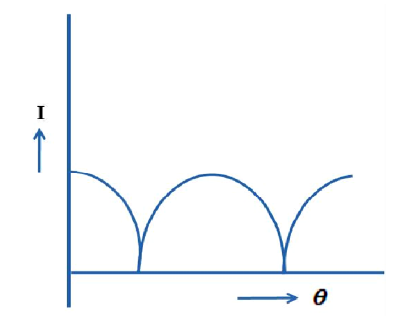
Unpolarised light is passed through a polaroid $P_1$. When this polarised beam passes through another polaroid $P_2$ and if the pass axis of $\mathrm{P}_2$ makes angle $\theta$ with the pass axis of $\mathrm{P}_1$, then write the expression for the polarised beam passing through $\mathrm{P}_2$. Draw a plot showing the variation of intensity when $\theta$ varies from 0 to $2 \pi$.
Answer


Intensity is $\frac{\text{I}}{2}\text{ }\cos^2\theta$ (if I0 is the intensity of unpolarised light.)
Intensity is ${\text{I}}\text{ }\cos^2\theta$ (if I is the intensity of polarized light.)

Need a full question paper?

Generate a complete, print-ready paper with questions like this in minutes — across 16+ boards, with answer keys.

Start Generating Free

Similar questions

A spherical surface of radius 30cm separates two transparent media A and B with refractive indices 1.33 and 1.48 respectively. The medium A is on the convex side of the surface. Where should a point object be placed in medium A so that the paraxial rays become parallel after refraction at the surface?
Two capacitors of capacitance 6 μF an 12 μF are connected in series with a battery. The voltage across the 6 capacitor is 2 V. Compute the total battery voltage.
Draw a diagram to show the standing pressure wave and standing displacement wave for the 3rd overtone mode of vibration of an open organ pipe.
What physical quantity is the same for Χ-rays of wavelength $10^{-10}m,$ red light of wavelength $6800\mathring{\text{A}}$ and radio waves of wavelength 500m?
The pressure of the gas in a constant volume gas thermometer is 70kPa at the ice point. Find the pressure at the steam point.
Write Snell's law and derive its general equation.
The equation $\omega=\frac{\mu_\text{v}-\mu_\text{r}}{\mu-1}$ asderived for a prism having small refracting angle. Is it also valid for a prism of large refracting angle? Is it also valid for a glass slab or a glass sphere?
What happens to the energy of light waves in interference?
Two cells of emfs 1.5 V and 2.0 V having internal resistances 0.2 $\Omega$ and 0.3 $\Omega$respectively are connected in parallel. Calculate the emf and internal resistance of the equivalent cell.
A silver wire has a resistance of $2.1\ \Omega\ \text{at}\ 27.5^\circ\text{C},$ and a resistance of $2.7\ \Omega\ \text{at}\ 100^\circ\text{C}.$ Determine the temperature coefficient of resistivity of silver.