MCQ
Upto what $pH$ must a solution containing a precipitate of $Cr{(OH)_3}$ be adjusted so that all of precipitate dissolves (When $C{r^{3 + }} = 0.1\,mol/\,l,\,{K_{sp}} = 6 \times {10^{ - 31}})$
- AUpto $4.4$
- BUpto $4.1$
- CUpto $4.2$
- ✓Upto $4.0$
${[OH]^{ - 3}} = {K_{sp/C{r^{3 + }}}} = \frac{{6 \times {{10}^{31}}}}{{1 \times {{10}^{ - 1}}}} = 6 \times {10^{ - 30}}$
${[OH]^ - } = 1.8 \times {10^{ - 10}}$
$pOH = (\log 1.8 + \log {10^{10}})$$ = 10 + 0.25 + 1$$ = 11.25$
$pH = 14 - 11.25$$ = 2.27$
Generate a complete, print-ready paper with questions like this in minutes — across 16+ boards, with answer keys.
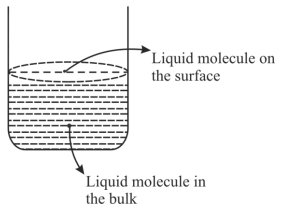
$A.$ Surface tension is the outcome of equal attractive and repulsion forces acting on the liquid molecule in bulk.
$B.$ Surface tension is due to uneven forces acting on the molecules present on the surface.
$C.$ The molecule in the bulk can never come to the liquid surface.
$D.$ The molecules on the surface are responsible for vapour pressure if the system is a closed system.