MCQ
Urea is preferred to ammonium sulphate as a nitrogeneous fertilizer because
  • A
    It is more soluble in water
  • B
    It is cheaper than ammonium sulphate
  • C
    It is quite stable
  • It does not cause acidity in the soil

Answer

Correct option: D.
It does not cause acidity in the soil
d
Urea is preferred to ammonium sulfate soluble in water as a nitrogenous fertilizer because It does not cause acidity in the soil. Also, urea is the best soluble nitrogenous fertilizer as it leaves only carbon dioxide after ammonia has been assimilated by weight. It contains nearly $47 \,\%$ of nitrogen by weight.

Need a full question paper?

Generate a complete, print-ready paper with questions like this in minutes — across 16+ boards, with answer keys.

Start Generating Free

Similar questions

Which of the following is used as an acid bath in dyeing cotton and wool?
When a substance is dissolved in a solvent, the vapour pressure of solvent decreases. It brings
The organic chloro compound, which shows complete sterochemical inversion during a $S_{N^{2}}$ reaction, is
$20 \%$ of acetic acid is dissociated when its $5\,g$ is added to $500\,mL$ of water. The depression in freezing point of such water is $.....\times 10^{-3} \;{ }^{\circ} C$. Atomic mass of $C , H$ and $O$ are $12,1$ and $16\,a.m.u.$ respectively.

[Given : Molal depression constant and density of water are $1.86\, K\, kg\, mol^{-1}$ and $1\, g\, cm^{-3}$ respectively.]
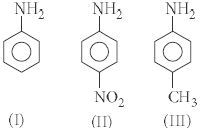
The correct increasing order of basic strength for the following compounds is
Calculate the molecular weight of a substance whose $7.0\%$ by mass solution in water freezes at $-0.93\,^oC$ . The cryoscopic constant of water is $1.86\,^oC\,kg\,molal^{-1}$ ........... $g\,mol^{-1}$.
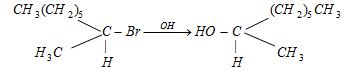
The following reaction is described as
Increasing the concentration of an electrophile in a typical $S_{N^2}$ reaction by  a factor  of $3$ and the concentration of the nucleophile by a factor of $3$ will  change the reaction rate to
Consider following two reaction,

$A \to {\text{Product ;}}\,\, - \frac{{d[A]}}{{dt}} = {k_1}{[A]^o}$

$B \to {\text{Product ;}}\,\, - \frac{{d[B]}}{{dt}} = {k_2}{[B]}$

Units of $k_1$ and $k_2$ are expressed in terms of molarity $(M)$ and time $(sec^{-1})$ as

In the following reaction : $xA \to  yB$ $\log \left[ { - \frac{{d\left[ A \right]}}{{dt}}} \right] = \log \left[ {\frac{{d\left[ B \right]}}{{dt}}} \right] + \log \,2$ where $-ve$ sign indicates rate of disappearance of the reactant. Thus, $x : y$ is