Question
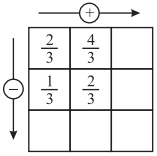
Complete the addition-subtraction box.
Answer

We have,
$\frac{2}{3}+\frac{4}{3}=\frac{2+4}{3}=\frac{6}{3}= 2$
$\frac{1}{3}+\frac{2}{3}=\frac{1+2}{3}=\frac{3}{3}= 1$
$\frac{2}{3}-\frac{1}{3}=\frac{2-1}{3}=\frac{1}{3}$
$\frac{4}{3}-\frac{2}{3}=\frac{4-2}{3}=\frac{2}{3}$
and $\frac{1}{3}+\frac{2}{3}=\frac{3}{3} = 1$
Hence, the above-given number box can be completed as:
$\frac{2}{3}$ $\frac{4}{3}$ $2$
$\frac{1}{3}$ $\frac{2}{3}$ $1$

Need a full question paper?

Generate a complete, print-ready paper with questions like this in minutes — across 16+ boards, with answer keys.
Start Generating Free

Similar questions

Draw wherever possible, a rough sketch of
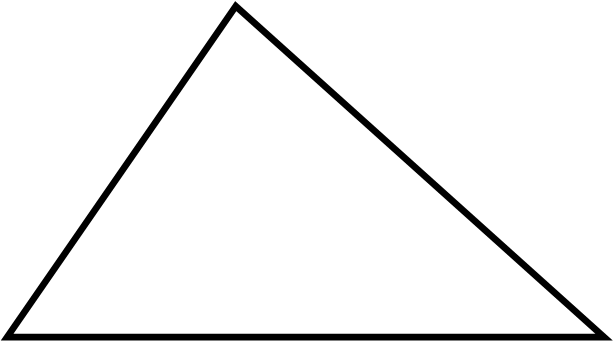
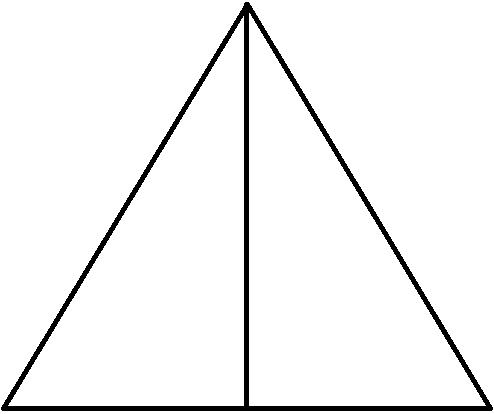
(a) a triangle with atleast two lines of symmetry and atleast two angles of symmetry.
(b) a triangle with only one line of symmetry but not having rotational symmetry.
(c) a quadrilateral with rotational symmetry but no reflection symmetry.
(d) a quadrilateral with reflection symmetry but not having rotational symmetry.
Draw an angle of measure $45^\circ $ and bisect it.
Draw an angle of $80^\circ$ using a protractor and divide it into four equal parts, using ruler and compasses. Check your construction by measurement.
Find the greatest number of five digits exactly divisble by $9, 12, 15, 18$ and $24.$
The circumferences of four wheels are $50\ cm, 60\ cm, 75\ cm$ and $100\ cm$. They start moving simultaneously. what least distance should they cover so that each wheel makes a complete number of revolutions?
Draw a line $l.$ Take a point $A,$ not lying on $l.$ Draw a line $m$ such that $\text{m}\perp\text{l}$ and passing through $A.$ Using ruler and compasses.
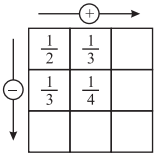
Complete the addition-subtraction box.

Draw any line segment $\overline{\text{PQ}}$. Without measuring $\overline{\text{PQ}}$, construct a copy of $\overline{\text{PQ}}$.
Two sides of a triangle are $12 \ cm$ and $14 \ cm.$ The perimeter of the triangle is $36 \ cm.$ What is the third side$?$
Complete the following table:
No. Shapes Rough figure Number of lines of symmetry
$(i)$ Scalene triangle $0$
$(ii)$ Isosceles triangle $1$
$(iii)$ Equilateral triangle    
$(iv)$ Rectangle    
$(v)$ Square    
$(vi)$ Parallelogram    
$(vii)$ Rhombus    
$(viii)$ Line    
$(ix)$ Line segment    
$(x)$ Angle    
$(xi)$ Isosceles trapezium    
$(xii)$ Kite    
$(xiii)$ Arrow head    
$(xiv)$ Semi-circle    
$(xv)$ Circle    
$(xvi)$ Regular pentagon    
$(xvii)$ Regular pentagon