Question
Use Euclid's division algorithm to find the $HCF$ of:
$184, 230$ and $276$

Answer

Given integers are $184, 230$ and $276$.
Let us first find the $HCF$ of $184$ and $230$ by Euclid lemma.
Clearly, $230 > 184$. So, we will apply Euclid’s division lemma to $230$ and $184.$
$230 = 184 \times 1 + 46$
Remainder is 46 which is a non-zero number. Now, apply Euclid’s division lemma to $184$ and $46.$
$184 = 46 \times 4 + 0$
The remainder at this stage is zero. Therefore, $46$ is the $HCF$ of $230$ and $184.$
Now, again use Euclid’s division lemma to find the $HCF$ of $46$ and $276.$
$276 = 46 \times 6 + 0$
The remainder at this stage is zero.
Therefore, $46$ is the $HCF$ of $184, 230$ and $276.$

Need a full question paper?

Generate a complete, print-ready paper with questions like this in minutes — across 16+ boards, with answer keys.
Start Generating Free

Similar questions

If $A, B, C$ are the interior angles of a $\triangle\text{ABC},$ show that:
$\sin\frac{\text{B+C}}{2}=\cos\frac{\text{A}}{2}$
Prove the following trigonometric identities.
$\frac{(1+\cot^2\theta)\tan\theta}{\sec^2\theta}=\cot\theta$
Write the ratio in which the line segment joining points $(2, 3)$ and $(3, -2)$ is divided by $x-$axis.
Split $207$ into three parts such that these are in $A.P.$ and the product of the two smaller parts is $4623.$
What is the probability that a number selected from the numbers $1, 2, 3, ....., 15$ is a multiple of $4?$
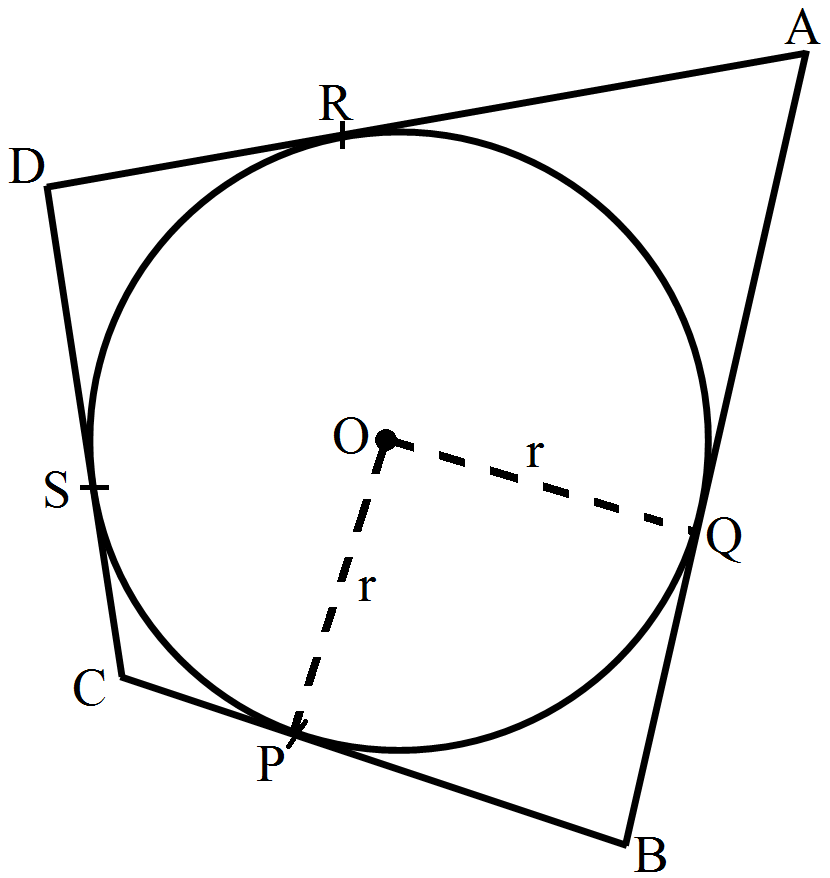
In the given figure, a circle with centre $O$, is inscribed in a quadrilateral $ABCD$ such that it touches the side $BC, AB, AD$ and $CD$ at points $P, Q, R$ and $S$ respectively. If $AB = 29\ cm, AD = 23\ cm$, $\angle\text{B} = 90^\circ$and $DS = 5\ cm$ then find the radius of the circle.
Find the $8^{th}$ term from the end of the $A.P. 7,\ 10, 13,... 184.$
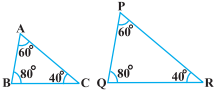
Triangle $ABC$ and $DEF$ are similar.
If $AC = 19\ cm$ and $DF = 8\ cm,$ find the ratio of the area of two triangles.
A solid iron pole consists of a cylinder of height $220\ cm$ and base diameter $24\ cm$ is surmounted by another cylinder of height $60\ cm$ and radius $8\ cm$. Find the mass of the pole, given that $1\ cm^3$ of iron has approximately $8\ g$ mass.
$($Use $\pi = 3.14)$