Question 12 Marks
Check whether $6^n$ can end with the digit $0$ for any natural number $n$.
AnswerIf the number $6^n$ ends with the digit zero, then it is divisibli by $5$.
Therefore the prime factorization of $6^n$ contains the prime $5$.
This is not possible because the only prime in the factorisation of $6^n$ is $2$ and $3$ and the uniqueness of the fundamental theorem of arithmetic guarantees that these are no other prime in the factorisation of $6^n$.
Hence it is very clear that there is no value of $n$ in natural numbers for which $6^n$ ends with the digit zero.
View full question & answer→Question 22 Marks
Without actually performing the long division, state whether state whether the following rational numbers will have a terminating decimal expansion or a non terminating repeating decimal expansion.
$\frac{987}{10500}$
AnswerThe given number is
$\frac{987}{10500}=\frac{987\div21}{10500\div21}=\frac{47}{500}$
Now,$ 500 = 2^2× 5^3$
The denominator can be written in the form of $2^m× 5^n$.
So, the given number has a terminating decimal expansion.
$\frac{987}{10500}=\frac{47}{500}=\frac{47}{5^3\times2^2}\times\frac{2}{2}$ $\frac{94}{5^3\times2^3}=\frac{94}{1000}=0.094$
View full question & answer→Question 32 Marks
Find the $LCM$ and $HCF$ of the following integer by applying the prime factorisation method.
$17, 23$ and $29$
Answer$17 = 1 \times 17$
$23 = 1 \times 23$
$29 = 1 \times 29$
$LCM$ of $17, 23,$ & $29$
$\begin{array}{c|c} 17 & 17-23-29 \\ \hline 23 & 1-23-29\\\hline29 & 1-1-29\\\hline & 1-1-1\end{array}$
So $LCM$ of $17, 23$ & $29$ is $17 \times 23 \times 29$
$= 11339$
From the above, $HCF (17, 23, 29) = 1$ and $LCM (17, 23, 29) = 11339$
View full question & answer→Question 42 Marks
Define $HCF$ of two positive integers and find the $HCF$ of the following pairs of numbers:
$475$ and $495$
AnswerWe need to find $H.C.F.$ of $475$ and $495$.
By applying Euclid’s Division lemma
$495 = 475 \times 1 + 20.$
Since remainder $\neq 0$, apply division lemma on $475$ and remainder $20$.
$475 = 20 \times 23 + 15.$
Since remainder $\neq 0$, apply division lemma on $20$ and remainder $15$.
$20 = 15 \times 1 + 5.$
Since remainder $\neq 0$, apply division lemma on $15$ and remainder $5$.
$15 = 5 \times 3 + 0.$
Therefore, $H.C.F.$ of $475$ and $495 = 5.$
View full question & answer→Question 52 Marks
What is a composite number?
AnswerA composite number is a positive integer which has a divisor other than one or itself.
In other words a composite number is any positive integer greater than one that is not a prime number.
View full question & answer→Question 62 Marks
Without actually performing the long division, state whether state whether the following rational numbers will have a terminating decimal expansion or a non terminating repeating decimal expansion.
$\frac{125}{441}$
AnswerThe given number is $\frac{125}{441}$
Here, $441 = 3^2\times 7^2 441 = 32 \times 72$ and none of $3$ and $7$ is a factor of $125$.
So, the given number is in its simplest form.
Now, $441 = 3^2\times 7^2$ is not of the form $2^m\times 5^n$.
So, the given number has a non-terminating repeating decimal expansion.
View full question & answer→Question 72 Marks
Write down the decimal expansions of the following rational numbers by writing their denominators in the form $2^{\mathrm{m}} \times 5^{\mathrm{n}}$, where, m, n are non-negative integers.
$\frac{14588}{625}$
AnswerThe given number is $\frac{14588}{625}.$
Clearly, $625=5^4$ is of the form $2^{\mathrm{m}} \times 5^{\mathrm{n}}$, where $\mathrm{m}=0$ and $\mathrm{n}=4$.
So, the given number has terminating decimal expansion.
$\therefore\ \frac{14588}{625}=\frac{14588\times2^4}{2^4\times5^4}=\frac{14588\times16}{(2\times5)^4}$ $=\frac{233408}{(10)^4}=\frac{233408}{10000}=23.3408$
View full question & answer→Question 82 Marks
Find the $LCM$ and $HCF$ of the following integer by applying the prime factorisation method.
$8, 9$ and $25$
Answer$ 8=2^3 \times 1 $
$ 9=3^2 \times 1 $
$ 25=5^2 \times 1 $
$LCM$ of $8, 9, 25$
$\begin{array}{c|c} 2 & 8-9-25 \\ \hline 2 & 4-9-25\\\hline2 & 2-9-25\\\hline 3 & 1-9-25\\\hline3 & 1-3-25\\\hline 5 & 1-1-25\\\hline5&1-1-5\\\hline & 1-1-1\end{array}$
So $LCM$ of $8, 9, 25$ is $= 2 \times 2 \times 2 \times 3 \times 3 \times 5 \times 5$
$= 1800$
From the above $HCF\ (8, 9, 25) = 1$ and $LCM\ (8, 9, 25) = 1800.$
View full question & answer→Question 92 Marks
If the prime factorization of a natural number n is $2^3 \times 3^2 \times 5^2 \times 7$, write the number of consecutive zeros in $n$.
AnswerGiven that prime factorization of a natural number is,
$n=2^3 \times 3^2 \times 5^2 \times 7$
$n = 8 × 9 × 25 × 7$
$n = 72 × 175$
$n = 12600$
View full question & answer→Question 102 Marks
Has the rational number $\frac{441}{2^2\times5^7\times7^2}$ terminating or a non terminating decimal representation?
AnswerGiven rational number is $\frac{441}{2^2\times5^7\times7^2}$
The denominator $\left(2^2 \times 5^7 \times 7^2\right)$ of given rational number is not in the from of $\left(2^{\mathrm{m}} \times 5^{\mathrm{n}}\right)$.
So, this is a non-terminating decimal representation.
View full question & answer→Question 112 Marks
Define $HCF$ of two positive integers and find the $HCF$ of the following pairs of numbers:
$18$ and $24$
AnswerWe need to find $H.C.F.$ of $18$ and $24$.
By applying division lemma
$24 = 18 \times 1 + 6$
Since remainder $\neq0$, apply division lemma on divisor $18$ and remainder $6$.
$18 = 6 \times 3 + 0$
Therefore, $H.C.F.$ of $18$ and $24$ is $6$
View full question & answer→Question 122 Marks
Prove that the product of two consecutive positive integers is divisible by $2.$
AnswerLet, $(n - 1)$ and n be two consecutive positive integers
$\therefore$ Their product $= n(n - 1)4$
$=n^2-n$
We know that any positive integer is of the form $2q$ or $2q + 1,$ for some integer $q$
When $n =2q,$ we have
$ n^2-n=(2 q)^2-2 q$
$ =4 q^2-2 q $
$ 2(2 q-1)$
Then $\mathrm{n}^2-\mathrm{n}$ is divisible by $2$ .
When $n=2 q+1$, we have
$ n^2-n=(2 q+1)^2-(2 q+1)$
$ =4 q^2+4 q+1-2 q-1 $
$ =4 q^2+2 q $
$ =2(2 q+1)$
Then $n^2- n$ is divisible by $2.$
Hence the product of two consecutive positive integers is divisible by $2.$
View full question & answer→Question 132 Marks
Without actually performing the long division, state whether state whether the following rational numbers will have a terminating decimal expansion or a non terminating repeating decimal expansion.
$\frac{35}{50}$
Answer$\frac{35}{50}=\frac{7}{10}=\frac{7}{2\times5}$
So, the simplest from of the given rational number $\frac{35}{50}$ is $\frac{7}{10}$ and determination 10 is of the form $(2^m× 5^n)$, where m and n are non-nagative integer.
Thus, $\frac{35}{50}$ has a terminating decimal expansion.
View full question & answer→Question 142 Marks
Without actually performing the long division, state whether state whether the following rational numbers will have a terminating decimal expansion or a non terminating repeating decimal expansion.
$\frac{23}{8}$
Answer$8 = 2^3$
The denominator is of the form $2^m× 5^n$.
Hence, the decimal expansion of $\frac{23}{6}$ is terminating.
View full question & answer→Question 152 Marks
Define $HCF$ of two positive integers and find the $HCF$ of the following pairs of numbers:
$70$ and $30$
AnswerPrime factors of $70$ and $30$ are
$70 = 2 \times 5 \times 7$
$30 = 2 \times 3 \times 5$
$HCF (70, 30) =$ Product of the smallest power of each common prime factor in the number
$= 2 \times 5$
$= 10$
View full question & answer→Question 162 Marks
State Euclid's division lemma.
AnswerEuclid’s Division Lemma:
Let $a$ and $b$ be any two positive integers.
Then, there exist unique integers $q$ and $r$ such that
$a = bq + r, 0 \leq r < b$
If b|a then $r = 0$
Otherwise, r satisfies the stronger inequality $0 < r < b$.
View full question & answer→Question 172 Marks
The $HCF$ to two numbers is $16$ and their product is $3072$. Find their $LCM$.
AnswerGiven: $HCF$ of two numbers is $16$. If product of numbers is $3072$
To Find: $L.C.M$ of numbers
$L.C.M \times H.C.F =$ First Number $\times $ Second Number
$L.C.M \times 16 = 3072$
$L.C.M$ $= \frac{3072}{16}$
$L.C.M = 192$
View full question & answer→Question 182 Marks
What can you say about the prime factorisations of the $43$ of the following rationals:
$43.\overline{123456789}$
AnswerWe have
$43.\overline{123456789}$
$43.\overline{123456789}$ has non-terminating decimal expansion.
So its denominator has factors other than $2$ or $5$.
View full question & answer→Question 192 Marks
Find the least number that is divisible by ail the numbers between $1$ to $10$ (both inclusive).
AnswerThe required least number which is divisible by $1$ to $10$ will be the $L.C.M.$ of $1$ to $10$.
$L.C.M.$ of $1$ to $10.$
$\begin{array}{c|c} 2 & 1,2,3,4,5,6,7,8,9,10 \\ \hline 2 & 1,1,3,2,5,3,7,4,9,5\\ \hline 3 & 1,1,3,1,5,3,7,2,9,5\\ \hline 5 & 1,1,1,1,5,1,7,2,3,6\\ \hline &1,1,1,1,1,1,7,2,3,1 \end{array}$
$= 2 \times 2\times 3 \times 5\times 7 \times 2 \times 3 = 2520$
View full question & answer→Question 202 Marks
Complete the missing entries in the following factor tree.
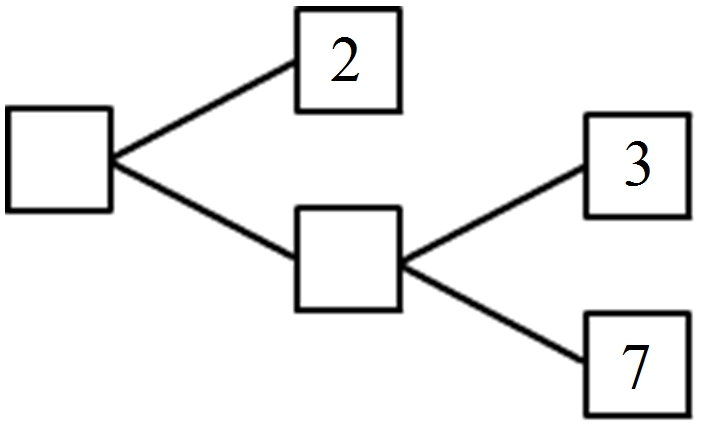
AnswerWe need to fill the values for $a$ and $b$ in the following factor tree:
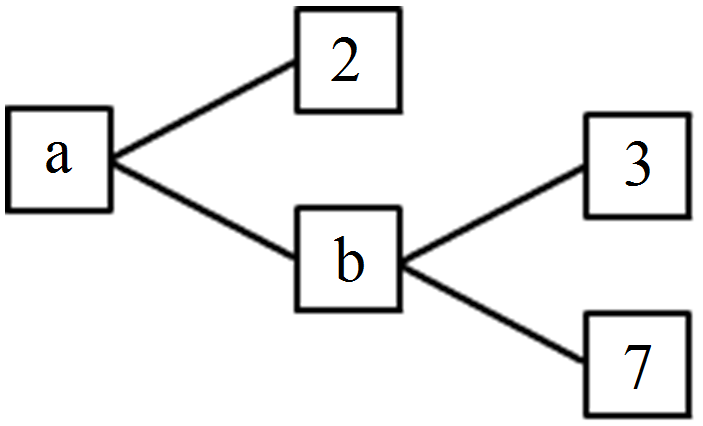
It is clear from the factor tree above that
$b = 3 \times 7$
$b = 21$
Also,
$a = 2 \times b$
$a = 2 \times 21$
$a = 42$
Thus, the missing entries are $21$ and $42$. View full question & answer→Question 212 Marks
Write down the decimal expansions of the following rational numbers by writing their denominators in the form $2^m× 5^n$, where, m, n are non-negative integers.
$\frac{7}{80}$
Answer$\frac{7}{80}=\frac{7}{2^4\times5^1}$
$(\because$ $80 = 16 \times 5 = 2 \times 2 \times 2 \times 2 \times 5 = 24 \times 51)$
{Multiplying and dividing by $5^3$}
$=\frac{875}{10000}=0.0875$
View full question & answer→Question 222 Marks
Without actually performing the long division, state whether state whether the following rational numbers will have a terminating decimal expansion or a non terminating repeating decimal expansion.
$\frac{77}{210}$
AnswerThe given number is $\frac{77}{210}$ and $HCF(77, 210) = 7.$
$\therefore\ \frac{77}{210}=\frac{77\div7}{210\div7}=\frac{11}{30}$
Here, $\frac{11}{30}$ is in its simplest form.
Here, $\frac{77}{210}$ is in its simplest form.
Now, $30 = 2 \times 3 \times 5$ is not of the form $2^m\times 5^n$.
So, the given number has a non-terminating repeating decimal expansion.
View full question & answer→Question 232 Marks
Write down the decimal expansions of the following rational numbers by writing their denominators in the form $2^m× 5^n$, where, m, n are non-negative integers.
$\frac{3}{8}$
AnswerThe given number is $\frac{3}{8}.$
$\frac{3}{8} = \frac{3}{2^{3}} = \frac{3}{2^{3} \times 5^{3}}$
$= \frac{3\times 5^{3}}{2^{3}\times 5^{3}} = \frac{3\times 125}{(10)3} = \frac{375}{1000} = 0.375$
Thus, the decimal expansion of given rational number is $0.375$
View full question & answer→Question 242 Marks
Define $HCF$ of two positive integers and find the $HCF$ of the following pairs of numbers:
$100$ and $190$
AnswerPrime factors of $100$ and $190$ are
$100 = 2 \times 2 \times 5 \times 5 = 2^2\times 5^2$
$190 = 2 \times 5 \times 19 = 2 \times 5 \times 19$
HCF $(100, 190) =$ Product of the smallest power of each common prime factor in the number
$= 2 \times 5$
$= 10$
View full question & answer→Question 252 Marks
The decimal expression of the rational number $\frac{43}{2^4\times5^3}$ will terminate after how many places of decimals.
AnswerThe denominator of $\frac{43}{2^4\times5^3}$ is $2^4× 5^3$ which is in the form of $2^m× 5^n$ where m and n are positive integers $\frac{43}{2^4\times5^3}$ has terminating decimals.
The decimal expansion of $\frac{43}{2^4\times5^3}$ terminates after $4$ (the highest power is $4$) decimal places.
View full question & answer→Question 262 Marks
Write whether $\frac{2\sqrt{45}+3\sqrt{20}}{2\sqrt{5}}$ on simplification gives a rational or an irrational number.
AnswerLet us simplify $\frac{2\sqrt{45}+3\sqrt{20}}{2\sqrt{5}}$
$\frac{2\sqrt{45}+3\sqrt{20}}{2\sqrt{5}}=\frac{6\sqrt{5}+6\sqrt{5}}{2\sqrt{5}}$
$=\frac{12\sqrt{5}}{2\sqrt{5}}$
$=6$
$6$ is rational number.
View full question & answer→Question 272 Marks
Use Euclid's division algorithm to find the $HCF$ of:
$184, 230$ and $276$
AnswerGiven integers are $184, 230$ and $276$.
Let us first find the $HCF$ of $184$ and $230$ by Euclid lemma.
Clearly, $230 > 184$. So, we will apply Euclid’s division lemma to $230$ and $184.$
$230 = 184 \times 1 + 46$
Remainder is 46 which is a non-zero number. Now, apply Euclid’s division lemma to $184$ and $46.$
$184 = 46 \times 4 + 0$
The remainder at this stage is zero. Therefore, $46$ is the $HCF$ of $230$ and $184.$
Now, again use Euclid’s division lemma to find the $HCF$ of $46$ and $276.$
$276 = 46 \times 6 + 0$
The remainder at this stage is zero.
Therefore, $46$ is the $HCF$ of $184, 230$ and $276.$
View full question & answer→Question 282 Marks
What is the smallest number that, when divided by $35, 56$ and $91$ leaves remainders of $7$ in each case?
Answer$L.C.M.$ of $35, 56, 91$
$\begin{array}{c|c} 7 & 35, 56, 91 \\ \hline 2 & 5, 8, 13 \end{array}$
$= 5 \times 7 \times 8 \times 13 = 3640$
Remainder in each case $= 7$
The required smallest number $= 3640 + 7 = 3647$
View full question & answer→Question 292 Marks
Define $HCF$ of two positive integers and find the $HCF$ of the following pairs of numbers:
$56$ and $88$
AnswerBy applying Euclid’s division lemma
$88 = 56 \times 1 + 32$
Since remainder $\neq 0$, apply division lemma on divisor of $56$ and remainder $32$.
$56 = 32 \times 1 + 24$
Since remainder $\neq 0$, apply division lemma on divisor of $32$ and remainder $24$.
$32 = 24 \times 1 + 8$
Since remainder $\neq 0$, apply division lemma on divisor of $24$ and remainder $8$.
$24 = 8 \times 3 + 0$
$\therefore$ $HCF$ of $56$ and $88$ is $= 8$.
View full question & answer→Question 302 Marks
What can you say about the prime factorisations of the $43$ of the following rationals:
$43.123456789$
AnswerWe have
$43.123456789=\frac{43123456789}{1000000000}$
we can write denominator $1000000000$ is in the from of $(2^m× 5^n).$
Hence, $43.123456789$ is terminating decimal, where $m$ and $n$ are non-negative integers.
View full question & answer→Question 312 Marks
Write the condition to be satisfied by $q$ so that a rational number $\frac{\text{p}}{\text{q}}$ has a terminating decimal expansion.
AnswerLet rational number be $n$ which is in the form of $\frac{\text{p}}{\text{q}}.$
The condition for non-terminating decimal expansion is that denominator of $\frac{\text{p}}{\text{q}}$ is $q$ which is not in the form of $(2^m× 5^n)$, where $m, n$ are non-negativ inteagrs.
View full question & answer→Question 322 Marks
Use Euclid's division algorithm to find the $HCF$ of:
$196$ and $38220$
AnswerGiven integers are $38220$ and $196$.
Clearly $38220 > 196$. So we will apply Euclid’s division lemma to $38220$ and $196$, we $38220 = (196)(195) + 0$ get,
The remainder at this stage is $0$. So the divisor at this stage is the $H.C.F.$
So the $H.C.F$ of $38220$ and $196$ is $196$.
View full question & answer→Question 332 Marks
Find the $LCM$ and $HCF$ of the following pairs of integers and verify that $LCM \times HCF =$ Product of the integers:
$510$ and $92$
AnswerTo Find: $L.C.M$ and $H.C.F$ of following pairs of integers
To Verify: $L.C.M \times H.C.F$ = product of the numbers
Let us first find the factors of $510$ and $92$
$510 = 2 \times 3 \times 5 \times 17$
$92 = 2^2\times 23$
$L.C.M$ of $510$, and $92 = 2 \times 2 \times 3 \times 5 \times 17 \times 23 = 23460$
$H.C.F$ of $510$, and$92 = 2$
We know that,
$L.C.M \times H.C.F$ = First number $\times $ Second number
$\Rightarrow 23460 \times 2 = 510 \times 92$
$\Rightarrow 46920 = 46920$
$L.C.M \times H.C.F$ = First number $\times $ Second number
$\Rightarrow 23460 \times 2 = 510 \times 92$
$\Rightarrow 46920 = 46920$
Hence verified.
View full question & answer→Question 342 Marks
Write down the decimal expansions of the following rational numbers by writing their denominators in the form $2^m× 5^n$, where, m, n are non-negative integers.
$\frac{129}{2^2\times5^7}$
AnswerThe given number is $\frac{129}{2^2\times5^2}.$
$\frac{129}{2^2\times5^7}=\frac{125\times2^5}{(2^7\times5^7)}=\frac{129\times32}{(10)^7}$
$=\frac{4128}{10000000}=0.0004128$
Thus, the decimal expansion of $\frac{129}{2^2\times5^7}$ is $0.0004128$
View full question & answer→Question 352 Marks
Define $HCF$ of two positive integers and find the $HCF$ of the following pairs of numbers:
$32$ and $54$
AnswerBy applying Euclid’s division lemma
$54 = 32 \times 1 + 22$
Since remainder $\neq 0$, apply division lemma on division of $32$ and remainder $22$.
$32 = 22 \times 1 + 10$
Since remainder $\neq 0$, apply division lemma on division of $22$ and remainder $10$.
$22 = 10 \times 2 + 2$
Since remainder $\neq 0$, apply division lemma on division of $10$ and remainder $2$.
$10 = 2 \times 5 [$remainder $0]$
Hence, $HCF$ of $32$ and $54$ is $2$
View full question & answer→Question 362 Marks
The $LCM$ and $HCF$ of two numbers are $180$ and $6$ respectively. If one of the numbers is $30$, find the other number.
AnswerSecond Number $= 361$
$L.C.M \times H.C.F =$ First Number $\times $ Second Number
$180 \times 6 = 30 \times$ Second Number
Second Number $=\frac{180\times6}{30}=36$
View full question & answer→Question 372 Marks
If $p$ and $q$ are two prime number, then what is their $HCF?$
AnswerIt is given that $p$ and $q$ are two prime numbers; we have to find their $HCF$.
We know that the factors of any prime number are $1$ and the prime number itself.
For example, let $p = 2$ and $q = 3$
Thus, the factors are as follows
$p = 2 \times 1$
And
$q = 3 \times 1$
Now, the $HCF$ of $2$ and $3$ is $1$.
Thus the $HCF$ of $p$ and $q$ is $1$.
View full question & answer→Question 382 Marks
Explain why $7 \times 11 \times 13 + 13$ and $7 \times 6 \times 5 \times 4 \times 3 \times 2 \times 1 + 5$ are composite numbers.
AnswerExplain: Why $7 \times 11 \times 13 + 13$ and $7 \times 6 \times 5 \times 4 \times 3 \times 2 \times 1 + 5$ are composite numbers.
We can see that both the numbers have common factor $7$ and $1$.
$7 \times 11 \times 13 + 13 = (77 + 1) \times 13$
$= 78 \times 13$
$7 \times 6 \times 5 \times 4 \times 3 \times 2 \times 1 + 5 = (7 \times 6 \times 4 \times 3 \times 2 \times 1) \times 2$
$= 1008 \times 5$
And we know that composite numbers are those numbers which have at least one more factor other than $1$.
Hence after simplification we see that both numbers are even and therefore the given two numbers are composite numbers.
View full question & answer→Question 392 Marks
The $HCF$ of two numbers is $145$ and their $LCM$ is $2175$. If one number is $725,$ find the other.
Answer$L.C.M \times H.C.F =$ First Number $\times $ Second Number
$2175 \times 145 = 725 \times $ Second Number
$\therefore$ Second Number $= \frac{(2175 \times 145)}{725} = 435$
View full question & answer→Question 402 Marks
Use Euclid's division algorithm to find the $HCF$ of:
$867$ and $255$
Answer$867 > 255$
$867 = 225 \times 3 + 102$
$255 = 102 \times 2 + 51$
$102 = 51 \times 2 + 0$
Hence, $HCF$ of $867$ and $255$ is $51$.
View full question & answer→Question 412 Marks
A rational number in its decimal expansion is $327.7081$. What can you say about the prime factors of $q$, when this number is expressed in the form $\frac{\text{p}}{\text{q}}?$ Give reasons.
Answer$327.7081$ is terminating decimal number. So, it represents a rational number and also its denominator must have the form $2^m× 5^n$.
Thus, $327.7081=\frac{3277081}{10000}=\frac{\text{p}}{\text{q}}\ (\text{say})$
$\therefore q=10^4=2 \times 2 \times 2 \times 2 \times 5 \times 5 \times 5 \times 5=2^4 \times 5^4=(2 \times 5)^4$
Hence, the prime factors of q is $2$ and $5$.
View full question & answer→Question 422 Marks
Define $HCF$ of two positive integers and find the $HCF$ of the following pairs of numbers:
$105$ and $120$
AnswerBy applying Euclid’s division lemma
$120 = 105 \times 1 + 15$
Since remainder ≠ 0, applying division lemma on divisor 105 and remainder 15.
$105 = 15 \times 7 + 0$
$\therefore$ $H.C.F$ of $105$ and $120 = 15$
View full question & answer→Question 432 Marks
Find the $LCM$ and $HCF$ of the following pairs of integers and verify that $LCM × HCF =$ Product of the integers:
$26$ and $91$
AnswerTo Find: $L.C.M$ and $H.C.F$ of following pairs of integers
To Verify: $L.C.M \times H.C.F$ = product of the numbers
Let us first find the factors of $26$ and $91$
$26 = 2 \times 13$
$91 = 7 \times 13$
$L.C.M$ of $26,$ and $91 = 2 \times 7 \times 13 = 182$
$H.C.F$ of $26,$ and $91 = 13$
We know that,
$L.C.M \times H.C.F$ = First number × Second number $\Rightarrow 182 \times 13 = 26 \times 91 \Rightarrow 2366 = 2366$
$L.C.M \times H.C.F$ = First number × Second number $\Rightarrow 182 \times 13 = 26 \times 91 \Rightarrow 2366 = 2366$
Hence verified.
View full question & answer→Question 442 Marks
Find the $LCM$ and $HCF$ of the following integer by applying the prime factorisation method.
$12, 15$ and $21$
Answer$12 = 2 \times 2 \times 3$
$15 = 5 \times 3$
$21 = 7 \times 3$
$3$ is common for all, it means $HCF$ of $12, 15$ & $21$ is $3$
Now calculate $LCM$ of $12, 15, 21$
$\begin{array}{c|c} 2 & 12-15-21 \\ \hline 2 & 6-15-21\\\hline3 & 3-15-21\\\hline 5 & 1-5-7\\\hline7 & 1-1-7\\\hline & 1-1-1\end{array}$
So $LCM$ of $12, 15, 21 is 2 \times 2 \times 3 \times 5 \times 7$
$= 420$
From the above, $HCF (12, 15, 21) = 3$ and $LCM (12, 15, 21) = 420$
View full question & answer→Question 452 Marks
What can you say about the prime factorisations of the $43$ of the following rationals:
$27.\overline{142857}$
AnswerWe have
$27.\overline{142857}$
We can see that it is a non-terminating repeating decimal expersion.
So, its denominator has factors others them $2$ or $5$.
View full question & answer→Question 462 Marks
State Fundamental Theorem of Arithmetic.
AnswerFundamental Theorem of Arithmetics: Every composite number can be expressed (factorised) as a product of primes and this factorization is unique except for the order in which the prime factors occur.
View full question & answer→Question 472 Marks
Define $HCF$ of two positive integers and find the $HCF$ of the following pairs of numbers:
$155$ and $1385$
AnswerWe need to find $H.C.F.$ of $155$ and $1385$.
By applying Euclid’s Division lemma
$1385 = 155 \times 8 + 145.$
Since remainder $≠ 0,$ apply division lemma on divisor $155$ and remainder $145$.
$155 = 145 \times 1 + 10.$
Since remainder $\neq 0,$ apply division lemma on divisor $145$ and remainder $10$.
$145 = 10 \times 14 + 5.$
Since remainder $\neq 0,$ apply division lemma on divisor $10$ and remainder $5$.
$10 = 5 \times 2 + 0.$
Therefore, $H.C.F.$ of $155$ and $1385 = 5.$
View full question & answer→Question 482 Marks
Find the $LCM$ and $HCF$ of the following pairs of integers and verify that $LCM \times HCF =$ Product of the integers:
$336$ and $54$.
AnswerTo Find: $L.C.M$ and $H.C.F$ of following pairs of integers
To Verify: $L.C.M \times H.C.F =$ product of the numbers
Let us first find the factors of $336$ and $54$
$336 = 2 \times 2 \times 2 \times 2 \times 3 \times 7$
$54 = 2 \times 3 \times 3 \times 3$
$L.C.M$ of $336$, and $54 = 2^4× 3^3× 7 = 3024$
$H.C.F$ of $336$, and $54 = 2 \times 3 = 6$
We know that,
$L.C.M \times H.C.F =$ First number $\times$ Second number
$\Rightarrow 3024 \times 6 = 336 \times 54$
$\Rightarrow 18144 = 18144$
Hence verified.
View full question & answer→Question 492 Marks
If the product of two numbers is $1080$ and their $HCF$ is $30$, find their $LCM$.
AnswerIt is given that the product of two numbers is $1080.$
Let the two numbers be $a$ and $b$.
Therefore,
$a \times b = 1080$
$HCF$ is $30$.
We need to find the $LCM$
We know that the product of two numbers is equal to the product of the $HCF$ and $LCM$.
Thus,
$\text{LCM}=\frac{\text{a}\times\text{b}}{\text{HCF}}$
$\text{LCM}=\frac{1080}{30}$
$\text{LCM}=36$
Hence the $LCM$ is $36$.
View full question & answer→Question 502 Marks
Use Euclid's division algorithm to find the $HCF$ of:
$135$ and $225$
AnswerWe have $225 > 135,$
So, we apply the division lemma to $225$ and $135$ to obtain.
$225 = 135 \times 1 + 90$
Here remainder $90 \neq 0$, we apply the division lemma again to $135$ and $90$ to obtain.
$135 = 90 \times 1 + 45$
We consider the new divisor $90$ and new remainder $45 \neq 0$, and apply the division lemma to obtain.
$90 = 2 \times 45 + 0$
Since at this time the remainder is zero, the process is stopped.
The divisor at this stage is $45$
Therefore, the $HCF$ of $135$ and $225$ is $45.$
View full question & answer→