Question
Use factor theorem to factorise $6 x^3+17 x^2+4 x-12$ completely.

Answer

Self

Need a full question paper?

Generate a complete, print-ready paper with questions like this in minutes — across 16+ boards, with answer keys.

Start Generating Free

Similar questions

A plumber fits a pipe of internal radius 10 cm from a tap to a cylindrical tank, which is 5 m in radius and 2 m deep. If the water flows through the pipe at the rate of 3 km/hr, in how much time will tank be filled?
Solve the following quadratic equation using formula method only :
$2 x+5 \sqrt{3} x+6=0$
Divide $15$ into two parts such that the sum of their reciprocals is
$\frac{3}{10}$
Two men on either side of a temple 75 m high observed the angle of elevation of the top of the temple to be 30° and 60° respectively. Find the distance between the two men.
If $15(2x^2 – y^2) = 7xy,$ find $x: y;$ if $x$ and $y$ both are positive.
The following distribution table shows the I.Q. level of 270 candidates appearing for a competitive exam.
I.Q.55 - 6969 - 8383 - 9797 - 111111 - 125
No. of candidates2050757550
Draw a histogram for this distribution.
Gopal  has some Rs.100 shares of company A, paying 10% dividend. He sells a certain number of these shares at a discount of 20% and invests the proceeds in Rs.100 shares at Rs.60 of company B paying 20% dividend. If his income, from the shares sold, increases by Rs.18,000, find the number of shares sold by Gopal.
State the locus of a point in a rhombus ABCD, which is equidistant
(i) from AB and AD;
(ii) from the vertices A and C.
The topmost branch of a tree is tied with a string attached to a pole in the ground. The length of this string Is 200m and it makes an angle of 45° with the ground. Find the distance of the pole to which the string is tied from the base of the tree.
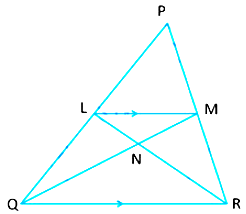
In the given triangle $\text{PQR}, LM$ is parallel to $QR$ and $PM : MR = 3: 4$

Calculate the value of ratio:
$(1) \frac{P L}{P Q}$ and then $\frac{L M}{Q R}$
$(2) \frac{\text { Area of } \Delta LMN }{\text { Area of } \Delta MNR }$
$(3) \frac{\text { Area of } \Delta LQM }{\text { Area of } \Delta LQN }$