Question
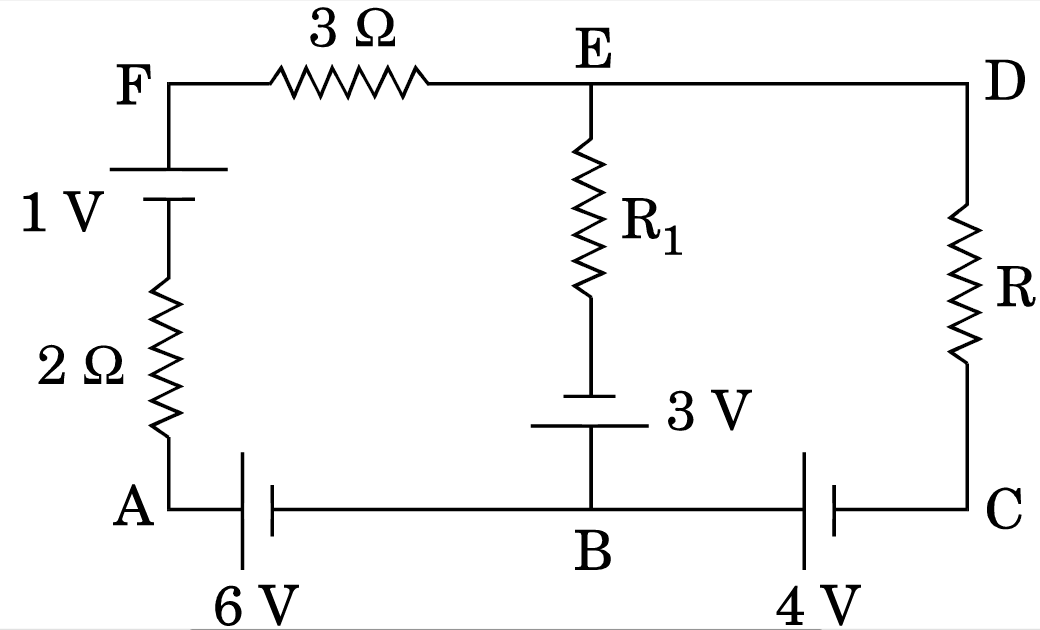
Use Kirchhoff ’s rules to determine the potential difference between the points $A$ and $D$ when no current flows in the arm $BE$ of the electric network shown in the figure.
Answer


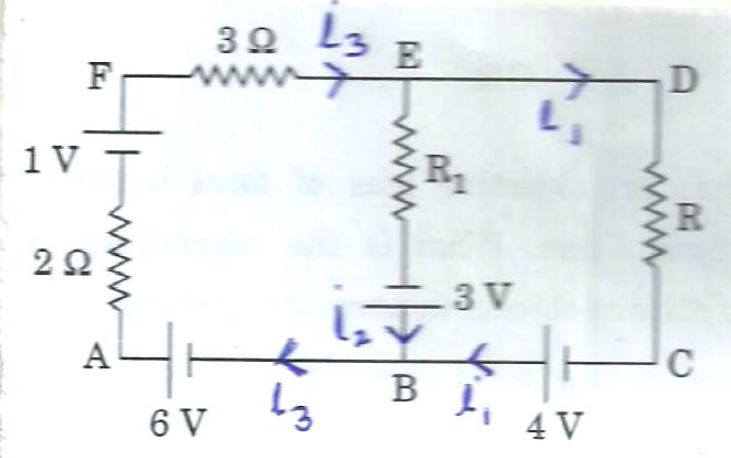
According to Kirchoff‟s Junction law at $B$
$\text{i}_{3} = \text{i}_{1} + \text{i}_{2} \therefore\text{i}_{3} = \text{i}_{1}$
$($As $I_2=0 ($given$)$
Applying second law to loop $\text{AFEB}$
$\text{i}_{3}\times2 + \text{i}_{3} \times3 + \text{i}_{2}\text{R}_{1} = 1+ 3 + 6 $
$\therefore\text{i}_{3} = \text{i}_{1} = 2 \text{A}$
From $A$ to $D$ along $\text{AFD} \therefore\text{V}_{\text{AD}} = 2\text{i}_{3} -1 +3 \times\text{i}_{3}$
$ = ( 4- 1 + 6 ) \text{V}$
$= 9 V.$

Need a full question paper?

Generate a complete, print-ready paper with questions like this in minutes — across 16+ boards, with answer keys.

Start Generating Free

Similar questions

Describe experiment of two coils explaining electromagnetic induction.
Depict the field-line pattern due to a bar magnet.
A Galilean telescope is $27\ cm$ long when focused to form an image at infinity. If the objective has a focal length of $30\ cm,$ what is the focal length of the eyepiece?
What type of extrinsic semiconductor is formed when:
  1. Germanium is doped with indium?
  2. Silicon is doped with bismuth?
Light falls from glass $(\mu=1.5)$ to air. Find the angle of incidence for which the angle of deviation is 90°.
A farsighted person cannot see objects placed closer to 50cm. Find the power of the lens needed to see the objects at 20cm.
Write a short note on Infrared waves.
Area of cross-section of a wire is $1.0 \times 10^{-7} m^2$ and the number of free electrons per cubic metre in the wire is $2 \times 10^{28}$ per $m ^3$. A current of 3.2 A is flowing in the wire. Find (i) current density in the wire (ii) drift velocity of free electrons.
Show that the electric field at the surface of a charged conductor is given by $\overrightarrow{\text{E}} = \frac{\sigma}{\varepsilon_{o}}\hat{\text{n}},$where σ is the surface charge density and $\hat{\text{n}}$is a unit vector normal to the surface in the outward direction.
Suppose, in certain conditions only those transitions are allowed to hydrogen atoms in which the principal quantum number n changes by 2. (a) Find the smallest wavelength emitted by hydrogen. (b) List the wavelength emitted by hydrogen in the visible range (380nm to 780nm).