Question
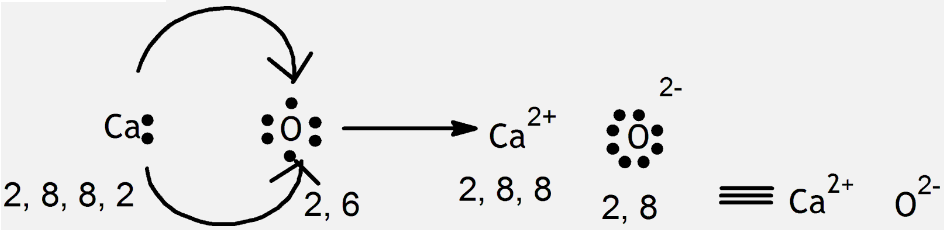
Use Lewis symbols to show electron transfer between the following atoms to form cations and anions: Ca and O

Answer


Ca and O:
The electronic configurations of Ca and O are as follows:
Ca: 2, 8, 8, 2
O: 2, 6
Oxygen requires two electrons more to complete its octet, whereas calcium has two electrons more than the nearest noble gas i.e., Argon. Hence, the electron transfer takes place as:

Need a full question paper?

Generate a complete, print-ready paper with questions like this in minutes — across 16+ boards, with answer keys.
Start Generating Free

Similar questions

Represent diagrammatically the bond moments and the resultant dipole moment in $\mathrm{CO}_2, \mathrm{NF}_3$ and $\mathrm{CHCl}_3$.
How much energy is required to ionise a H atom if the electron occupies n = 5 orbit? Compare your answer with the ionization enthalpy of H atom (energy required to remove the electron from n = 1 orbit).
Arrange 2, 2-dimethylbutane, 3-methylpentane and n-hexane in increasing order of their boiling point.
  1. Name a compound that will be required to obtain butane using Kolbe's electrolytic method.
  2. Why does benzene show electrophilic substitution easily?
  3. Complete the following:
$\text{CH}_3-\text{C}=\text{CH}_2+\text{H}_2\text{O}\xrightarrow{\text{H}^+}\\ \ \ \ \ \ \ \ \ \ \ \ \ \ |\\ \ \ \ \ \ \ \ \ \ \ \ \ \text{CH}_3$
Which of the following pairs of elements would have a more negative electron gain enthalpy?
F or Cl
Write chemical reactions of:
  1. Wurtz-Fittig reaction.
  2. Kolbe's electrolytic method.
  3. B-Elimination reaction.
Commercially available concentrated hydrochloric acid contains $38 \% \mathrm{HCl}$ by mass.
i. What is the molarity of the solution (density of solution $=1.19 \mathrm{~g} \mathrm{~mL}^{-1}$ )?
ii. What volume of the above concentrated HCl is required to make 1.0 L of 0.10 M HCl ?
Complete the following reactions:
  1. $8\text{LiH}+\text{AlCl}_6\xrightarrow{\ \ \ \ \ \ \ \ \ }$
  2. $2\text{LiH}+\text{B}_2\text{H}_6\xrightarrow{\ \ \ \ \ \ \ \ \ }$
  3. $2\text{NaH}+\text{B}_2\text{H}_6\xrightarrow{\ \ \ \ \ \ \ \ \ }$
For the following compound, write structural formulas and IUPAC names for all possible isomers having the number of double or triple bond as indicated:
$\mathrm{C}_4 \mathrm{H}_8$ (one double bond).
An alkyl halide ' A ' of formula $\mathrm{C}_6 \mathrm{H}_{13} \mathrm{Cl}$ on treatment with alcoholic KOH gives two isomeric alkenes ' B ' and ' C ' with molecular formula $\mathrm{C}_6 \mathrm{H}_{12}$. Both alkenes on hydrogenation give 2, 3-dimethyl butane. Predict the structure of 'A', 'B' and ' C '.