Question
Use the formula $\lambda _m T = 0.29 \ cm K$ to obtain the characteristic temperature ranges for different parts of the electromagnetic spectrum. What do the numbers that you obtain tell you?

Answer

A body at a particular temperature produces a continous spectrum of wavelengths. In case of a black body, the wavelength corresponding to maximum intensity of radiation is given according to Planck's law. It can be given by the relation,
$\lambda_\text{m}=\frac{0.29}{\text{T}}\text{ cm} \ \text{K}$
Where,
$\lambda_\text{m}=$ maximum wavelength
$T =$ temperature
Thus, the temperature for different wavelengths can be obtained as:
$\text{For} \ \lambda_\text{m}=10^{-4} \ \text{cm}; \ \text{T}=\frac{0.29}{10^{-4}}=2900\ ^\circ\text{K}$
$\text{For} \ \lambda_\text{m}=5\times10^{-5} \ \text{cm}; \ \text{T}=\frac{0.29}{5\times10^{-5}}=5800\ ^\circ\text{K}$
$\text{For} \ \lambda_\text{m}=10^{-6} \ \text{cm}; \ \text{T}=\frac{0.29}{10^{-6}}=290000\ ^\circ\text{K}$ and so on.
The numbers obtained tell us that temperature ranges are required for obtaining radiations in different parts of an electromagnetic spectrum.
As the wavelength decreases, the corresponding temperature Increases.

Need a full question paper?

Generate a complete, print-ready paper with questions like this in minutes — across 16+ boards, with answer keys.
Start Generating Free

Similar questions

Due to the electric dipole, drive the formula of the electric field at any point located on its axial line. Draw necessary diagram.
Answer the following$:$
  1. Name the em waves which are used for the treatment of certain forms of cancer. Write their frequency range.
  2. Thin ozone layer on top of stratosphere is crucial for human survival. Why?
  3. Why is the amount of the momentum transferred by the em waves incident on the surface so small?

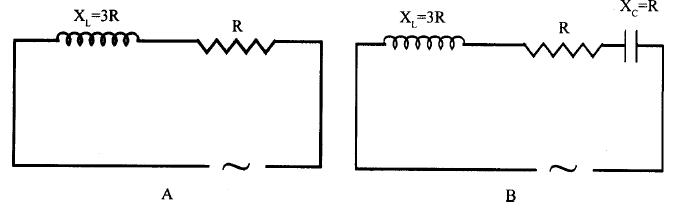
Given below are two electric circuits A and B.
 

Calculate the ratio of power factor of the circuit B to the power factor of circuit A.
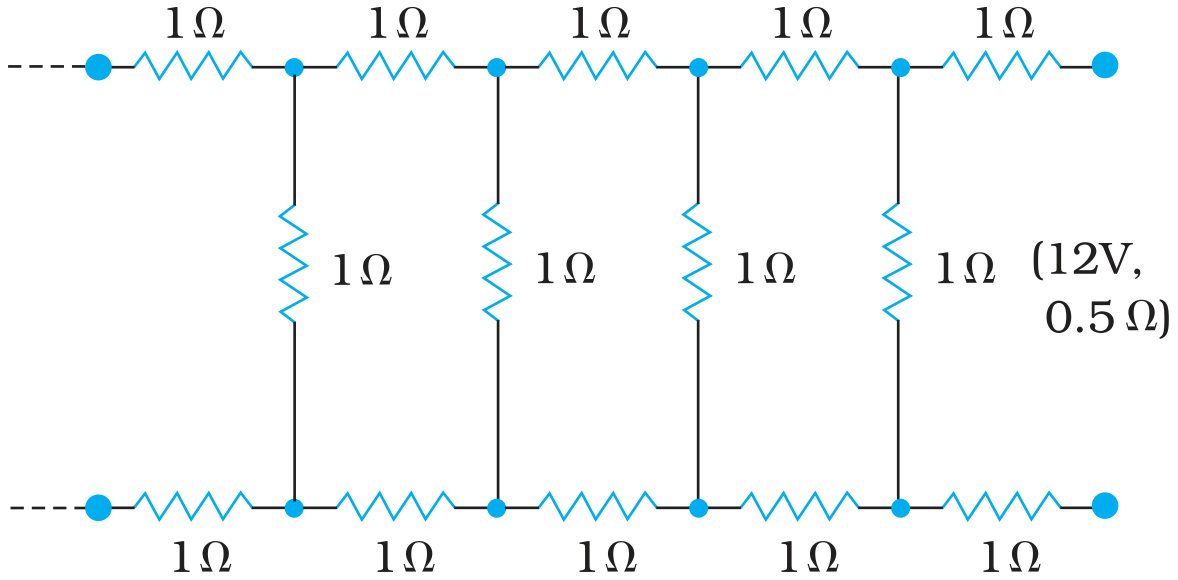
Determine the current drawn from a 12 V supply with internal resistance $0.5\ \Omega$ by the infinite network shown in Fig. Each resistor has $1\ \Omega$ resistance.
The kinetic energy of a charged particle decreases by 10J as it moves from a point at potential 100V to a point at potential 200V. Find the charge on the particle.
The decay constant of $^{238}U$ is $4.9 \times 10^{-18} S^{-1}.$
  1. What is the average-life of $^{238}U?$
  2. What is the half-life of $^{238}U?$
  3. By what factor does the activity of a $^{238}U$ sample decrease in $9 \times 10^9$ years$?$
​​​​​​​
The magnifying power of a converging lens used as a simple microscope is $\Big(1+\frac{\text{D}}{\text{f}}\Big).$ A compound microscope is a combination of two such converging lenses. Why don't we have magnifying power $\Big(1+\frac{\text{D}}{\text{f}_\text{o}}\Big) \Big(1+\frac{\text{D}}{\text{f}_\text{o}}\Big)?$ In other words, why can the objective not be treated as a simple microscope but the eyepiece can?
$(II) (a)$ Define electric flux and write its $SI$ unit.
$(b)$ Use Gauss᾿s law to obtain the expression for the electric field due to a uniformly charged infinite plane sheet of charge.
A vertical cylinder of height $100\ cm$ contains air at a constant temperature. The top is closed by a frictionless light piston. The atmospheric pressure is equal to $75\ cm$ of mercury. Mercury is slowly poured over the piston. Find the maximum height of the mercury column that can be put on the piston.
A circular loop of radius r carrying a current i is held at the centre of another circular loop of radius R(>> r) carrying a current I. The plane of the smaller loop makes an angle of 30° with that of the larger loop. If the smaller loop is held fixed in this position by applying a single force at a point on its periphery, what would be the minimum magnitude of this force?