If the frequency of EM radiations is halved then the energy of EM radiation will become:
Question types
Electromagnetic Waves question types
350 questions across 8 question groups — pick any mix to generate a Physics paper with step-by-step answer keys.
350
Questions
8
Question groups
5
Question types
01
M.C.Q (1 Marks)
179 Q→02Assertion (A) & Reason (B) MCQ
14 Q→031 Marks Question
53 Q→042 Marks Questions
23 Q→053 Marks Question
45 Q→064 Marks Questions
10 Q→075 Marks Questions
25 Q→08Fill in the blanks.
1 Q→Sample Questions
Electromagnetic Waves questions
One sample from each question group in this chapter. Select any group above to see the full set with answer keys.
View full solution →
Ultraviolet rays coming from sun are absorbed by:
The angular frequency of emf wave will be $($in $\frac{\text{rad}}{\text{s}})$
View full solution →Which one of the following has the shortest wavelength?
An electric field $\overrightarrow{\text{E}}$ and a magnetic field $\overrightarrow{\text{B}}$ exist in a region. The fields are not perpendicular to each other.
View full solution →Two statements are given-one labelled Assertion (A) and the other labelled Reason (R). Select the correct answer to these questions from the codes (a), (b), (c) and (d) as given below.
Reason: The energy of X-rays photon is less than that of light photon.
- Both A and R are true and R is the correct explanation of A.
- Both A and R are true but R is not the correct explanation of A.
- A is true but R is false.
- A is false and R is also false.
Reason: The energy of X-rays photon is less than that of light photon.
Two statements are given-one labelled Assertion (A) and the other labelled Reason (R). Select the correct answer to these questions from the codes (a), (b), (c) and (d) as given below.
Reason: Electromagnetic waves carries energy.
- Both A and R are true and R is the correct explanation of A.
- Both A and R are true but R is not the correct explanation of A.
- A is true but R is false.
- A is false and R is also false.
Reason: Electromagnetic waves carries energy.
Two statements are given-one labelled Assertion (A) and the other labelled Reason (R). Select the correct answer to these questions from the codes (a), (b), (c) and (d) as given below.
Reason: The electromagnetic waves do not required any material medium for propagation.
- Both A and R are true and R is the correct explanation of A.
- Both A and R are true but R is not the correct explanation of A.
- A is true but R is false.
- A is false and R is also false.
Reason: The electromagnetic waves do not required any material medium for propagation.
Two statements are given-one labelled Assertion (A) and the other labelled Reason (R). Select the correct answer to these questions from the codes (a), (b), (c) and (d) as given below.
Reason: Energy of electromagnetic waves is shared equally by the electric and magnetic fields.
- Both A and R are true and R is the correct explanation of A.
- Both A and R are true but R is not the correct explanation of A.
- A is true but R is false.
- A is false and R is also false.
Reason: Energy of electromagnetic waves is shared equally by the electric and magnetic fields.
Two statements are given-one labelled Assertion (A) and the other labelled Reason (R). Select the correct answer to these questions from the codes (a), (b), (c) and (d) as given below.
Reason: Infrared waves heat up the earth surface.
- Both A and R are true and R is the correct explanation of A.
- Both A and R are true but R is not the correct explanation of A.
- A is true but R is false.
- A is false and R is also false.
Reason: Infrared waves heat up the earth surface.
shows a capacitor made of two circular plates each of radius $12 \ cm,$ and separated by $5.0 \ cm$. The capacitor is being charged by an external source $($not shown in the figure$)$. The charging current is constant and equal to $ 0.15A.$
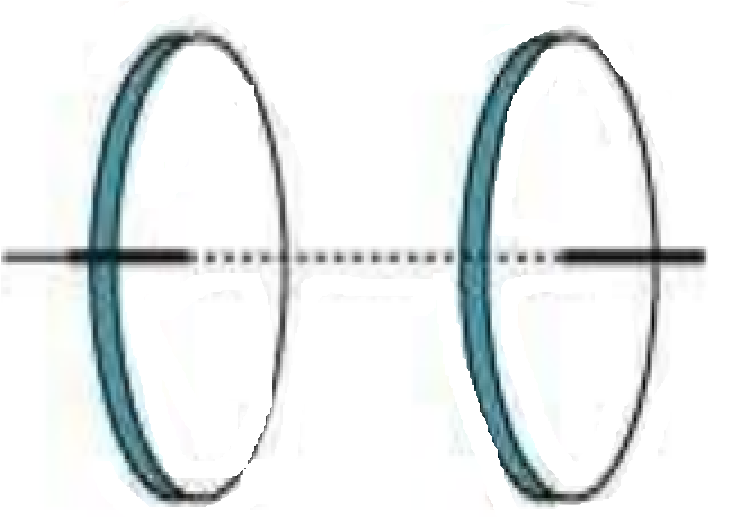
View full solution →- Calculate the capacitance and the rate of charge of potential difference between the plates.
- Obtain the displacement current across the plates.
- Is Kirchhoff’s first rule $($junction rule$)$ valid at each plate of the capacitor? Explain.
Suppose that the electric field part of an electromagnetic wave in vacuum is $\text{E}=\{(3.1 \ \text{N}/\text{C}\cos[(1.8 \text{rad}/ \text{m}) \text{y}+(5.4\times10^6 \ \text{red}/\text{s}\text{t}]\hat{\text{i}}\}$.
View full solution →- What is the direction of propagation?
- What is the wavelength $\lambda$ ?
- What is the frequency $ν$ ?
- What is the amplitude of the magnetic field part of the wave?
- Write an expression for the magnetic field part of the wave.
A plane electromagnetic wave of frequency $25 MHz$ travels in free space along the $x$-direction. At a particular point in space and time, $E =6.3 \hat{ j } V / m$. What is $B$ at this point?
View full solution →In which directions do the electric and magnetic field vectors oscillate in an electromagnetic wave propagating along the x-axis?
Write the relation for the speed of electromagnetic waves in terms of the amplitudes of electric and magnetic fields.
The magnetic field in a plane electromagnetic wave is given by $B_y=\left(2 \times 10^{-7}\right) T \sin \left(0.5 \times 10^3 x+1.5 \times 10^{11} t\right)$.
(a) What is the wavelength and frequency of the wave?
(b) Write an expression for the electric field.
View full solution →(a) What is the wavelength and frequency of the wave?
(b) Write an expression for the electric field.
Identify the electromagnetic waves whose wavelengths lie in the range$:$
View full solution →- $10^{–11} m < \lambda < 10^{–14} m$
- $10^{–4} m < \lambda < 10^{–6} m$
Identify the electromagnetic waves whose wavelengths vary as
View full solution →- $10^{–12 m} < \lambda < 10^{–8} m$
- $10^{–3 m} < \lambda< 10^{–1} m$
Draw a sketch of a plane electromagnetic wave propagating along the z-direction. Depict clearly the directions of electric and magnetic fields varying sinusoidally with z.
How does Ampere-Maxwell law explain the flow of current through a capacitor when it is being charged by a battery? Write the expression for the displacement current in terms of the rate of change of electric flux.
Use the formula $\lambda _m T = 0.29 \ cm K$ to obtain the characteristic temperature ranges for different parts of the electromagnetic spectrum. What do the numbers that you obtain tell you?
View full solution →What physical quantity is the same for $X-$rays of wavelength $10^{-10} m,$ red light of wavelength $6800 \mathring A$ and radiowaves of wavelength $500m$?
View full solution →How are electromagnetic waves produced? What is the source of energy carried by a propagating electromagnetic wave? Identify the electromagnetic radiations used:
- In remote switches of household electronic devices.
- As diagnostic tool in medicine.
- Identify the part of the electromagnetic spectrum which is:
- Suitable for radar system used in aircraft navigation,
- Produced by bombarding a metal target by high-speed electrons.
- Why does a galvanometer show a momentary deflection at the time of charging or discharging a capacitor? Write the necessary expression to explain this observation.
Identify the following electromagnetic radiations as per the wavelengths given below.
Write one application of each.
View full solution →Write one application of each.
- 1$0^{–3}nm$
- $10^{–3} m$
- $1 nm$
An electromagnetic wave transports linear momentum as it travels through space. If an electromagnetic wave transfers a total energy $U$ to a surface in time $t,$ then total linear momentum delivered to the surface is $\text{p}=\frac{\text{U}}{\text{c}}.$ When an electromagnetic wave falls on a surface, it exerts pressure on the surface. ln $1903,$ the American scientists Nichols and Hull succeeded in measuring radiation pressures of visible light where other had failed, by making a detailed empirical analysis of the ubiquitous gas heating and ballistic effects.
View full solution →- The pressure exerted by an electromagnetic wave of intensity $I (Wm^{-2})$ on a non$-$reflecting surface is $(c$ is the velocity of light$).$
- $\text{Ic}$
- $\text{Ic}^2$
- $\frac{\text{I}}{\text{c}}$
- $\frac{\text{I}}{\text{c}^2}$
- Light with an energy flux of $18\frac{\text{W}}{\text{cm}^2}$ falls on a non$-$reflecting surface at normal incidence. The pressure exerted on the surface is:
- $3\frac{\text{N}}{\text{m}^2}$
- $2\times10^{-4}\frac{\text{N}}{\text{m}^2}$
- $6\frac{\text{N}}{\text{m}^2}$
- $6\times10^{-4}\frac{\text{N}}{\text{m}^2}$
- Radiation of intensity $0.5Wm^{-2}$ are striking a metal plate. The pressure on the plate is:
- $0.166 \times 10^{-8}Nm^{-2}$
- $0.212 \times 10^{-8}Nm^{-2}$
- $0.132 \times 10^{-8}Nm^{-2}$
- $0.083 \times 10^{-8}Nm^{-2}$
- A point source of electromagnetic radiation has an average power out$-$put of $1500W.$ The maximum value of electric field at a distance of 3m from this source $($in $Vm^{-1})$ is:
- $500$
- $100$
- $\frac{500}{3}$
- $\frac{250}{3}$
- The radiation pressure of the visible light is of the order of,
- $10^{-2}\frac{\text{N}}{\text{m}^2}$
- $10^{-4}\frac{\text{N}}{\text{m}}$
- $10^{-6}\frac{\text{N}}{\text{m}^2}$
- $10^{-8}\text{N}$
Professor C.V Raman surprised his students by suspending freely a tiny light ball in a transparent vacuum chamber by shining a laser beam on it. Which property of EM waves was he exhibiting? Give one more example of this property.
In a microwave oven, the food is kept in a plastic container and the microwave is directed towards the food. The food is cooked without melting or igniting the plastic container. Explain.
A metal rod is placed along the axis of a solenoid carrying a high-freqμency alternating current. It is found that the rod gets heated. Explain why the rod gets heated.
Electrons oscillating in a circuit give rise to radiowaves. $A$ transmitting antenna radiates most effectively the radiowaves of wavelength equal to the size of the antenna. The infrared waves incident on a substance set into oscillation all its electrons, atoms and molecules. This increases the internal energy and hence the temperature of the substance.
View full solution →- If $v_g, v_x$ and $v_m$ are the speeds of gamma rays, $X-$rays and microwaves respectively in vacuum, the
- $v_g > v_x > v_m$
- $v_g < v_x < v_m$
- $v_g > v_x > v_m$
- $v_g = v_x = v_m$
- Which of the following wi $II$ deflect in electric field?
- $X-$rays.
-
$\gamma-\text{rays}.$
- Cathode rays.
- Ultraviolet rays.
- $\gamma-\text{rays}$ are detected by:
- Point contact diodes.
- Thennopiles.
- Ionization chamber.
- Photocells.
- The frequency of electromagnetic wave, which best suited to observe a particle ofradius $3 \times 10^{-4}cm$ is the order of,
- $10^{15}Hz$
- $10^{14} Hz$
- $10^{13}Hz$
- $10^{12}Hz$
- We consider the radiation emitted by the human body. Which one of the following statements is true?
- The radiation emitted is in the infrared region.
- The radiation is emitted only during the day.
- The radiation is emitted during the summers and absorbed during the winters.
- The radiation emitted lies in the ultraviolet region and hence it is not visible.
Answer the following question:
Some scientists have predicted that a global nuclear war on the earth would be followed by a severe ‘nuclear winter’ with a devastating effect on life on earth. What might be the basis of this prediction?
Some scientists have predicted that a global nuclear war on the earth would be followed by a severe ‘nuclear winter’ with a devastating effect on life on earth. What might be the basis of this prediction?
In a plane electromagnetic wave, the electric field oscillates sinusoidally at a frequency of $2.0 \times 10^{10} Hz$ and amplitude $48 V m^{-1}.$
View full solution →- What is the wavelength of the wave?
- What is the amplitude of the oscillating magnetic field?
- Show that the average energy density of the $E$ field equals the average energy density of the $B$ field. $[c = 3 \times 10^8 m s^{-1}.]$
The terminology of different parts of the electromagnetic spectrum is given in the text. Use the formula $E = hv\ ($for energy of a quantum of radiation: photon$)$ and obtain the photon energy in units of $eV$ for different parts of the electromagnetic spectrum. In what way are the different scales of photon energies that you obtain related to the sources of electromagnetic radiation?
View full solution →Answer the following question:
If the earth did not have an atmosphere, would its average surface temperature be higher or lower than what it is now?
If the earth did not have an atmosphere, would its average surface temperature be higher or lower than what it is now?
Suppose that the electric field amplitude of an electromagnetic wave is $E_0 = 120 N/C$ and that its frequency is $ν = 50.0 MHz. (a)$ Determine $, B_0, ω, k,$ and $\lambda . (b)$ Find expressions for $E$ and $B$.
View full solution →In an electromagnetic wave, the amplitude of electric field is 60 Volt/meter. If the wave is transmitted in free space then the magnitude of magnetic field will be ____________
Generate a Electromagnetic Waves paper free
Pick question groups from the list above, set marks and difficulty, and export a branded PDF with step-by-step answer keys. First 3 chapters free — no signup.