Maharashtra BoardEnglish MediumSTD 12 SciencePhysicsWave Optics3 Marks
Question
Using analytical method for interference bands, obtain an expression for path difference between two light waves.
✓
Answer
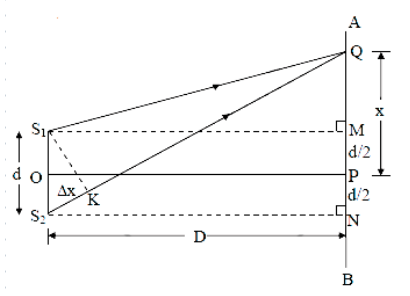
a) Let $S_1$ and $S_2$ be the two coherent monochromatic sources which are separated by short distance $d$. They emit light waves of wavelength $\lambda$
b) Let $D =$ horizontal distance between screen and source
c) Draw $S _1 M$ and $S _2 N \perp AB$
$OP =$ perpendicular bisector of slit.
Since $S_1 P=S_2 P$, the path difference between waves reaching $P$ from $S_1$ and $S_2$ is zero, therefore there is a bright point at $P$.
d) Consider a point Q on the screen which is at a distance x from the central point P on the screen. Light waves from $S_1$ and $S_2$ reach at $Q$ simultaneously by covering path $S_1 Q$ and $S_2 Q$ where they superimpose
e. \(\operatorname{In} \Delta S _1 MQ\),
\(\left( S _1 Q \right)^2=\left( S _1 M \right)^2+( MQ )^2\)
\(\left(S_1 Q\right)^2=D^2+\left(x-\frac{d}{2}\right)^2\)...(1)
f. \(\operatorname{In} \Delta S _2 NQ\),
\(\left( S _2 Q \right)^2=\left( S _2 N \right)^2+( NQ )^2\)
\(\therefore \quad\left( S _2 Q \right)^2= D ^2+\left| x +\frac{ d }{2}\right|^2\)...(2)
g. Subtract equation (1) from (2),
\(\left( S _2 Q \right)^2-\left( S _1 Q \right)^2\)
\(=\left(D^2+\left(x+\frac{d}{2}\right)^2\right)-\left(D^2+\left(x-\frac{d}{2}\right)^2\right)\)
\(=D^2+\left(x+\frac{d}{2}\right)^2-D^2-\left(x-\frac{d}{2}\right)^2\)
\(=\left(x+\frac{d}{2}\right)^2-\left(x-\frac{d}{2}\right)^2\)
\(=\left(x^2+\frac{d^2}{4}+x d\right)-\left(x^2+\frac{d^2}{4}-x d\right)\)
\(=x^2+\frac{d^2}{4}+x d-x^2-\frac{d^2}{4}+x d\)
\(\left( S _2 Q \right)^2-\left( S _1 Q \right)^2=2 xd\)
\(\therefore \quad\left( S _2 Q + S _1 Q \right)\left( S _2 Q - S _1 Q \right)=2 xd\)
\(\therefore \quad S _2 Q - S _1 Q =\frac{2 XQ }{ S _2 Q + S _1 Q }\)...(3)
h). If x << D and d << D then,
$S_1Q ≈ S_2Q ≈ D$
$S_2Q + S_1Q = 2D$
∴ Equation (3) becomes,
\(S_2 Q-S_1 Q=\frac{2 x d}{2 D}\)
\(\therefore S_2 Q-S_1 Q=\frac{x d}{D}\)
\(\therefore \triangle x=\frac{x d}{D}\)...(4)
Equation (4) gives the path difference of two interfering light waves
Need a full question paper?
Generate a complete, print-ready paper with questions like this in minutes — across 16+ boards, with answer keys.