Question
Using Archimedes' principle, describe an experiment to find the relative density of a solid denser than water.

Answer

We can find the relative density of a solid denser than water by following the experiment.

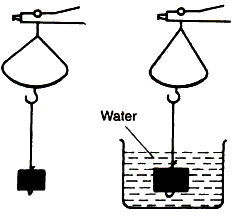
Weighing a solid in air and water
Find the weight $\left( W _1 gf \right)$ of a solid in the air using a hydrostatic balance.
Tie the solid firmly with a thread and suspend it from the hook. Lower the solid in water and find its weight.
Record the result as shown below:
Weight of solid in air $=w_1 gf$.
Weight of solid in water $= W _2 gf$. The apparent loss of weight of solid $=\left( W _1- W _2\right) gf$.
Relative density $=W_1 /\left(W_1-W_2\right)$ The relative density of the solid = (weight of solid in the air )/(Apparent loss of weight of solid in water).

Need a full question paper?

Generate a complete, print-ready paper with questions like this in minutes — across 16+ boards, with answer keys.
Start Generating Free

Similar questions

What fact about liquid pressure does the following diagram in the following figure illustrate?
A block of wood of mass $24$ kg floats on water. The volume of wood is $0.032 m^3$. Find :(a) the volume of block below the surface of water,
(b) the density of wood.
(Density of water $=1000 kg m ^{-3}$ )
(a) State the formula for calculating percentage error
(b) Is it possible to increase the degree of accuracy by mathematical manipulations? Support your answer by an example.
Complete the following diagrams shown in the following figures by drawing the reflected rays.
Image
An object of length 4 cm is placed in front of a concave mirror at distance 30 cm. The focal length of mirror is 15 cm.
  1. Where will the image form?
  2. What will be the length of image?
Explain the working of a hydraulic brake with a simple labelled diagram.
What fraction of an iceberg of density 910 $kgm^{-3}$ will be above the surface of sea water of density $1170 kgm ^{-3}$ ?
By drawing a neat diagram define the following:
1. Mirror
2. Incident ray
3. Reflected ray
4. Angle of incidence
5. Angle of reflection
6. Normal
 A train travels with a speed of $60 km h ^{-1}$ from station $A$ to station $B$ and then comes back with a speed $80 km^{-1}$ from station $B$ to station A. Find -
i. The average speed
ii. The average velocity of the train.
Draw displacement - time graphs f.or the following situations:
1. When a body is stationary.
2. When a body is moving with uniform velocity.
3. When a body is moving with variable velocity.