Question
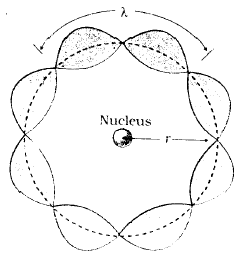
  1. Using de Broglie's hypothesis, explain with the help of a suitable diagram, Bohr's second postulate of quantization of energy levels in a hydrogen atom.
  2. The ground state energy of hydrogen atom is - 13.6 eV. What are the kinetic and potential energies of the electron in this state?
Answer

  1. $\lambda = \frac{\text{h}}{\text{p}} = \frac{\text{h}}{\text{mv}}$

$2\pi\text{r} = \text{n}\lambda$
$ =\text{n}\frac{\text{h}}{\text{mv}}$
$\Rightarrow\text{mvr} = \text{L} = \frac{\text{nh}}{2\pi}$
  1. Kinetic energy=13.6 eV
Potential energy = -27.2 eV.

Need a full question paper?

Generate a complete, print-ready paper with questions like this in minutes — across 16+ boards, with answer keys.

Start Generating Free

Similar questions

A laser beam has intensity $2.5 \times 10^{14}\ Wm^{-2}.$ Find amplitudes of electric and magnetic fields in the beam.
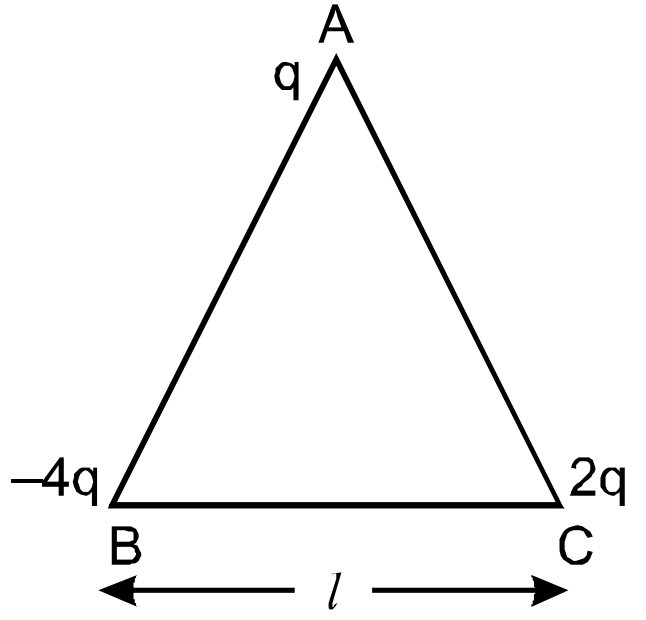
  1. Three point charges $q, -4q$ and $2q$ are placed at the vertices of an equilateral triangle $\text{ABC}$ of side $‘l\ ’$ as shown in the figure. Obtain the expression for the magnitude of the resultant electric force acting on the charge $q.$
  1. Find out the amount of the work done to separate the charges at infinite distance.
An electron and alpha particle have the same kinetic energy. How are the de Broglie wavelengths associated with them related?
What are the advantages of using soft iron as a core, instead of steel, in the coils of galvanometers?
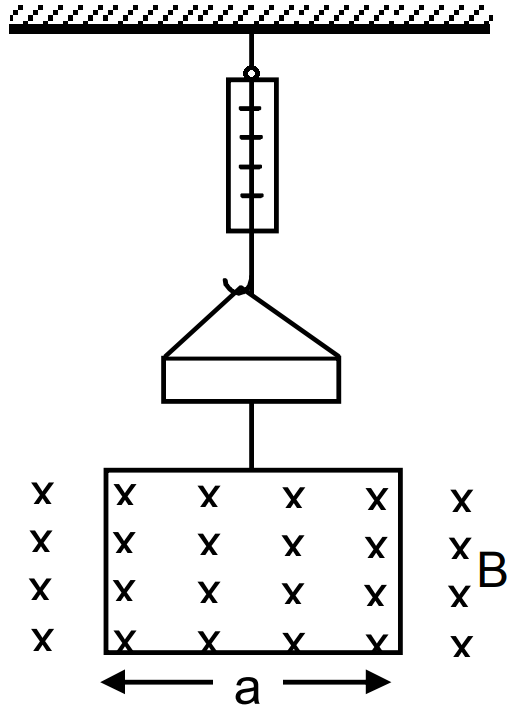
A rectangular wire loop of width a is suspended from the insulated pan of a spring balance, as shown in A current i exists in the anti-clockwise direction in the loop. A magnetic field Bexists in the lower region. Find the change in the tension of the spring if the current in the loop is reversed.
  1. Define the term ‘intensity of radiation’ in terms of photon picture of light.
  2. Two monochromatic beams, one red and the other blue, have the same intensity. In which case (i) The number of photons per unit area per second is larger, (ii) The maximum kinetic energy of the photoelectrons is more? Justify your answer.

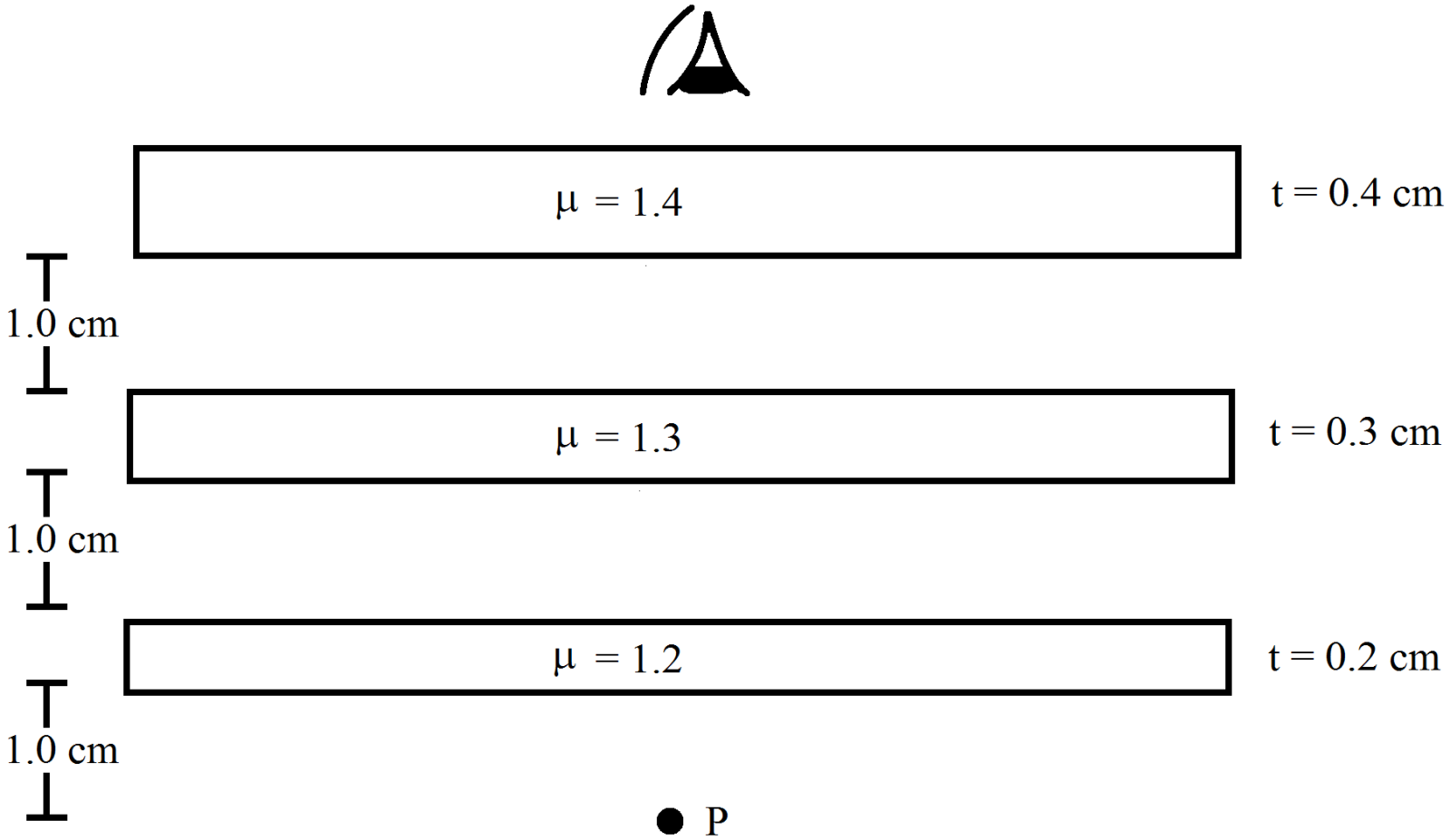
Locate the image of the point P as seen by the eye in the figure.
Define semiconductors on the basis of energy band theory. What are the charge carriers in semiconductor? What do semiconductors start behaving like at absolute zero temperature?
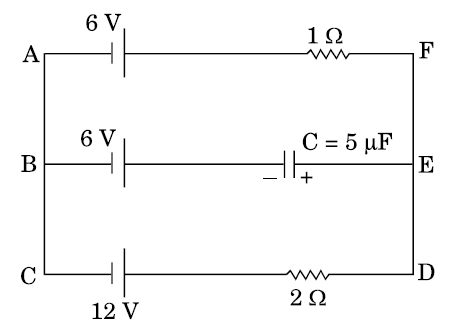
In the given circuit, with steady current, calculate the potential difference across the capacitor and the charge stored in it.
Write any three characteristics of nuclear force.