Question
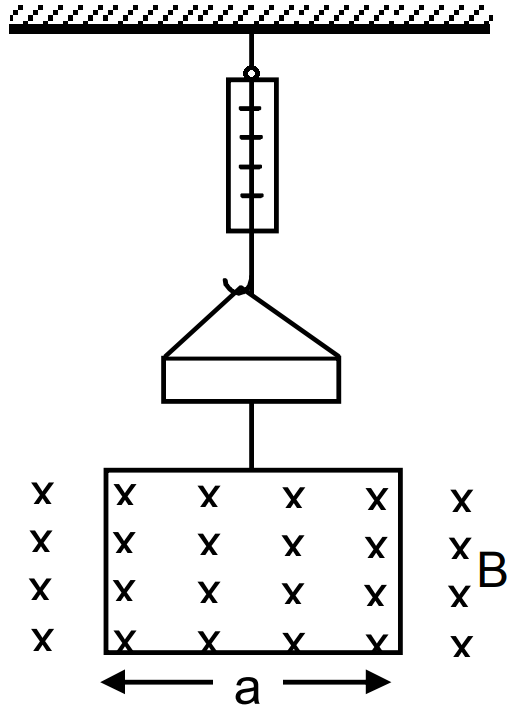
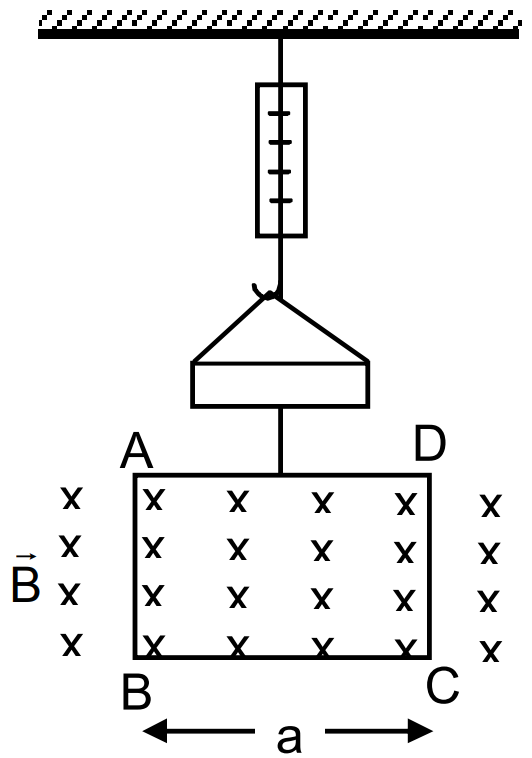
A rectangular wire loop of width a is suspended from the insulated pan of a spring balance, as shown in A current i exists in the anti-clockwise direction in the loop. A magnetic field Bexists in the lower region. Find the change in the tension of the spring if the current in the loop is reversed.
Answer


Current anticlockwise
Since the horizontal Forces have no effect.
Let us check the forces for current along AD & BC [Since there is no $\overrightarrow{\text{B}}$ ]
In AD, F = 0
For BC
F = iaB upward
Current clockwise
Similarly, F = - iaB downwards
Hence change in force = change in tension
= iaB - (-iaB) = 2 iaB

Need a full question paper?

Generate a complete, print-ready paper with questions like this in minutes — across 16+ boards, with answer keys.

Start Generating Free

Similar questions

The current in a solenoid of 240 turns, having a length of 12cm and a radius of 2cm, changes at a rate of 0.8A/s. Find the emf induced in it.
A particle goes in a circle of radius 2.0cm. A concave mirror of focal length 20cm is placed with its principal axis passing through the centre of the circle and perpendicular to its plane. The distance between the pole of the mirror and the centre of the circle is 30cm. Calculate the radius of the circle formed by the image.
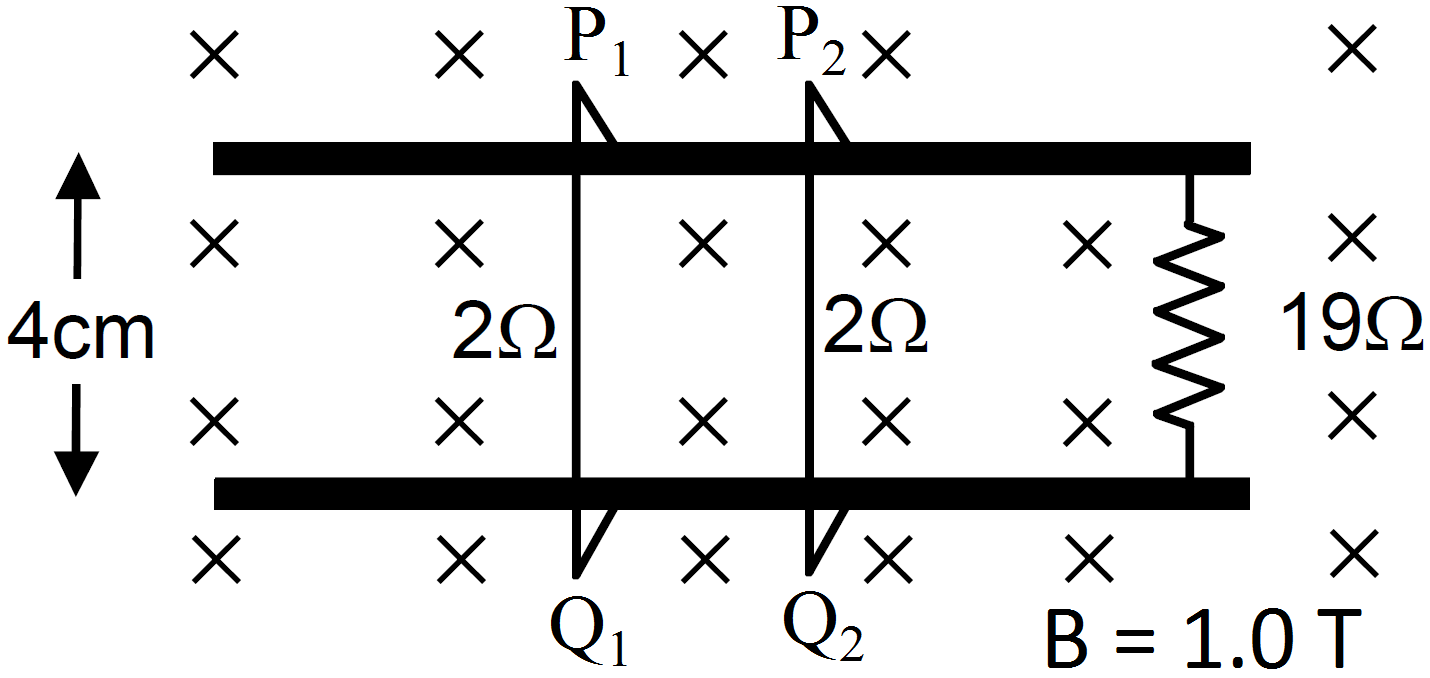
Consider the situation shown in figure. The wires $P_1Q_1$ and $P_2Q_2$ are made to slide on the rails with the same speed $5\ cm/s$. Find the electric current in the $19\Omega$ resistor if:
  1. Both the wires move towards right.
  2. If $P_1Q_1$ moves towards left but $P_2Q_2$ moves towards right.
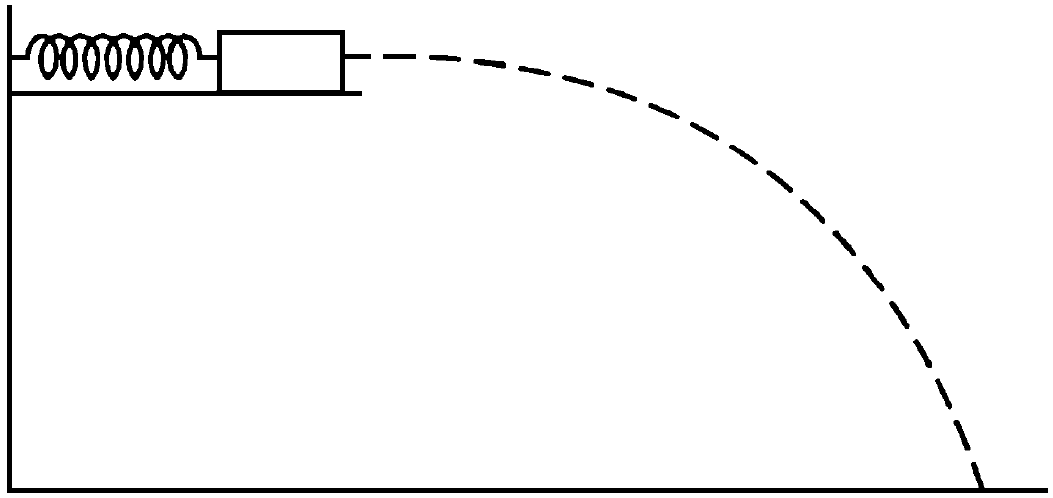
A small block of mass 100g is pressed against a horizontal spring fixed at one end to compress the spring through 5.0cm (figure). The spring constant is 100N/m. When released, the block moves horizontally till it leaves the spring. Where will it hit the ground 2m below the spring?
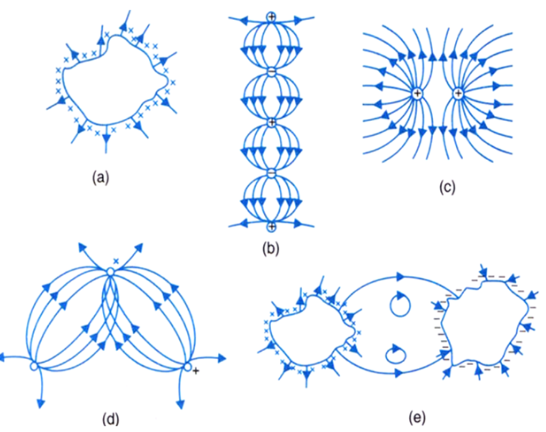
Which among the curves shown in Fig. 1.35 cannot possibly represent electrostatic field lines?
Draw the energy band diagrams $($at $T >$ 0K$)$ for $n-$type and $p-$type semiconductors. Using diagram, explain why in $n-$type semiconductor the conduction band has most electrons from the donor impurities.
Explain how the scattering experiment can be analyzed in detail from Rutherford's nuclear model.
A beam of light moving along $x$-axis is represented by the electric field $E_y=600 Vm ^{-1} \sin \omega$ $\left(t-\frac{x}{c}\right)$. Calculate the maximum magnitudes of electric and magnetic fields on a charge $q=2 e$ moving along the $y$-axis with a speed of $3.0 \times 10^7 m / s$ (where $\left.e=1.6 \times 10^{-19} C \right)$.
A certain material has refractive indices 1.56, 1.60 and 1.68 for red, yellow and violet light respectively.
  1. Calculate the dispersive power.
  2. Find the angular dispersion produced by a thin prism of angle 6° made of this material.
A $2.00m$ long rope, having a mass of $80g,$ is fixed at one end and is tied to a light string at the other end. The tension in the string is $256N.$
  1. Find the frequencies of the fundamental and the first two overtones.
  2. Find the wavelength in the fundamental and the first two overtones.