Question
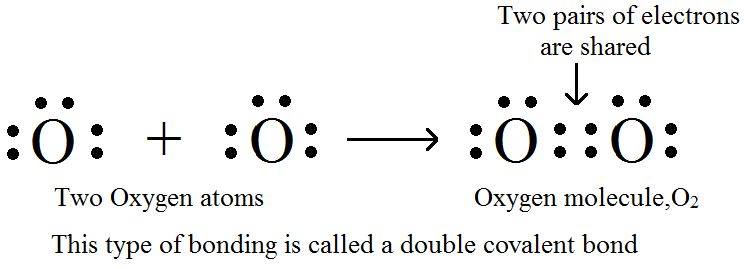
Using electron-dot diagrams which show only the outermost shell electrons, show how a molecule of oxygen, O2, is formed from two oxygen atoms. What name is given to this type of bonding? (At. No. of oxygen = 8)

Need a full question paper?

Generate a complete, print-ready paper with questions like this in minutes — across 16+ boards, with answer keys.
Start Generating Free

Similar questions

Explain the process of preparation of soap in laboratory.
A substance (X) be oxidised to acetic acid (CH3COOH)? Name substance (X) and write two tests to demonstrate acidic nature of acetic acid.
A carboxylic acid $\text{C}_{2}\text{H}_{4}\text{O}_{2}$ reacts with an alcohol in the presence of $\text{H}_{2}\text{SO}_{4}$ to form a compound ‘X’. The alcohol on oxidation with $\text{KMnO}_{4} $ alkaline followed by acidification gives the same carboxylic acid, $\text{C}_{2}\text{H}_{4}\text{O}_{2}$. Write the name and structure of
  1.  Carboxylic acid.
  2.  Alcohol.
  3.  The compound ‘X’.
Give two examples each of:
  1. Group 1 elements.
  2. Group 17 elements.
  3. Group 18 elements.
Explain giving one example, how highly reactive metals (which are high up in the reactivity series) are extracted.
What is a thermite reaction? Explain with the help of an equation. State one use of this reaction.
A solution of potassium chloride when mixed with silver nitrate solution, an insoluble white substance is formed. Write the chemical reaction involved and also mention the type of the chemical reaction?
The atomic number of an element is 12.
  1. Write its electronic configuration and determine its valency.
  2. Is it more reactive or less reactive than Ca (atomic number 20)? Justify your answer giving reason.
  3. Is it a metal or a non-metal?
  4. Write the formula of its oxide.
Consider the following salts:
Na2CO3, NaCl, NH4Cl, CH3COONa, K2SO4, (NH4) SO4 Which of these salts will give:
  1. Acidic solutions?
  2. Neutral solutions?
  3. Basic solutions (or alkaline solutions)?
Define the following in terms of gain or loss of hydrogen with one example:
  1. Oxidation.
  2. Reduction.