Question
Using electron-dot diagrams which show only the outermost shell electrons, show how a molecule of nitrogen, N, is formed from two nitrogen atoms. What name is given to this type of bonding? (Atomic number of nitrogen is 7)
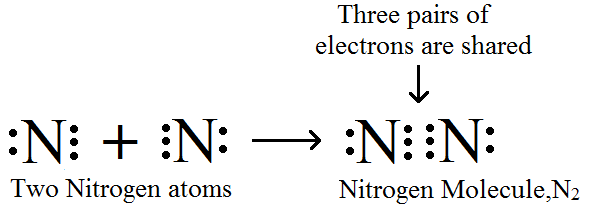
Answer

Since nitrogen has 5 electrons in its outermost shell so, to achieve the 8-electron structure of an inert gas, it needs 3 more electrons and hence combines with another nitrogen atom to form a molecule of nitrogen gas.

This type of bonding is called covalent bonding.

Need a full question paper?

Generate a complete, print-ready paper with questions like this in minutes — across 16+ boards, with answer keys.

Start Generating Free

Similar questions

Salt A commonly used in bakery products on heating gets converted into another salt B which itself is used for removal of hardness of water and a gas C is evolved. The gas C when passed through lime water, turns it milky. Identify A, B and C.
Define the terms:
  1. mineral.
  2. ore.
  3. gangue.
2mL of sodium hydroxide solution is added to a few pieces of granulated zinc metal taken in a test tube. When the contents are warmed, a gas evolves which is bubbled through a soap solution before testing. Write the equation of the chemical reaction involved and the test to detect the gas. Name the gas which will be evolved when the same metal reacts with dilute solution of a strong acid.
A compound X which is prepared from gypsum has the property of hardening when mixed with a proper quantity of water.
  1. Identify the compound X,
  2. Write the chemical equation for its preparation.
  3. For what purpose is it used in hospitals?
Give one example each of a salt which gives an aqueous solution having:
  1. pH less than 7
  2. pH equal to 7
  3. pH more than 7
What would be observed on adding a 5% alkaline potassium permanganate solution drop by drop to some warm ethanol in a test-tube? Write the name of the compound formed during the chemical reaction. Also write chemical equation of the reaction which takes place.
Sample pieces of five metals A, B, C, D and E were added to the tabulated solutions separately. The results observed are shown in the table:
MetalFeSO4CuSO4ZnSO4AgNO3Al2(SO4)3
ANo ChangeNo ChangeNo ChangeCoating on metalNo Change
BGrey Deposit on metalBrown Coating on metalNo ChangeCoating on metalNo Change
CNo ChangeNo ChangeNo ChangeNo ChangeNo Change
DNo Change---------No ChangeCoating on metalNo Change
E---------Brown CoatingNew CoatingNew CoatingNo Change

Based on the observations recorded in the table, answer the following:
(1) Which is the most reactive metal?
(2) Which is the least reactive metal?
(3) What would be observed if metal D were added to a solution of copper (II) sulphate?
(4) What would be observed if metal E were added to a solution of iron (II) sulphate?
(5) Arrange the metals $\mathrm{A}, \mathrm{B}, \mathrm{C}, \mathrm{D}$ and E in decreasing order of their reactivity?
On adding a drop of barium chloride solution to an aqueous solution of sodium sulphite, white precipitate is obtained.
  1. Write a balanced chemical equation of the reaction involved.
  2. What other name can be given to this precipitation reaction?
  3. On adding dilute hydrochloric acid to the reaction mixture, white precipitate disappears. Why?
An aldehyde as well as a ketone can be represented by the same molecular formula, say C3H6O. Write their structure and name them. State the relation between the two in the language of science.
State one example of a Dobereiner’s triad, showing in it that the atomic mass of middle element is half - way between those of the other two.