Question
Using factor theorem, factorize the following polynomials:
$2y^3 - 5y^2 - 19y + 42$

Answer

Let $f(y)=2 y^3-5 y^2-19 y+42$ be the given polynomial.
Now, putting $y=2$, we get
$f(2)=2(2)^3-5(2)^2-19(2)+42$
$=16-20-38+42$
$=-58+58=0$
Therefore, $(y-2)$ is a factor of polynomial $f(y)$.
Now,
$f(y)=2 y^2(y-2)-y(y-2)-21(y-2)$
$=(y-2)\left(2 y^2-y-21\right)$
$=(y-2)\left(2 y^2-7 y+6 y-21\right)$
$=(y-2)(y+3)(2 y-7)$
Hence $(y-2),(y+3)$ and $(2 y-7)$ are the factors of polynomial $f(y)$.

Need a full question paper?

Generate a complete, print-ready paper with questions like this in minutes — across 16+ boards, with answer keys.
Start Generating Free

Similar questions

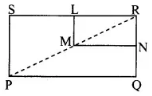
In the adjoining figure, □PQRS and □MNRL are rectangles. If point M is the midpoint of side PR, then prove that,
i. SL = LR
ii. $LN =\frac{1}{2} S Q$.

Image
Given: □PQRS and □MNRL are rectangles. M is the midpoint of side PR.

The class size of distribution is 25 and the first class-interval is 200-224. There are seven class-intervals.
Write the class-marks of each interval.
The blood groups of 30 students of class VIII are recorded as follows:
A, B, O, O, AB, O, A, O, B, A, O, B, A, O, O, A, AB, O, A, A, O, O, AB, B, A, O, B, A, B, O
Represent this data in the form of a frequency distribution table. Find out which is the most common and which is the most rarest blood group among these students.
Water in a canal 30 dm wide and 12 dm deep, is flowing with a velocity of 100 km every hour.
What much area will it irrigate in 30 minutes if 8 cm of standing water is desired?
The daily maximum temperatures (in degree Celsius) recorded in a certain city during the month of November are as follows:
25.8, 24.5, 25.6, 20.7, 21.8, 20.5, 20.6, 20.9, 22.3, 22.7, 23.1, 22.8, 22.9, 21.7, 21.3, 20.5, 20.9, 23.1, 22.4, 21.5, 22.7, 22.8, 22.0, 23.9, 24.7, 22.8, 23.8, 24.6, 23.9, 21.1.
Represent the data in the form of a frequency distribution table with class size 11°C.
Given below are the cumulative frequencies showing the weights of 685 students of a school. Prepare a frequency distribution table.
Weight (in kg)
No. of students
Below 30
0
Below 30
24
Below 35
78
Below 40
183
Below 45
294
Below 50
408
Below 55
543
Below 60
621
Below 65
674
Below 70
685
Diagonals $PR$ and $QS$ of a rhombus $\text PQRS$ are $20\ cm$ and $48\ cm$ respectively. Find the length of side $PQ$.
Divide the polynomial $(2y^4 - 3y^3 + 5y - 4) ÷ (y - 1)$ By synthetic division method and Linear method.
Why do we group data?
If one angle of a triangle is equal to the sum of the other two, show that the triangle is a right angle triangle.