Question
Using factor theorem, factorize the following polynomials: $2y^3 + y^2 - 2y - 1$

Answer

Let $p(y) = 2y^3 + y^2 - 2y - 1$ By hit and trial method
$p(1) = 2(1)^3 + (1)^2 - 2(1) - 1$
$= 2 + 1 - 2 - 1 = 0$
So, $y -1$ is a factor of this polynomial.

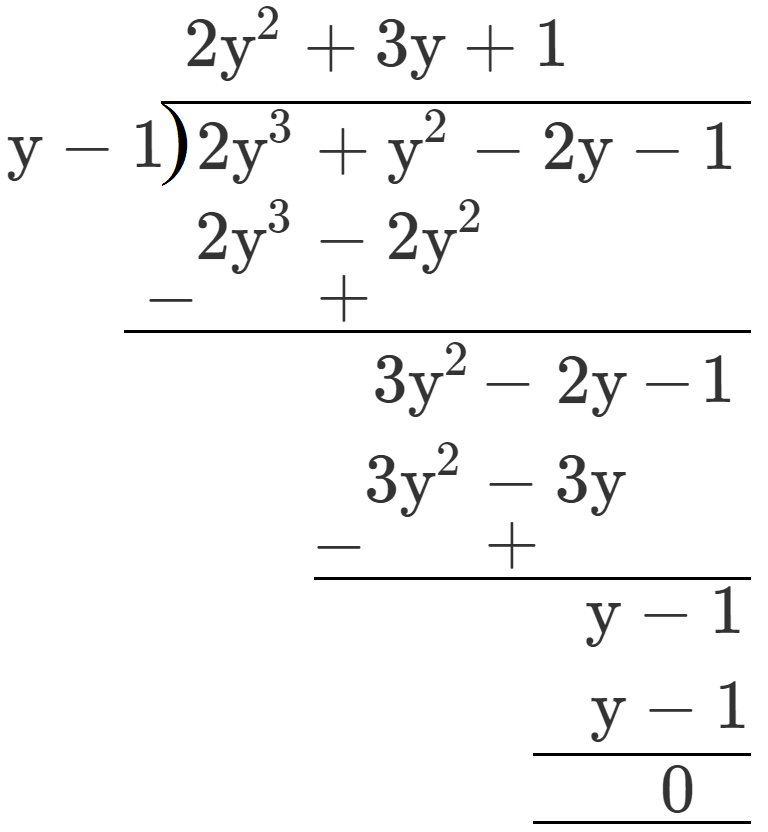
Now, By long division method,
$\therefore 2y^3 + y^2 - 2y - 1$
$= (y - 1)(2y^2 + 3y + 1)$
$= (y - 1)(2y^2 + 2y + y + 1)$
$= (y - 1)[2y(y + 1) + 1(y + 1)]$
$= (y - 1)(y + 1)(2y + 1)$

Need a full question paper?

Generate a complete, print-ready paper with questions like this in minutes — across 16+ boards, with answer keys.
Start Generating Free

Similar questions

Points $A(5, 3), B(-2, 3)$ and $D(5, -4)$ are three vertices of a square $ABCD.$ Plot these points on a graph paper and hence find the coordinates of the vertex $C.$
If $3 x-7 y=10$ and $x y=-1$, find the value of $9 x^2+49 y^2$.
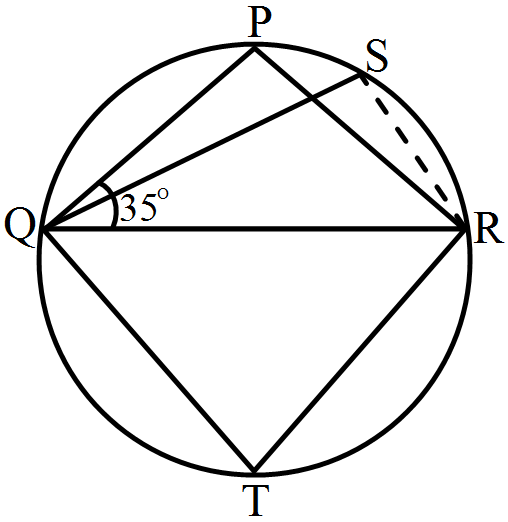
In the given figure, $\triangle\text{PQR}$ is an isosceles triangle with $PQ = PR$ and $\text{m}\angle\text{PQR}=35^\circ.$ Find $\text{m}\angle\text{QSR}$ and $\text{m}\angle\text{QTR}.$
$E$ is the mid-point of a median $AD$ of $\Delta\text{ABC}$ and $BE$ is produced to meet $AC$ at $F.$ Show that $\text{AF}=\frac{1}{3}\text{AC}.$
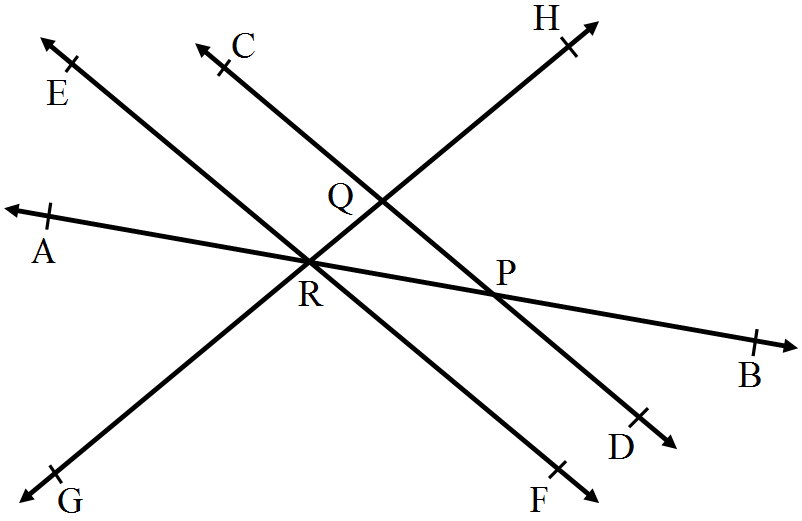
In the adjoining figure, name:
$i.$ Two pairs of intersecting lines and their corresponding points of intersection.
$ii.$ Three concurrent lines and their points of intersection.
$iii.$ Three rays.
$iv.$ Two line segments.
$BD$ and $CE$ are bisectors of $\angle\text{B}$ and $\angle\text{C}$ of an isosceles $\triangle\text{ABC}$ with $\text{AB}=\text{AC}.$ Prove that $\text{BD}=\text{CE}.$
$ABCD$ is a parallelogram in which $BC$ is produced to $E$ such that $CE = BC$ (Fig.) $AE$ intersects $CD$ at $F.$ If ar $(DFB) = 3\ cm^2$ , find the area of the parallelogram $ABCD$. 
Simplify:
$(x^2 + y^2 - z^2)^2 - (x^2 - y^2 + z^2)^2$
Find the value of the following correct to three place of decimals, it begin that $\sqrt2=1.4142, \sqrt3=1.732,\ \sqrt5=2.2360,\ \sqrt6=2.4495$ and $\sqrt{10}=3.162.$ $\frac{3-\sqrt5}{3+2\sqrt5}$
The difference between inside and outside surfaces of a cylindrical tube is $14\ cm$ long is $88\ sq$. cm. If the volume of the tube is $176$ cubic $cm$, Find the inner and outer radii of the tube.