Question
Using factor theorem, factorize the following polynomials:
$x^3 + 13x^2 + 32x + 20$

Answer

Let $p(x) = x^3 + 13x^2+ 32x + 20$
The factors of 20 are $\pm1,\pm2,\pm4,\pm5\dots$
By hit and trial method
$p(-1) = (-1)^3 + 13(-1)^2 + 32(-1) + 20$
$= -1 + 13 - 32 + 20$
$= 33 - 33 = 0$
As $p(-1$) is zero, so $x + 1$ is a factor of this polynomial p(x).
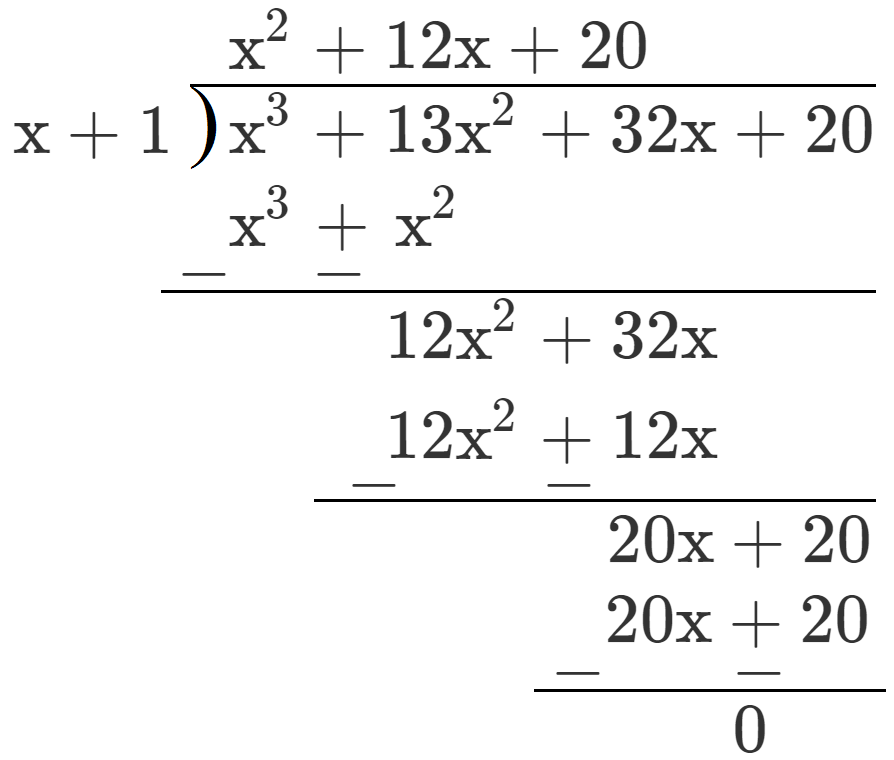
Let us find the quotient while dividing $x^3 + 13x^2 + 32x + 20 by (x + 1)$
By long division
​​​​​​​

We know that
Dividend = $Divisor \times Quotient + Remainder$
$x^3 + 13x^2 + 32x + 20 = (x + 1)(x^2 + 12x + 20) + 0$
$= (x + 1)(x^2 + 10x + 2x + 20)$
$= (x + 1)[x(x + 10) + 2(x + 10)]$
$= (x + 1)(x + 10)(x + 2)$
$= (x + 1)(x + 2)(x + 10)$

Need a full question paper?

Generate a complete, print-ready paper with questions like this in minutes — across 16+ boards, with answer keys.
Start Generating Free

Similar questions

Draw the graph of the following linear equations in two variables:
2y = -x + 1
If $\text{a}=\frac{\sqrt{3}-\sqrt{2}}{\sqrt{3}+\sqrt{2}}$ and $\text{b}=\frac{\sqrt{3}+\sqrt{2}}{\sqrt{3}-\sqrt{2}},$ find the value of $a^2 + b^2 - 5ab.$
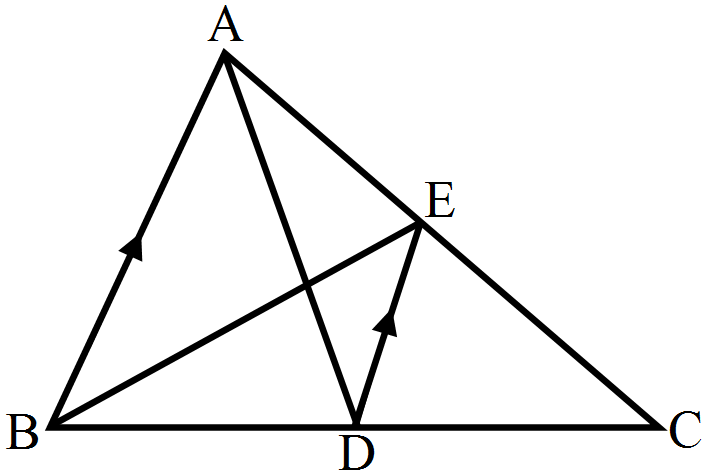
In the adjoining figure, AD is a median of $\triangle\text{ABC}$ and DE || BA. Show that BE is also a median of $\angle\text{ABC}.$
The radii of two cylinders are in the ratio 2:3 and their heights are in the ratio 5:3. Calculate the ratio of their volumes and the ratio of their curved surfaces.
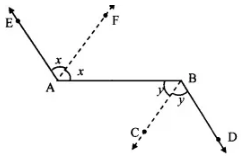
In the given figure, ray AE || ray BD, ray AF is the bisector of ∠EAB and ray BC is the bisector of ∠ABD. Prove that line AF || line BC.

Image
Given: Ray AE || ray BD, and
ray AF and ray BC are the bisectors of ∠EAB and ∠ABD respectively.
To prove: line AF || line BC
Represent $\sqrt{6},\sqrt{7},\sqrt{8}$ on the number line.
Find the area of a rhombus whose perimeter is 80m and one of whose diagonal is $24m.$
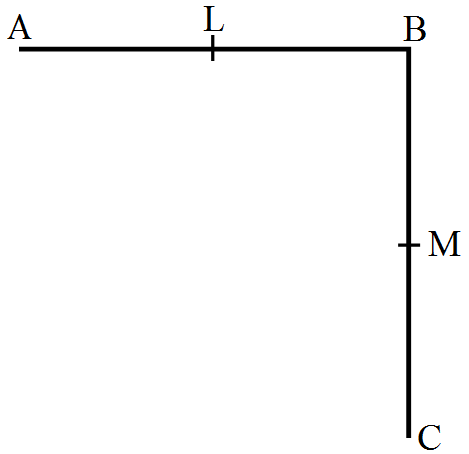
In the given figure, L and M are the mid-points of AB and BC respectively.
  1. If AB = BC, prove that AL = MC.
  2. If BL = BM, prove that AB = BC.
Hint:
  1. $\text{AB}=\text{BC}\Rightarrow\frac{1}{2}\text{AB}=\frac{1}{2}\text{BC}\Rightarrow\text{AL}=\text{MC}.$
  2. $\text{BL}=\text{BM}\Rightarrow2\text{BL}=2\text{BM}\Rightarrow\text{AB}=\text{BC}.$
If $\text{x}-\frac{1}{\text{x}}=\frac{1}{2},$ then write the value of $4\text{x}^2+\frac{4}{\text{x}^2}.$
Two circular cylinders of equal volumes have their heights in the ratio $1 : 2$. Find the ratio of two radii.