Question
Using Gauss’s theorem, show mathematically that for any point outside the shell, the field due to a uniformly charged thin spherical shell is the same as if the entire charge of the shell is concentrated at the centre. Why do you expect the electric field inside the shell to be zero according to this theorem?
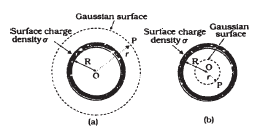
Answer

$\phi =\oint\limits_{s}\overrightarrow{\text{E}}.\overrightarrow{\text{d}}\text{s} = \frac{\text{q}}{\varepsilon_{\circ}}$
Derivation: $\text{E}\times4\pi\text{r}^{2} =\frac{\sigma}{\varepsilon_{\circ}}4\pi\text{R}^{2}$
$\therefore \text{E} = \frac{\sigma\text{R}^{2}}{\varepsilon_{\circ}\text{r}^{2}}$
where $\text{q} = 4\pi\text{R}^{2}\sigma$ is the total charge on the spherical shell. Electrostatic field is zero, since total charge inside the shell is zero or charge reside on the surface of the shell.

Need a full question paper?

Generate a complete, print-ready paper with questions like this in minutes — across 16+ boards, with answer keys.

Start Generating Free

Similar questions

Two neutral particles are kept $1m$ apart. Suppose by some mechanism some charge is transferred from one particle to the other and the electric potential energy lost is completely converted into a photon. Calculate the longest and the next smaller wavelength of the photon possible.
A point charge of $2.0\  \mu\ C$ is at the centre of a cubic Gaussian surface $9.0 \ cm$ on edge. What is the net electric flux through the surface?
A light ray falling at an angle of $45^\circ$ with the surface of a clean slab of ice of thickness $1m$ is refracted into it at an angle of $30^\circ$ . Calculate the time taken by the light rays, to cross the slab. Speed of light in vacuum $= 3 \times 10^8m/s$
Consider a sphere of radius R with charge density distributed as$\rho\text{(r)}=\text{kr for r}\leq\text{R}$
$=0\text{ for f}>\text{R}.$
Find the electric field at all points r.
Write the order of frequency range and one use of each of the following electromagnetic radiations$:$
  1. Microwaves.
  2. Ultra$-$violet rays.
  3. Gamma rays.
In a hydrogen atom, the electron and proton are bound at a distance of about $0.53 \mathring{\text{A}}$:
  1. Estimate the potential energy of the system in $eV,$ taking the zero of the potential energy at infinite separation of the electron from proton.
  2. What is the minimum work required to free the electron, given that its kinetic energy in the orbit is half the magnitude of potential energy obtained in $(a)?$
  3. What are the answers to $(a)$ and $(b)$ above if the zero of potential energy is taken at $1.06 \mathring A$ separation?
Answer the following question :
Why must both the objective and the eyepiece of a compound microscope have short focal lengths?
Red light, however bright it is, cannot produce the emission of electrons from a clean zinc surface. But even weak ultraviolet radiation can do so. Why?
Electrons are emitted from the cathode of negligible work function, when photons of wavelength $\lambda$ are incident on it. Derive the expression for the de Broglie wavelength of the electrons emitted in terms of the wavelength of the incident light.
Monochromatic light of wavelength 589 nm is incident from air on a water surface. What are the wavelength, frequency and speed of (a) reflected, and (b) refracted light? Refractive index of water is 1.33.
Two particles $A$ and $B$ having charges of $+2.00 \times 10^{-6}C$ and of $-4.00 \times 10^{-6}C$ respectively are held fixed at a separation of $20.0\ cm.$ Locate the point$(s)$ on the line $AB$ where
  1. The electric field is zero.
  2. The electric potential is zero.