Question
Using Gauss’s theorem, show mathematically that for any point outside the shell, the field due to a uniformly charged thin spherical shell is the same as if the entire charge of the shell is concentrated at the centre. Why do you expect the electric field inside the shell to be zero according to this theorem?
Answer

$\phi =\oint\limits_{s}\overrightarrow{\text{E}}.\overrightarrow{\text{d}}\text{s} = \frac{\text{q}}{\varepsilon_{\circ}}$

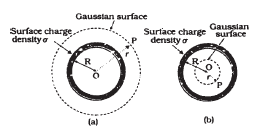
Derivation: $\text{E}\times4\pi\text{r}^{2} =\frac{\sigma}{\varepsilon_{\circ}}4\pi\text{R}^{2}$

$\therefore \text{E} = \frac{\sigma\text{R}^{2}}{\varepsilon_{\circ}\text{r}^{2}}$

where $\text{q} = 4\pi\text{R}^{2}\sigma$ is the total charge on the spherical shell. Electrostatic field is zero, since total charge inside the shell is zero or charge reside on the surface of the shell.

Need a full question paper?

Generate a complete, print-ready paper with questions like this in minutes — across 16+ boards, with answer keys.

Start Generating Free

Similar questions

A transverse wave of amplitude 0.50mm and frequency 100Hz is produced on a wire stretched to a tension of 100N. If the wave speed is 100m/s, what average power is the source transmitting to the wire?
A converging lens and a diverging mirror are placed at a separation of 15cm. The focal length of the lens is 25cm and that of the mirror is 40cm. Where should a point source be placed between the lens and the mirror so that the light, after getting reflected by the mirror and then getting transmitted by the lens, comes out parallel to the principal axis?
  1. Drive the expression for electric field at a point on the equatorial line of an electric dipole.
  2. Depict the orientation of the dipole in (i) stable, (ii) unstable equilibrium in a uniform electric field.
Two isolated metal spheres A and B have radii R and 2R respectively, and same charge q. Find which of the two spheres have greater energy density just outside the surface of the spheres.
Show that the wavelength of electromagnetic radiation is equal to the de Broglie wavelength of its quantum (photon).
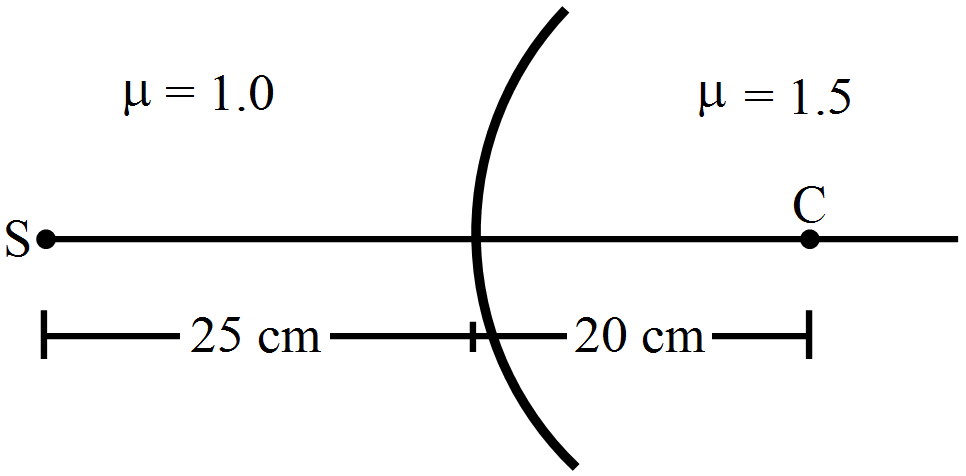
Locate the image formed by refraction in the situation shown in figure.

Explain the construction of compound microscope with the help of figure and derive the equation of magnification.
A convex lens made up of glass of refractive index 1.5 is dipped, in turn, in:

  1. Medium A of refractive index 1.65
  2. Medium B of refractive index 1.33

Explain, giving reasons, whether it will behave as a converging lens or a diverging lens in each of these two media.

The work function for the following metals is given:
Na: 2.75 eV; K: 2.30 eV; Mo: 4.17 eV; Ni: 5.15 eV. Which of these metals will not give photoelectric emission for a radiation of wavelength 3300 Å from a He-Cd laser placed 1 m away from the photocell? What happens if the laser is brought nearer and placed 50 cm away?
The magnetic field B inside a long solenoid, carrying a current of 5.00A, is 3.14 × 10⁻²T. Find the number of turns per unit length of the solenoid.