Question
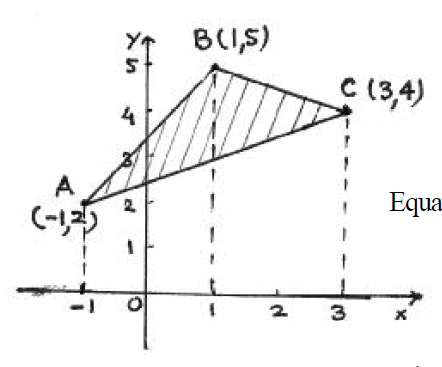
Using integration, find the area of the region bounded by the triangle whose vertices are (–1, 2), (1, 5) and (3, 4).
Answer

Correct fiqure

Equation of
$\text{AB is}:\text{y} =\frac{1}{2}(3 \text{x} + 7 )$
$\text{BC is:}\text{y} = \frac{1}{2}(11 - \text{x})$
$\text{AC is}:\text{y} =\frac{1}{2}(\text{x} + 5 )$
Required area $ =\frac{1}{2}\int\limits_{-1}^{1}(3 \text{x} + 7 )\text{dx} + \frac{1}{2}\int\limits_{1}^{3}(11 - \text{x})\text{dx} - \frac{1}{2}\int\limits_{-1}^{3}(\text{x} + 5 )\text{dx}$
$ = \bigg[\frac{1}{12}(3 \text{x} + 7 )^{2}\bigg]_{-1}^{1} - \frac{1}{4}\bigg[(11-\text{x})^{2}\bigg]_{1}^{3} - \frac{1}{4}\bigg[(\text{x} + 5)^{2}\bigg]_{-1}^{3}$
= 7 + 9 – 12 = 4 sq. units.

Need a full question paper?

Generate a complete, print-ready paper with questions like this in minutes — across 16+ boards, with answer keys.

Start Generating Free

Similar questions

Find the slope of the normal to the curve $\text{x} =1-\text{a}\sin \theta,\text{y}=\text{b} \cos^2\theta \text{ at } \theta =\frac{\pi}{2}.$
Solve the following differential equation
$\frac{\text{dy}}{\text{dx}}-\text{x}\text{e}^\text{x}-\frac{5}{2}+\cos^2\text{x}$
If $\text{A}=\begin{bmatrix}1&0&-2\\3&-1&0\\-2&1&1\end{bmatrix},\text{B}=\begin{bmatrix}0&5&-4\\-2&1&3\\-1&0&2\end{bmatrix}$ and $\text{C}=\begin{bmatrix}1&5&2\\-1&1&0\\0&-1&1\end{bmatrix},$ verify that A(B - C) = AB - AC.
A card is drawn and replaced in an ordinary pack of 52 cards. How many times must a card be drawn so that.
  1. there is at least an even chance of drawing a heart.
  2. the probability of drawing a heart is greater than $\frac{3}{4}$?
Evaluate the following intregals:
$\int\frac{\text{x}^2+1}{(2\text{x}+1)(\text{x}^2-1)}\text{ dx}$
Show that the points A (1, -2, -8), B (5, 0, -2) and C (11, 3, 7) are collinear, and find the ratio in which B divides AC.
Show that the function f given by:
$f(x) = \begin{matrix} \frac{e^{1/x} - 1}{e^{1/x} + 1} & ,\text{if }x \neq 0 \\ -1 & ,\text{if }x = 0 \\ \end{matrix} $
is discontinuous at $x = 0$
Show that the following system of linear equations is consistent and also find solution:
$2x + 3y = 5$
$6x + 9y = 15$
Find the points of discontinuity, if any of the following function:
$\text{f(x)}=\begin{cases}\frac{\text{x}^4+\text{x}^3+2\text{x}^2}{\tan^{-1}\text{x}},&\text{if }\text{ x}\neq0\\10,&\text{if }\text{ x}=0\end{cases}$
Evaluate:
$\begin{vmatrix}\text{a}&\text{b}+\text{c}&\text{a}^2\\\text{b}&\text{c}+\text{a}&\text{b}^2\\\text{c}&\text{a}+\text{b}&\text{c}^2\end{vmatrix}$