Question
Using lens maker's formula obtain the equation of lens.

Answer


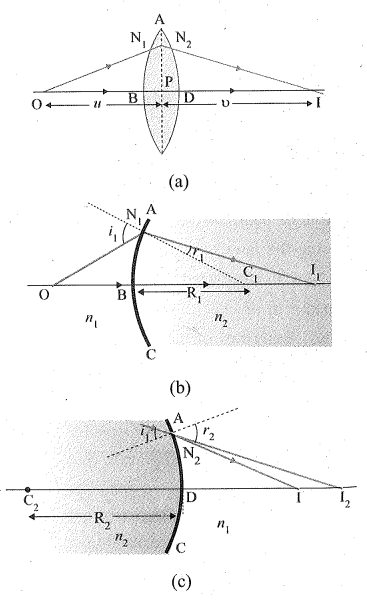
Image
→For refraction at two spherical surfaces of lens,
$\begin{aligned}& \frac{n_1}{ OB }+\frac{n_1}{ DI }=\left(n_2-n_1\right)\left(\frac{1}{ BC _1}+\frac{1}{ DC _2}\right) \\\therefore \quad & n_1\left(\frac{1}{ OB }+\frac{1}{ DI }\right)=\left(n_2-n_1\right)\left(\frac{1}{ BC _1}+\frac{1}{ DC _2}\right) \\\therefore \quad & \frac{1}{ OB }+\frac{1}{ DI }=\left(n_{21}-1\right)\left(\frac{1}{ BC _1}+\frac{1}{ DC _2}\right)\end{aligned}$
→using sign convention,
$OB =-u, DI =v, BC _1= R _1 \text { and } DC _2=- R _2.$
Substituting these values in above equation,
$\therefore-\frac{1}{u}+\frac{1}{v}=\left(n_{21}-1\right)\left(\frac{1}{ R _1}-\frac{1}{ R _2}\right)$            ...(1)
→lens maker's formula,
$\therefore \quad \frac{1}{f}=\left(n_{21}-1\right)\left(\frac{1}{ R _1}-\frac{1}{ R _2}\right)$              ...(2)
→Comparing equation (1) and (2),
$\therefore \frac{1}{v}-\frac{1}{u}=\frac{1}{f}$
→This equation is known as lens equation.
→This equation is true for both convex and concave lens.

Need a full question paper?

Generate a complete, print-ready paper with questions like this in minutes — across 16+ boards, with answer keys.
Start Generating Free

Similar questions

If the separation between the slits in a Young's double slit experiment is increased, what happens to the fringe-width? If the separation is increased too much, will the fringe pattern remain detectable?
  1. In what way is diffraction from each slit related to the interference pattern in a double slit experiment?
  2. Two wavelengths of sodium light 590 nm and 596 nm are used, in turn, to study the diffraction taking place at a single slit of aperture 2 × 10⁻⁴ m. The distance between the slit and the screen is 1.5 m. Calculate the separation between the positions of the first maxima of the diffraction pattern obtained in the two cases.
A potentiometer wire of length 1 m has a resistance of 5 $\Omega$. It is connected to a 8 V battery in series with a resistance of 15 $\Omega$. Determine the emf of the primary cell which gives a balance point at 60 cm.
It is said that any charge given to a conductor comes to its surface. Should all the protons come to the surface? Should all the electrons come to the surface? Should all the free electrons come to the surface?
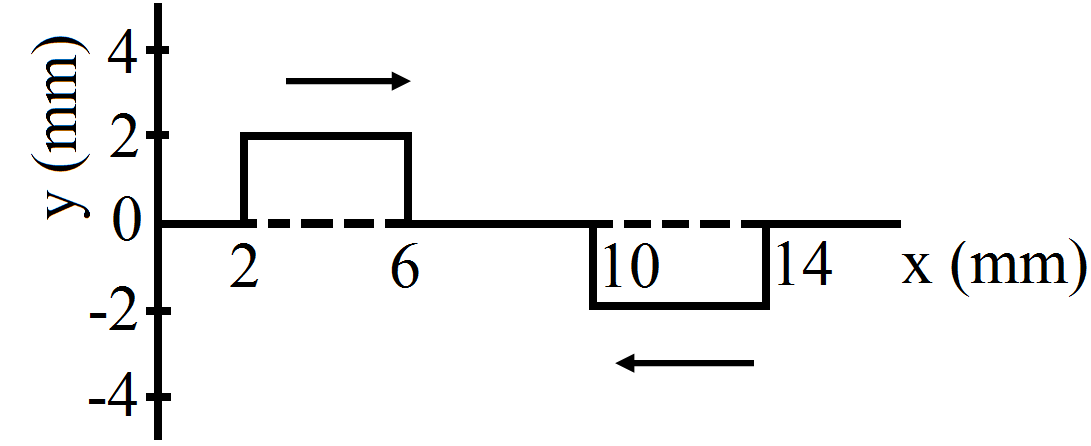
Figure shows two wave pulses at t = 0 travelling on a string in opposite directions with the same

wave speed 50cm/s. Sketch the shape of the string at t = 4ms, 6ms, 8ms, and 12ms.
  1. Show, giving a suitable diagram, how unpolarized light can be polarised by reflection.
  2. Two polaroids P1 and P2  are placed with their pass axes perpendicular to each other. Unpolarised light of intensity Io is incident on P1 A third polaroid P3 is kept in between P1 and P2 such that its pass axis makes an angle of $60^{\circ}$with that of P1. Determine the intensity of light transmitted through P1, P2 and P3.
A capacitance C charged to a potential difference V is discharged by connecting its plates through a resistance R. Find the heat dissipated in one time constant after the connections are made. Do this by calculating $\int\text{i}^2\text{R}$ dt and also by finding the decrease in the energy stored in the capacitor.
A $10 \mu F$ capacitor is connected to a $230 \cdot V, 50 Hz$ source. Find the capacitive reactance and the current (rms and peak) in the circuit. If the frequency is doubled what happens to the capacitive reactance and the current ?
Use the formula λm T = 0.29 cm K to obtain the characteristic temperature ranges for different parts of the electromagnetic spectrum. What do the numbers that you obtain tell you?
A nucleus with mass number $A =240$ and binding energy per nucleon $=7.6 MeV$ breaks into two fragments each of $A =120$ with binding energy per nucleon $= 8.5 MeV $. Calculate the released energy.