Question
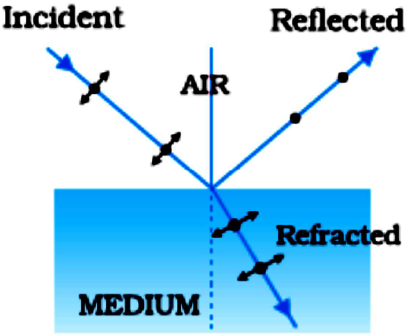
  1. Show, giving a suitable diagram, how unpolarized light can be polarised by reflection.
  2. Two polaroids P1 and P2  are placed with their pass axes perpendicular to each other. Unpolarised light of intensity Io is incident on P1 A third polaroid P3 is kept in between P1 and P2 such that its pass axis makes an angle of $60^{\circ}$with that of P1. Determine the intensity of light transmitted through P1, P2 and P3.
Answer

  1. When unpolarised light is incident on the boundary between two transparent media, the reflected light gets plane polarized with its electric vector perpendicular to the plane of incidence.

The polarization is complete when the reflected and refracted rays are at right angles to each other. This condition occurs for an angle of incidence, ip, where tan ip = $\mu$

  1. Intensity of light through $\text{P}_1=\frac{I_0}{2}$

Intensity of light through $\text{P}_2=\frac{I_0}{2}\cos^260$

$\frac{I_0}{2}.\bigg(\frac{1}{2}\bigg)^2=\frac{I_0}{8}$

Intensity of light through $ \text{P}_3=\frac{I_0}{8}\cos^230=\frac{I_0}{8}\times\bigg(\frac{\sqrt{3}}{2}\bigg)^2=\frac{3I_0}{32}$

Need a full question paper?

Generate a complete, print-ready paper with questions like this in minutes — across 16+ boards, with answer keys.

Start Generating Free

Similar questions

Find the energy liberated in the reaction:
223Ra → 209Pb + 14C.
The atomic masses needed are as follows.
223Ra 209Pb 14C
22.018u 208.981u 14.003u
  1. Six lead-acid type of secondary cells each of emf 2.0 V and internal resistance $0.015\Omega$ are joined in series to provide a supply to a resistance of $8.5\ \Omega.$ What are the current drawn from the supply and its terminal voltage?
  2. A secondary cell after long use has an emf of 1.9 V and a large internal resistance of $380\ \Omega$ What maximum current can be drawn from the cell? Could the cell drive the starting motor of a car?
A thin prism is made of a material having refractive indices 1.61 and 1.65 for red and violet light. The dispersive power of the material is 0.07. It is found that a beam of yellow light passing through the prism suffers a minimum deviation of 4.0° in favourable conditions. Calculate the angle of the prism.
A 3cm tall object is placed at a distance of 7.5cm from a convex mirror of focal length 6cm. Find the location, size and nature of the image.
In the original Fizeau method, the light travelled 8.6km and then returned. What could be the difficulty if this distance is taken as 8.6m?
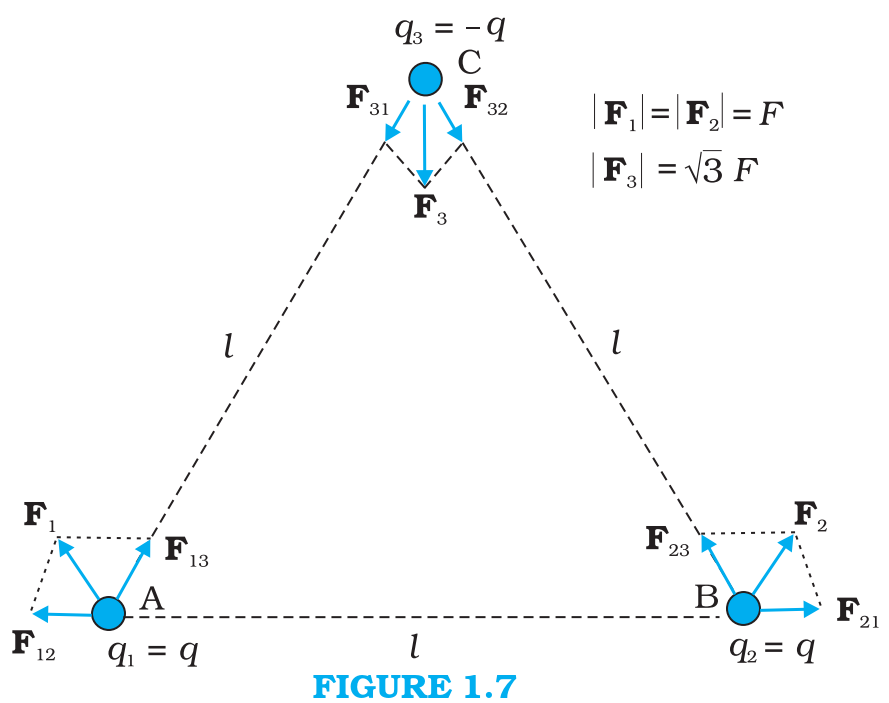
Consider the charges q, q, and –q placed at the vertices of an equilateral triangle, as shown in Fig. 1.7. What is the force on each charge?
Image
What is the de Broglie wavelength of:
  1. A bullet of mass 0.040 kg travelling at the speed of 1.0 km/s,
  2. A ball of mass 0.060 kg moving at a speed of 1.0 m/s, and
  3. A dust particle of mass 1.0 × 10–9 kg drifting with a speed of 2.2 m/s?
The magnetic field of a beam emerging from a filter facing a floodlight is given by B0 = 12 × 10-8sin (1.20 × 107z - 3.60 × 1015t) T. What is the average intensity of the beam?
Find magnetic field on the axis of a circular current carrying loop.
A ball falls on the ground from a height of 2.0m and rebounds up to a height of 1.5m. Find the coefficient of restitution.