Question
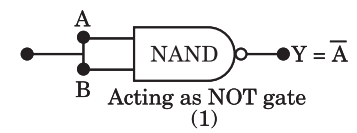
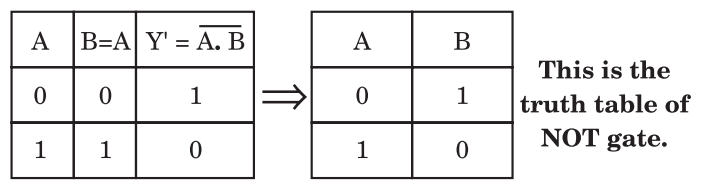
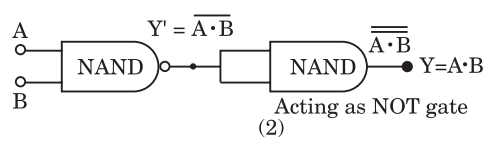
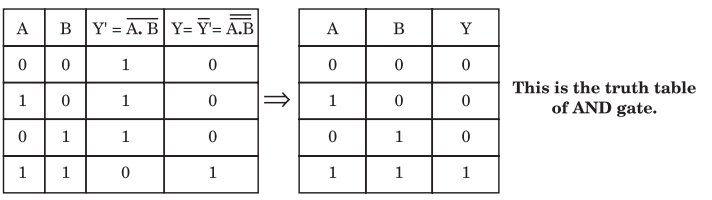
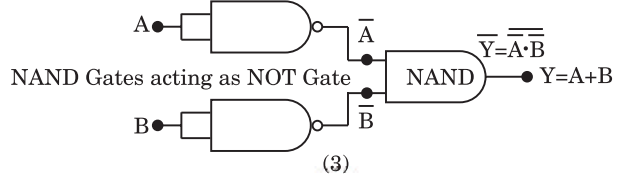
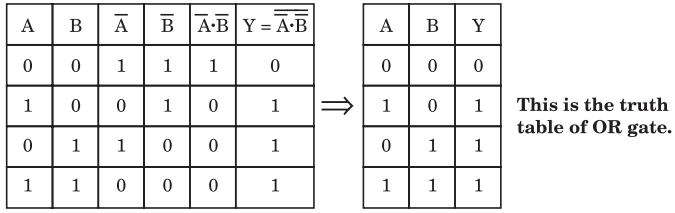
Using only NAND gate make combination diagrams to obtained NOT, AND and OR gates.

Need a full question paper?

Generate a complete, print-ready paper with questions like this in minutes — across 16+ boards, with answer keys.
Start Generating Free

Similar questions

Write Ampere's circuital law. Obtained and expression for magnetic field on the axis of a current carrying long solenoid with the help of ampere circuital law. Draw necessary diagram.
Why is it found experimentally difficult to detect neutrinos in nuclear $\beta$-decay?
Consider a gravity$-$free hall in which an experimenter of mass $50\ kg$ is resting on a $5\ kg$ pillow, $8ft$ above the floor of the hall. He pushes the pillow down so that it starts falling at a speed of $8ft/s.$ The pillow makes a perfectly elastic collision with the floor, rebounds and reaches the experimenter's head. Find the time elapsed in the process.
A magnetic dipole of magnetic moment $1.44A-m^2$ is placed horizontally with the north pole pointing towards north. Find the position of the neutral point if the horizontal component of the earth's magnetic field is $18 \mu\text{T}.$
On a winter day when the atmospheric temperature drops to $-10^\circ C$, ice forms on the surface of a lake.
  1. Calculate the rate of increase of thickness of the ice when $10\ cm$ of ice is already formed.
  2. Calculate the total time taken in forming $10\ cm$ of ice. Assume that the temperature of the entire water reaches $0^\circ C$ before the ice starts forming. Density of water $= 1000\ kgm^{-3}$, latent heat of fusion of ice $=3.36\times10^5\text{Jkg}^{-1}$ and thermal conductivity of ice $=1.7\text{Wm}^{-1}{^{\circ}}\text{C}^{-1}.$ Neglect the expansion of water on freezing.
The spectral series of hydrogen atom were accounted for by Bohr using the relation $\text{V}=\text{R}\Bigg(\frac{1}{\text{n}^2_1}-\frac{1}{\text{n}^2_2}\Bigg)$
where $R =$ Rydberg constant $= 1.097 \times 107m^{-1}$ Lyman series is obtained when an electron jumps to first orbit from any subsequent orbit. Similarly, Balmer series is obtained when an electron jumps to $2^{nd}$ orbit from any subsequent orbit, Paschen series is obtained when an electron jumps to $3^{rd}$ orbit from any subsequent orbit. Whereas Lyman series lies in $U.V$. region, Balmer series is in visible region and Pasch en series lies in infrared region. Series limit is obtained when $n_2 = \infty$
  1. The wavelength of first spectral line of Lyman series is.
  1. $1215.4A$
  2. $12154\ cm$
  3. $1215.4m$
  4. $1215.4mm$
  1. The wavelength limit of Lyman series is.
  1. $1215.4A$
  2. $511.9A$
  3. $951.6A$
  4. $911.6A$
  1. The frequency of first spectral line of Bahner series is.
  1. $1.097 \times 10^7Hz$
  2. $4.57 \times 10^{14}Hz$
  3. $4.57 \times 10^{15}Hz$
  4. $4.57 \times 10^{16}Hz$
  1. Which of the following transitions in hydrogen atoms emit photons of highest frequency?
  1. $n = 1$ to $ n = 2$
  2. $n = 2$ to $n = 6$
  3. $n = 6$ to $n = 2$
  4. $n = 2$ to $n = 1$
  1. The ratio of minimum to maximum wavelength in Balmer series is.
  1. $5 : 9$
  2. $5 : 36$
  3. $1 : 4$
  4. $3 : 4$
A person is standing on a weighing machine placed on the floor of an elevator. The elevator starts going up with some acceleration, moves with uniform velocity for a while and finally decelerates to stop. The maximum and the minimum weights recorded are $72\ kg$ and $60\ kg.$ Assuming that the magnitudes of the acceleration and the deceleration are the same, find:
  1. The true weight of the person.
  2. The magnitude of the acceleration. Take $g = 9.9m/s^2.$
If double slit apparatus is immersed in a liquid of refractive index, $\mu$ the wavelength of light reduces to $\lambda$ and fringe width also reduces to $\beta=\frac{\beta}{\mu}$.
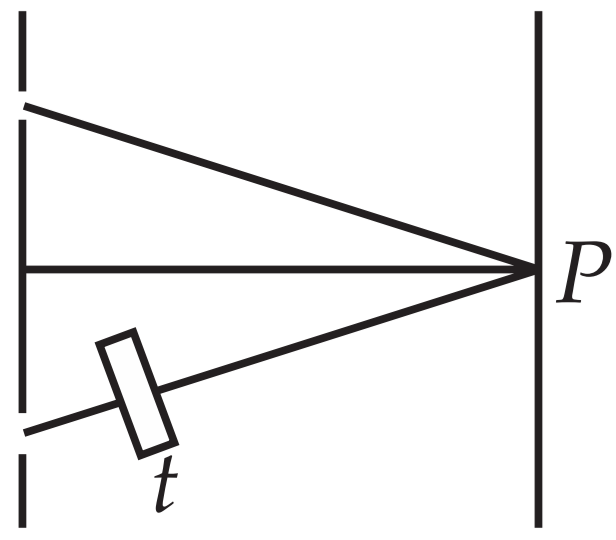
The given figure shows a double $-$ slit experiment in which coherent monochromatic light of wavelength $\lambda$ from a distant source is incident upon the two slits, each of width $\text{w}(\text{w}>>\lambda)$ and the interference pattern is viewed on a distant screen. A thin piece of glass of thickness $ t$ and refractive index $n$ is placed between one of the slit and the screen, perpendicular to the light path.
  1. ln Young's double slit interference pattern, the fringe width.
  1. Can be changed only by changing the wavelength of incident light.
  2. Can be changed only by changing the separation between the two slits.
  3. Can be changed either bychangingthe wavelength or by changing the separation between two sources.
  4. Is a universal constant and hence cannot be changed.
  1. If the width w ofone of the slits is increased to $2w,$ the become the amplitude due to slit.
  1. $1.5\text{a}$
  2. $\frac{\text{a}}{2}$
  3. $2\text{a}$
  4. No change.
  1. ln $\text{YDSE},$ let $A$ and $B$ be two slits. Films of thicknesses $t_A$ and $t_B$ and refractive indices $m_A$ and $m_B$ are placed in front of $A$ and $B,$ respectively. If $\mu_\text{A}\text{t}_\text{A}=\mu_\text{B}\text{t}_\text{B}$ then the central maxima will:
  1. Not shift.
  2. Shift towards $A$.
  3. Shift towards $B.$
  4. Shift towards $A$ if $t_B = t_A$ and shift towards $B$ if $t_B < t_A$​​​​​​​
  1. ln Young's double slit experiment, a third slit is made in between the double slits. Then:
  1. Fringes of unequal width are formed.
  2. Contrast between bright and dark fringes is reduced.
  3. Intensity of fringes totally disappears.
  4. Only bright tight is observed on the screen.
  1. ln Young's double slit experiment, if one of the slits is covered with a microscope cover slip, then:
  1. Fringe pattern disappears.
  2. The screen just gets illuminated.
  3. In the fringe pattern, the brightness of the bright fringes will decreases and the dark fringes will become more dark.
  4. Bright fringes will be more bright and dark fringes will become more dark.
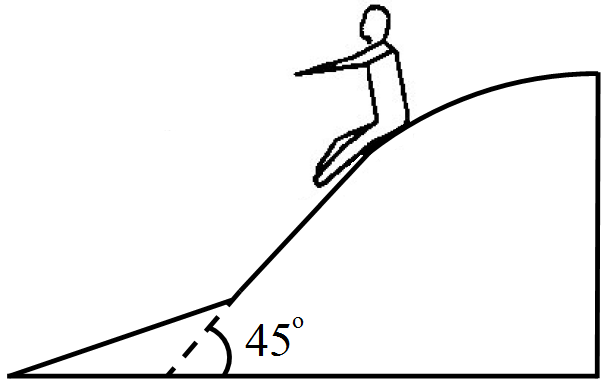
In a children$-$park an inclined plane is constructed with an angle of incline $45^\circ$ in the middle part. Find the acceleration of a boy sliding on it if the friction coefficient between the cloth of the boy and the incline is $0.6$ and $g = 10m/s^2$.
By mistake, an eye surgeon puts a concave lens in place of the lens in the eye after a cataract operation. Will the patient be able to see clearly any object placed at any distance?