Question
Why is it found experimentally difficult to detect neutrinos in nuclear $\beta$-decay?

Answer

Neutrinos are neutral (chargeless), (almost) massless particles that hardly interact with matter.Alternate Answer
The neutrinos can penetrate large quantity of matter without any interactionAlternate Answer
Neutrinos are chargeless and (almost) massless particles.

Need a full question paper?

Generate a complete, print-ready paper with questions like this in minutes — across 16+ boards, with answer keys.

Start Generating Free

Similar questions

Mutual inductance is the phenomenon of inducing emfina coil, due to a change of current in the neighbouring coil. The amount of mutual inductance that links one coil to another depends very much on the relative positioning of the two coils, their geometry and relative separation between them. Mutual inductance between the two coils increases ft, times if the coils are wound over an iron core of relative permeability.
  1. A short solenoid of radius a, number of turns per unit length $n_1,$ and length $L$ is kept coaxially inside a very long solenoid of radius $b,$ number of turns per unit length $n_2.$ What is the mutual inductance of the system?
  1. $\ce{\mu_0\pi\text{b}^2\text{n}_1\text{n}_2\text{L}}$
  2. $\ce{\mu_0\pi\text{a}^2\text{n}_1\text{n}_2\text{L}^2}$
  3. $\ce{\mu_0\pi\text{a}^2\text{n}_1\text{n}_2\text{L}}$
  4. $\ce{\mu_0\pi\text{b}^2\text{n}_1\text{n}_2\text{L}^2}$
  1. If a change in current of $0.01A$ in one coil produces a change in magnetic flux of $2 \times 10^{-2}$ weber in another coil, then the mutual inductance between coils is:
  1. $0$
  2. $0.5H$
  3. $2H$
  4. $3H$
  1. Mutual inductance of two coils can be increased by:
  1. Decreasing the number of turns in the coils.
  2. Increasing the number of turns in the coils.
  3. Winding the coils on wooden cores.
  4. None of these.
  1. When a sheet of iron is placed in between the two co$-$axial coils, then the mutual inductance between the coils will:
  1. Increase.
  2. Decrease.
  3. Remains same.
  4. Cannot be predicted.
  1. The $SJ$ unit of mutual inductance is:
  1. $\ce{Ohm}.$
  2. $\ce{Mho}.$
  3. Henry.
  4. None of these.
A car starts from rest on a half kilometer long bridge. The coefficient of friction between the tyre and the road is $1.0$. Show that one cannot drive through the bridge in less than $10s.$
According to Einstein, when a photonoflight offrequencyu or wavelength $\lambda$ is incident on a photosensitive metal surface of work function $\phi_0$, where $\phi_0<\text{h}\upsilon \ ($here $, h$ is Planck's constant$),$ then the emission of photoelectrons takes place. The maximum kinetic energy of the emitted photoelectrons is given by $\text{K}_\text{max}=\text{h}\upsilon-\phi_0$. If the frequency of the incident light is $\upsilon_0$ called thresold frequency, the photoelectrons are emitted from metal without any kinetic energy. So $\text{h}\upsilon_0=\phi_0$.
  1. A metal of work function $3.3eV$ is illuminated by light of wavelength $300\ nm$. The maximum kinetic energy of photoelectrons emitted is $($taking $h = 6.6 \times 10^{-34} Js).$
  1. $0.413eV$
  2. $0.825eV$
  3. $1.65eV$
  4. $1.32eV$
  1. The variation of maximum kinetic energy $(K_{max})$ of the variation of maximum kinetic energy $(\upsilon)$ of the incident radiations can be represented by:
  1. The variation of photoelectric current $(i)$ with the intensity of the incident radiation $(I)$ can be represented by:
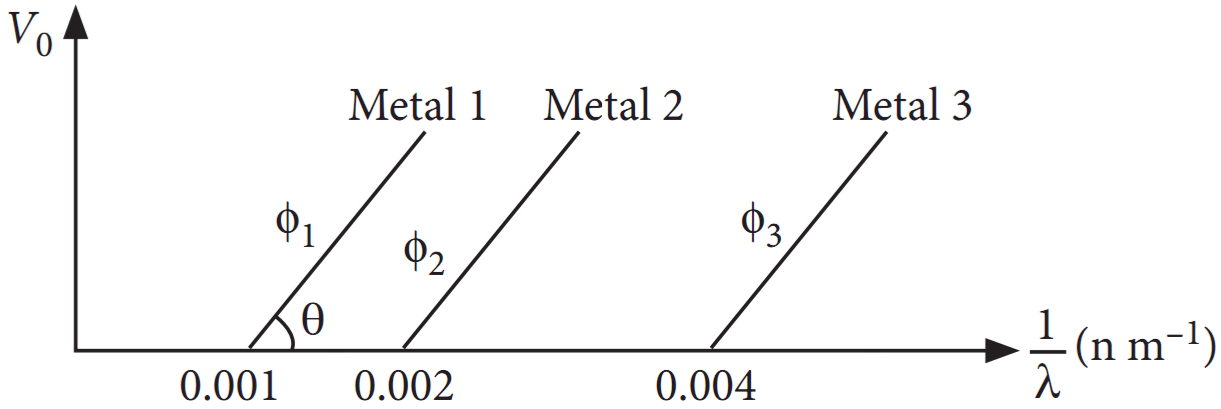
  1. The graph between the stopping potential $(V_0)$ and $\Big(\frac{1}{\lambda}\Big)$ is shown in the figure. $\phi_1,\phi_2,\phi_3$ are work function. Which of the following options is correct?
  1. $\phi_1:\phi_2:\phi_3=1:2:3$
  2. $\phi_1:\phi_2:\phi_3=4:2:1$
  3. $\phi_1:\phi_2:\phi_3=1:2:4$
  4. Ultraviolet tight can be used to emit photoelectrons from metal $2$ and metal $3$ only.
  1. Which of the following figures represent the variation of particle momentum and the associated de $-$ Broglie wavelength?
The radio and TV programmes, telecast at the studio, reach our antenna by wave motion. Is it a mechanical wave or nonmechanical?
A small object is embedded in a glass sphere $(\mu=1.5)$ of radius 5.0cm at a distance 1.5cm left to the centre. Locate the image of the object as seen by an observer standing.
  1. To the left of the sphere.
  2. To the right of the sphere.
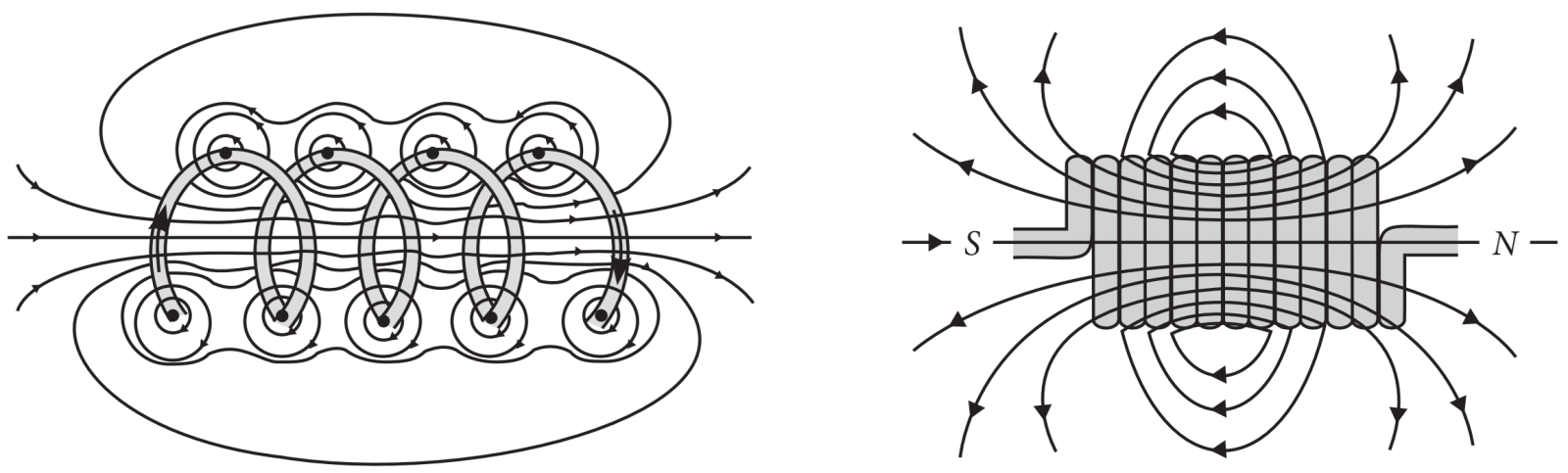
A solenoid is a long coil of wire tightly wound in the helical form. Solenoid consists of closely stacked rings electrically insulated from each other wrapped around a non$-$conducting cylinder.
Figure below shows the magnetic field lines of a solenoid carrying a steady current $I.$ We see that if the turns are closely spaced, the resulting magnetic field inside the solenoid becomes fairly uniform, provided that the length of the solenoid is much greater than its diameter. for an "ideal" solenoid, which is infinitely long with turns tightly packed, the magnetic field inside the solenoid is uniform and parallel to the axis, and vanishes outside the solenoid.
  1. A long solenoid has $800$ turns per metre length of solenoid. a current of $1.6A$ flows through it. The magnetic induction at the end of the solenoid on its axis is
  1. $10 \times 10^{-4}T$
  2. $8 \times 10^{-4}T$
  3. $32 \times 10^{-4}T$
  4. $4 \times 10^{-4}T$
  1. Choose the correct statement in the following.
  1. The magnetic field inside the solenoid is less than that of outside.
  2. The magnetic field inside an ideal solenoid is not at all uniform.
  3. The magnetic field at the centre, inside an ideal solenoid is almost twice that at the ends.
  4. The magnetic field at the centre, inside an ideal solenoid is almost half of that at the ends.
  1. The magnetic field $(B)$ inside a long solenoid having $n$ turns per unit length and carrying current $I$ when iron core is kept in it is $(\mu_0 =$ permeability of vacuum, $=$ magnetic susceptibility$)$
  1. $\mu_0\text{ nI}(\text{l}-\chi)$
  2. $\mu_0\text{ nI }\chi$
  3. $\mu_0\text{ nI}^2(\text{1}+\chi)$
  4. $\mu_0\text{ nI}(\text{1}+\chi)$
  1. A solenoid oflength land having $l$ turns carries a current $I$ is in anticlockwise direction. The magnetic field is:
  1. $\mu_0\text{ nI}$
  2. $\mu_0\frac{\text{ nI}}{\text{l}^2}$
  3. A​​​​​​along the axis of solenoid.
  4. Perpendicular to the axis of coil.
  1. The magnitude of the magnetic field inside a long solenoid is increased by:
  1. Decreasing its radius.
  2. Decreasing the current through it.
  3. Increasing its area of cross$-$section.
  4. Introducing a medium of higher permeability.
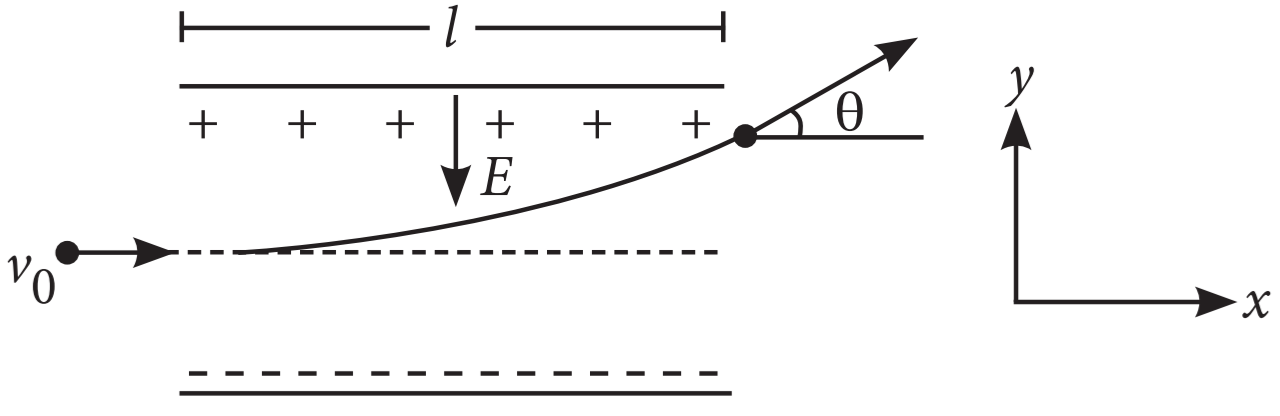
When a charged particle is placed in an electric field, it experiences an electrical force. If this is the only force on the particle, it must be the net force. The net force will cause the particle to accelerate according to Newton's second law. So $\vec{\text{F}}_\text{e}=\text{q}\vec{\text{E}}=\text{m}\vec{\text{a}}$
If $\vec{\text{E}}$ is uniform, then $\vec{\text{a}}$ is constant and $\vec{\text{a}}=\text{q}\vec{\text{E}}\text{/ m.}$ If the particle has a positive charge, its acceleration is in the direction of the field. If the particle has a negative charge, its acceleration is in the direction opposite to the electric field. Since the acceleration is constant, the kinematic equations can be used.
  1. An electron of mass $m,$ charge e falls through a distance h metre in a uniform electric field $E$. Then time of fall,
  1. $\text{t}=\sqrt{\frac{\text{2hm}}{\text{eE}}}$
  2. $\text{t}=\frac{\text{2hm}}{\text{eE}}$
  3. $\text{t}=\sqrt{\frac{\text{2eE}}{\text{hm}}}$
  4. $\text{t}=\frac{\text{2eE}}{\text{hm}}$
  1. An electron moving with a constant velocity $v$ along $X-$ axis enters a uniform electric field applied along $Y-$ axis. Then the electron moves:
  1. With uniform acceleration along $Y-$ axis
  2. Without any acceleration along $Y-$ axis
  3. In a trajectory represented as $y = ax^2$
  4. In a trajectory represented as $y = ax$
  1. Two equal and opposite charges of masses $m_1$ and $m_2$ are accelerated in an uniform electric field through the same distance. What is the ratio of their accelerations if their ratio of masses is $\frac{\text{m}_1}{\text{m}_2}=0.5?$
  1. $\frac{\text{a}_1}{\text{a}_2}=2$
  2. $\frac{\text{a}_1}{\text{a}_2}=0.5$
  3. $\frac{\text{a}_1}{\text{a}_2}=3$
  4. $\frac{\text{a}_1}{\text{a}_2}=1$
  1. A particle of mass $m$ carrying charge $q$ is kept at rest in a uniform electric field $E$ and then released. The kinetic energy gained by the particle, when it moves through a distance $y$ is:
  1. $\frac{1}{2}\text{qEy}^2$
  2. $qEy$
  3. $qEy^2$
  4. $qE^2y$
  1. $A$ charged particle is free to move in an electric field. It will travel:
  1. Always along a line of force.
  2. Along a line of force, if its initial velocity is zero.
  3. Along a line of force, if it has some initial velocity in the direction of an acute angle with the line of force.
  4. None of these.
The electric field intensity at a point at a distance of 20 cm from the centre of a sphere is 10 Volt/meter. Find the intensity of the electric field at a point located at a distance 8 cm from the centre of that circle. The radius of the sphere is 5 cm.
The magnetic field at a point, $10\ cm$ away from a magnetic dipole, is found to be $2.0 \times 10^{-4 }T$. find the magnetic moment of the dipole if the point is.
  1. In end-on position of the dipole.
  2. In broadside-onposition of the dipole.
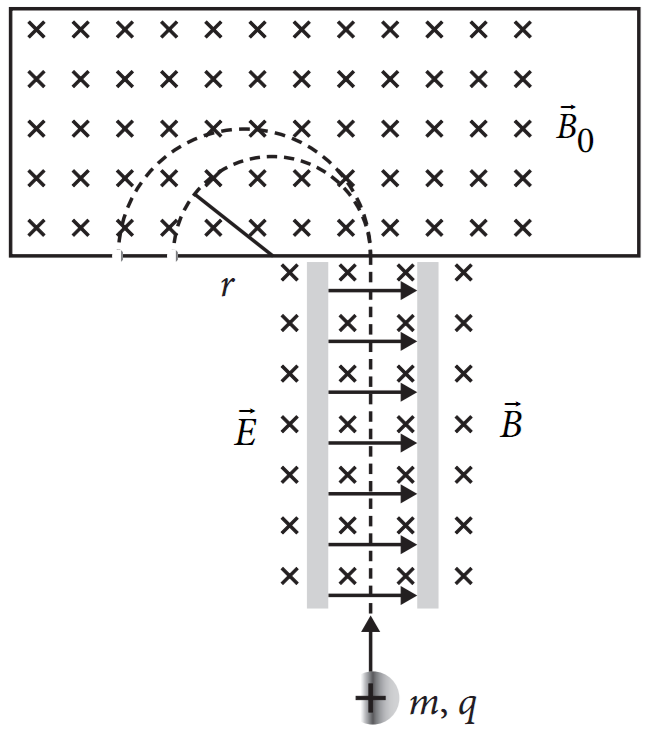
Various methods can be used to measure the mass of an atom. One possibility is through the use of a mass spectrometer. The basic feature of a Banbridge mass spectrometer is illustrated in figure. A particle carrying a charge $+q$ is first sent through a velocity selector and comes out with velocity $\text{v}=\frac{\text{E}}{\text{B}}.$
The applied electric and magnetic fields satisfy the relation $E = vB$ so that the trajectory of the particle is a straight line. Upon entering a region where a second magnetic field $\vec{\text{B}}_0$ pointing into the page has been applied, the particle will move in a circular path with radius rand eventually strike the photographic plate.
  1. In mass spectrometer, the ions are sorted out in which of the following ways?
  1. By accelerating them through electric field.
  2. By accelerating them through magnetic field.
  3. By accelerating them through electric and magnetic field.
  4. By applying a high voltage.
  1. Radius of particle in second magnetic field $B_0$ is :
  1. $\frac{2\text{mv}}{\text{qE}_0}$
  2. $\frac{\text{mv}}{\text{qE}_0}$
  3. $\frac{\text{mv}}{\text{qB}_0}$
  4. $\frac{2\text{mE}_0\text{v}}{\text{qB}_0}$
  1. Which of the following will trace a circular trajectory with largest radius?
  1. Proton
  2. $ct-$particle
  3. Electron
  4. A particle with charge twice and mass thrice that of electron.
  1.  Mass of the particle in terms $q, B_0, B,$ rand $E$ is :
  1. $\frac{\text{qbr}}{\text{E}}$
  2. $\frac{\text{qbr}}{\text{E}}$
  3. $\frac{\text{qbr}}{\text{E}}$
  4. $\frac{\text{qbr}}{\text{E}}$ 
  1. The particle comes out of velocity selector along a straight line, because :
  1. Electric force is less than magnetic force.
  2. Electric force is greater than magnetic force.
  3. Electric and magnetic force balance each other.
  4. Can't say.