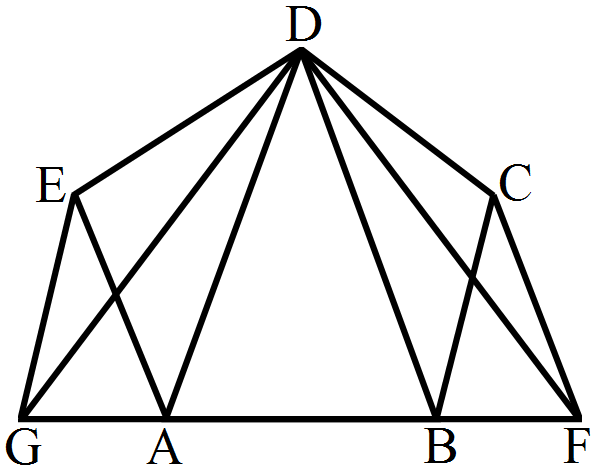
Question
Using rulers and compasses only, draw an angle of measure 135°.

Answer


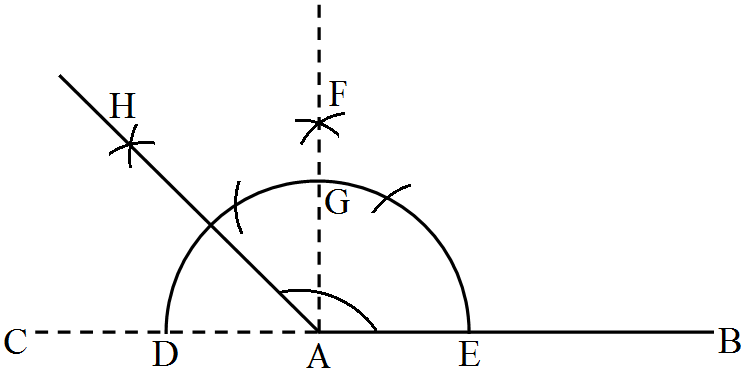
Steps of construction:
  1. Draw a line segment AB and produce BA to C.
  2. Keeping A as the center and any radius draw an arc which intersects AC at D and AB at E.
  3. Keeping D and E as center and radius more than half of DE draw arcs which intersect each other at F.
  4. Join FA which intersects the arc in (2) at G.
  5. Keeping G and D as center and radius more than half of GD draw arcs which intersect each other at H.
  6. Join HA.
Therefore $\angle\text{HAB}=135^\circ$

Need a full question paper?

Generate a complete, print-ready paper with questions like this in minutes — across 16+ boards, with answer keys.
Start Generating Free

Similar questions

The monthly wages of 30 workers in a factory are given below:
83.0, 835, 890, 810, 835, 836, 869, 845, 898, 890, 820, 860, 832, 833, 855, 845, 804, 808, 812, 840, 885, 835, 836, 878, 840, 868, 890, 806, 840, 890.
Represent the data in the form of a frequency distribution with class size 10.
If the angles A, B and C of $\triangle\text{ABC}$ satisfy the relation B − A = C − B, then find the measure of $\angle\text{B}.$
Prove that if the two arms of an angle are perpendicular to the two arms of another angle, then the angles are either equal or supplementary.
The ratio of two numbers is 5 : 7. If 40 is added in each number, then the ratio becomes
25 : 31, Find the numbers.
Without actual division, show that $\left(x^3-3 x^2-13 x+15\right)$ is exactly divisible by $\left(x^2+2 x-3\right)$
Is it possible to draw a triangle with sides of length 2cm, 3cm and 7cm?
If $\text{a}=\frac{\sqrt{3}-\sqrt{2}}{\sqrt{3}+\sqrt{2}}$ and $\text{b}=\frac{\sqrt{3}+\sqrt{2}}{\sqrt{3}-\sqrt{2}},$ find the value of $a^2 + b^2 - 5ab.$
The given figure shows a pentagon ABCDE. EG, drawn parallel to DA, meets BA produced at G, and CF, drawn parallel to DB, meets AB produced at F. Show that:
$\text{ar}(\text{pentagon ABCDE})=\text{ar}(\triangle\text{DGF}).$
What must be added to $x^3 - 3x^2 - 12x + 19$ so that the result is exactly divisibly by $x^2 + x - 6$?
In the following, use factor theorem to find whether polynomial g(x) is a factor of polynomial f(x) or, not:
$f(x) = x^3 - 6x^2 + 11x - 6, $
$g(x)=x^2 - 3x + 2$