Question
Using $\text{B}=\mu_0\text{H},$ find the ratio $\frac{\text{E}_0}{\text{H}_0}$ for a plane electromagnetic wave propagating through vacuum. Show that it has the dimensions of electric resistance. This ratio is a universal constant called the impedance of free space.
Answer

$\text{B}=\mu_0\text{H}$$\text{H}=\frac{\text{B}}{\mu_0}$
$\frac{\text{E}_0}{\text{H}_0}=\frac{\frac{\text{B}_0}{(\mu_0\in_0\text{C})}}{\frac{\text{B}_0}{\mu_0}}=\frac{1}{\in_0\text{C}}$
$=\frac{1}{8.85\times10^{-12}\times3\times10^8}$
$=376.6\Omega=377\Omega$
$\text{Dimension}\frac{1}{\in_0\text{C}}=\frac{1}{\big[\text{LT}^{-1}\big]\big[\text{M}^{-1}\text{L}^{-3}\text{T}^{4}\text{A}^2\big]}$
$=\frac{1}{\text{M}^{-1}\text{L}^{-2}\text{T}^{3}\text{A}^2}=\text{M}^1\text{L}^2\text{T}^{-3}\text{A}^{-2}=[\text{R}]$

Need a full question paper?

Generate a complete, print-ready paper with questions like this in minutes — across 16+ boards, with answer keys.

Start Generating Free

Similar questions

Considering the pressure p to be proportional to the density, find the pressure p at a height h if the pressure on the surface of the earth is $p_0$.
Explain why: A brass tumbler feels much colder than a wooden tray on a chilly day.
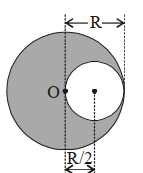
A sphere of radius $R$ has been cut out of $\left(\frac{R}{2}\right)$ solid sphere of radius $R$ as shown in the figure. Find the position of the center of mass of the remaining sphere.
Image
Show that $\text{AB} + \overline{\text{AB}}$ is always 1.
Find the radius of gyration of a circular ring of radius r about a line perpendicular to the plane of the ring and passing through one of its particles.
A long cylindrical wire of radius b carries a current i distributed uniformly over its cross-section. Find the magnitude of the magnetic field at a point inside the wire at a distance a from the axis.
A vector $\overrightarrow{\text{A}}$ makes an angle of 20° and $\overrightarrow{\text{B}}$ makes an angle of 110° with the X-axis. The magnitudes of these vectors are 3 m and 4 m respectively. Find the resultant.
What happens to the moment of force about a point, if the line of action of the force moves towards the point?
As gas expands from initial volume $V_1$ to $V_2$ in three process whose $P$$-V$ curve is shown in the figure, which process is which? In which of the following processes is the gas used the most?
The position vector of a particle depends on time as follows (in meters).
$\vec{r}=\left(2+3 t-t^3\right) \hat{i}+\left(-t+t^2\right) \hat{j}+\left(7 t+t^3\right) \hat{k}$
Find (i) Displacement of particle from $t=0 sec$ to $t=1 sec$ (ii) At $t=1 sec$, find the magnitude of instantaneous velocity and instantaneous acceleration of particle.