Question
Using the differential equation of linear S.H.M., obtain an expression for acceleration, velocity, and displacement of simple harmonic motion.

Answer

i. Expression for acceleration in linear S.H.M:
a. From the differential equation,
$ \frac{ d ^2 x }{ dt ^2}+\omega^2 x =0$
$\frac{ d ^2 x }{ dt ^2}=-\omega^2 x \ldots . . $
b. But, linear acceleration is given by, $ \frac{ d ^2 x }{ dt ^2}= a $ From equations (1) and (2), $ a=-\omega^2 x $
Equation (3) gives acceleration in linear S.H.M.
ii. Expression for velocity in linear S.H.M:
a. From the differential equation of linear S.H.M
$ \frac{ d ^2 x }{ dt ^2}=-\omega^2 x$
$\therefore \frac{ d }{ dt }\left(\frac{ dx }{ dt }\right)=-\omega^2 x$
$\therefore \frac{ dv }{ dt }=-\omega^2 x \ldots \ldots\left(\because \frac{ dx }{ dt }= v \right)$
$\therefore \frac{ dv }{ dx } \cdot \frac{ dx }{ dt }=-\omega^2 x$
$\therefore v \frac{ dv }{ dx }=-\omega^2 x \ldots \ldots .\left(\because \frac{ dx }{ dt }= v \right)$
$\therefore v dv =-\omega^2 xdx \ldots \ldots \ldots . .(4) $
b. Integrating both sides of equation (4),
$ \int v d v=\int-\omega^2 x d x$
$\frac{v^2}{2}=-\frac{\omega^2 x^2}{2}+C $
where, $C$ is the constant of integration.
c. At extreme position, $x= \pm A$ and $v=0$.
Substituting these values in equation (5),
$ 0=-\frac{\omega^2 A ^2}{2}+ C$
$\therefore C =\frac{\omega^2 A ^2}{2} \ldots \ldots \ldots \ldots $
d. Substituting equation (6) in equation (5),
$ \frac{ v ^2}{2}=-\frac{\omega^2 x ^2}{2}+\frac{\omega^2 A ^2}{2}$
$\therefore v ^2=\omega^2 A ^2-\omega^2 x ^2$
$\therefore v ^2=\omega^2\left( A ^2- x ^2\right)$
$\therefore v = \pm \omega \sqrt{ A ^2- x ^2} $
This is the required expression for velocity in linear S.H.M.
iii. Expression for displacement in linear S.H.M:
a. From the differential equation of linear S.H.M, velocity is given by,
$v=\omega \sqrt{ A ^2- x ^2}$
But, in linear motion, $v=\frac{d x}{d t}$
From equation ( 1 ) and ( 2 ),
$ \frac{ dx }{ dt }=\omega \sqrt{ A ^2- x ^2}$
$\therefore \frac{ dx }{\sqrt{ A ^2- x ^2}}=\omega dt . $
b. Integrating both sides of equation (3),
$ \int \frac{d x}{\sqrt{ A ^2- x ^2}}=\int \omega d t$
$\therefore \sin ^{-1}\left(\frac{ x }{ A }\right)=\omega t +\Phi $
where, $\alpha$ is constant of integration which depends upon initial condition (phase angle)
$ \therefore \frac{ x }{ A }=\sin (\omega t +\Phi)$
$\therefore x = A \sin (\omega t +\Phi) $
This is the required expression for displacement of a particle performing linear S.H.M. at time t.

Need a full question paper?

Generate a complete, print-ready paper with questions like this in minutes — across 16+ boards, with answer keys.
Start Generating Free

Similar questions

The flux rule is the terminology that Feynman used to refer to the law relating magnetic flux to emf. (RP Feynman, Feynman lectures on Physics, Vol II)
The period of oscillation of a body of mass $m_1$ suspended from a light spring is $T.$ When a body of mass $m_2$ is tied to the first body and the system is made to oscillate, the period is $2T.$ Compare the masses $m_1$ and $m_2$
Explain the formation of stationary waves by analytical method. Show the formation of stationary wave diagrammatically.
Write a short note on Indian musical scale.
Discuss different modes of vibrations in an air column of a pipe open at both the ends. State the cause of end. correction. Find the end correction for the pipe open at both the ends in fundamental mode
What are the electric potentials outside and inside a charged spherical conductor in electro static equilibrium?
An ac circuit with a $10 \Omega$ resistor, $0.1 H$ inductor and $50 \mu F$ capacitor is connected across a $200 V / 50 Hz$ supply. Compute
$(i)$ the power factor
$(ii)$  the average power dissipated in the circuit.
What is the recommendation for this?
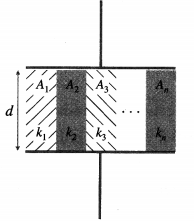
A parallel-plate capacitor consists of $n$ dielectric slabs of end-face areas $A_1, A_2 \ldots \ldots \ldots . ., A_n$ and respective relative permittivities (dielectric constants) $k_1, k_2, \ldots ., k_n$, in the space between the plates as shown in below figure. Find the equivalent capacitance of this arrangement. Hence, show that if the areas are equal, the capacitance is $C=\frac{\varepsilon_0 A}{n d} \sum_j k_j$.
Image
State the characteristics of the electromagnetic waves.